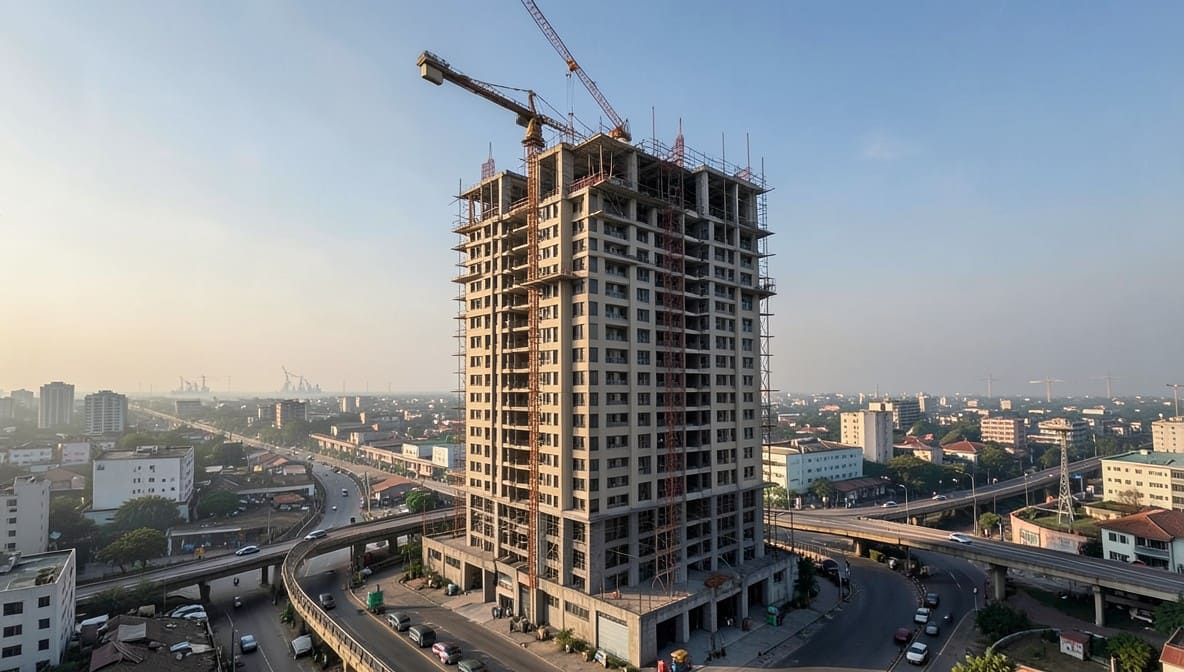
The Bombay High Court has delivered a landmark ruling affirming that rights crystallized under a valid regulatory regime cannot be undone by the subsequent abeyance of a superseding circular, particularly when construction has progressed substantially in reliance on statutory permissions. The judgment decisively rejects the Naval Authorities’ attempt to impose a No Objection Certificate (NOC) requirement based on outdated guidelines, reinforcing that executive instructions cannot override constitutional property rights absent legislative backing.
Background & Facts
The Dispute
The dispute centers on the redevelopment of Building No. 41 in Adarsh Nagar, Worli, Mumbai, owned by Prabhadevi Indraprastha Co-operative Housing Society Ltd. (Respondent No. 4). The original structure, built in 1953, had become dilapidated. The Society, as lessee of the land from Maharashtra Housing and Area Development Authority (MHADA), appointed Techno Freshworld LLP (Petitioner) as developer to redevelop the site into two buildings: a rehabilitation building for 72 existing families and a sale building for open-market units.
Key Facts
- The plot, bearing C.S. No. 209 (Part), admeasures 1601.25 sq. mtrs. and is located near INS Trata, a naval establishment.
- The Petitioner obtained Development Control and Promotion Regulations (DCPR-2034) approvals from MHADA, including an Intimation of Approval dated 26 July 2022.
- The Petitioner engaged IRS Chennai to determine proximity to INS Trata. Its report dated 24 August 2021 certified the site was 528.82 meters from INS Trata Site I and outside the Coastal Regulation Zone (CRZ).
- The Petitioner demolished the old building and relocated all 72 families between September and November 2022.
- The Petitioner applied for and received multiple Commencement Certificates from MHADA:
- 3 February 2023: Commencement Certificate for shore piling
- 12 April 2023: Commencement Certificate for stilt and 6th level podium
- 5 April 2024: Commencement Certificate for full rehabilitation building
- 30 May 2024: Commencement Certificate for 21st floor of sale building
- 23 October 2024: Commencement Certificate for additional floor in rehab building
- 11 August 2025: Commencement Certificate for full sale building
- The Petitioner completed the rehabilitation building and applied for Occupation Certificate on 28 August 2025.
- On 10 October 2025, the application was rejected on technical grounds; upon rectification, it was rejected again on 29 October 2025 for the first time on the ground of non-submission of a Naval NOC.
- On 24 October 2025, MHADA issued a Stop Work Notice based on a letter from INS Trata dated 2 September 2025, which claimed the site was only 280 meters from INS Trata Site II.
- The Petitioner obtained the 2 September 2025 letter via RTI and discovered that INS Trata had raised objections as early as November - December 2023, which MHADA had previously rejected.
- A joint meeting between MHADA and INS Trata on 7 October 2025 concluded with a decision to issue the Stop Work Notice, despite MHADA’s earlier acknowledgment that no NOC was required.
- The Petitioner had spent approximately Rs. 200 crores on the project and Rs. 40 crores as premiums to MHADA.
Procedural History
- 31 March 2022: Development Agreement executed between Petitioner and Respondent No. 4
- 11 April 2022: Power of Attorney executed
- 17 June 2022: Tripartite agreement with MHADA
- 26 July 2022: Intimation of Approval granted by MHADA
- 3 February 2023: First Commencement Certificate issued
- 12 April 2023: Second Commencement Certificate issued
- 5 April 2024: Third Commencement Certificate issued
- 30 May 2024: Fourth Commencement Certificate issued
- 23 October 2024: Fifth Commencement Certificate issued
- 11 August 2025: Sixth Commencement Certificate issued
- 28 August 2025: First application for Occupation Certificate
- 10 October 2025: First rejection of Occupation Certificate (technical grounds)
- 16 October 2025: Re-submitted application
- 29 October 2025: Rejection on grounds of missing Naval NOC
- 24 October 2025: Stop Work Notice issued
- 28 October 2025: Petitioner filed Writ Petition (L.) No. 36387 of 2025
- 28 January 2026: Judgment reserved
- 5 May 2026: Judgment pronounced
The Parties' Positions
Petitioner (Techno Freshworld LLP): Argued that the construction was fully compliant with all statutory permissions granted by MHADA under DCPR-2034. It relied on the Ministry of Defence’s Circular dated 23 December 2022, which reduced the NOC requirement to 50 meters from defence establishments, and contended that the site (528.82 meters from Site I) was well outside this limit. It further argued that the 23 December 2022 circular had superseded all prior circulars, and its abeyance in February 2023 could not revive the earlier, extinguished guidelines. The Petitioner emphasized that MHADA had granted six Commencement Certificates without any NOC condition, creating a crystallized right.
Respondent No. 3 (Navy/INS Trata): Contended that the site was only 280 meters from INS Trata Site II, falling within the 500-meter radius under the 2011 circulars. It argued that the 23 December 2022 circular was merely suspended, not repealed, and thus the 2011 guidelines revived. It further claimed Regulation 59 of DCPR-2034 mandated a Defence NOC and that the Petitioner’s construction posed a security threat by enabling line-of-sight surveillance into naval installations.
Relief Sought
The Petitioner sought:
- Quashing of the Stop Work Notice dated 24 October 2025
- A writ of mandamus directing MHADA and the Navy to grant the Occupation Certificate and process all pending applications without insisting on a Naval NOC
- Declaration that the MoD circulars dated 18 May 2011, 18 March 2015, 17 November 2015, 23 December 2022, and 23 February 2023 are ultra vires and violative of Articles 14, 19(1)(g), 73, and 300A of the Constitution
The Legal Issue
The central question was whether the abeyance of a superseding executive circular (23 December 2022) revives an earlier, extinguished circular (18 May 2011), and whether a statutory right to construct, crystallized under valid permissions, can be nullified by a belated demand for a Defence NOC based on outdated guidelines.
Arguments Presented
For the Petitioner
The Petitioner, led by Senior Advocate Ravi Kadam, argued that:
- The Ministry of Defence’s Circular dated 23 December 2022 explicitly superseded all prior circulars, including those of 2011, 2015, and 2016. Supersession extinguishes the prior law.
- The subsequent abeyance of the 23 December 2022 circular by the 23 February 2023 communication did not revive the extinguished 2011 guidelines. Abeyance suspends, but does not resurrect, repealed law.
- The Petitioner’s rights crystallized on 3 February 2023, when the first Commencement Certificate was issued under the 23 December 2022 regime, and were further solidified by five subsequent certificates.
- The Supreme Court in Goan Real Estate and this Court in Brihanmumbai Mahanagarpalika and State of Uttar Pradesh v. Hirendra Pal Singh held that rights acquired under a valid law cannot be undone by its subsequent invalidation or suspension.
- Regulation 59 of DCPR-2034 requires a Defence NOC only if the requirement is both (i) mandated by the Defence Authority and (ii) notified by the Urban Development Department, Government of Maharashtra - a condition not fulfilled.
- The Navy’s conduct was arbitrary and discriminatory, as numerous buildings within 500 meters of INS Trata were constructed without NOC, while others received it inconsistently.
- The demand for NOC at the final stage of construction, after four years of approvals and Rs. 200 crore investment, violated Article 300A and Article 14.
For the Respondent
The Navy, represented by Senior Advocate Rajshekar Govilkar, contended that:
- The 23 December 2022 circular was only suspended, not repealed, and thus the 2011 guidelines automatically revived.
- Regulation 59 of DCPR-2034 mandates a Defence NOC for any construction within 500 meters of a defence establishment, irrespective of the MoD circulars.
- The IRS Chennai report was flawed as it ignored Site II of INS Trata, where the actual distance was 280 meters.
- The Navy cannot act suo motu; it relies on MHADA to forward proposals. The delay in objection was MHADA’s fault, not the Navy’s.
- The Supreme Court’s dismissal of the SLP in Union of India v. Dolby Builders implied that the 2011 circulars remain valid for non-parties.
- National security concerns override private property rights, and the construction posed a direct line-of-sight threat to INS Trata.
The Court's Analysis
The Court undertook a rigorous doctrinal analysis of the legal status of executive circulars, the effect of supersession and abeyance, and the crystallization of rights under constitutional property protections.
The Court first examined the hierarchy of legal instruments. It held that the Ministry of Defence’s Circular dated 23 December 2022 was a valid executive instruction that explicitly superseded the earlier circulars of 2011, 2015, and 2016. Supersession, as distinct from suspension or repeal, extinguishes the prior law. The Court relied on State of Uttar Pradesh v. Hirendra Pal Singh to affirm that “a repeal puts an end to the law. A suspension holds it in abeyance.” The 23 February 2023 communication placing the 2022 circular in abeyance could not revive the extinguished 2011 guidelines.
"Once by issuance of fresh guidelines vide Circular dated 23 December, 2022 was notified superseding the earlier guidelines... the earlier guidelines... stand completely extinguished and/or obliterated."
The Court then turned to the doctrine of crystallization of rights. It held that the Petitioner’s rights became vested on 3 February 2023, when the first Commencement Certificate was issued under the 23 December 2022 regime. Subsequent certificates, granted over two years, confirmed the Petitioner’s reasonable reliance. The Court cited Goan Real Estate and Construction Ltd. v. Union of India, where the Supreme Court held that actions taken under a valid law remain protected even if the law is later invalidated.
"The rights of the parties were crystallized by the amending notification till part of the same was declared illegal by this Court. Therefore, notwithstanding the fact that part of the amending notification was declared illegal by this Court, all orders passed under the said notification and actions taken pursuant to the said notification would not be affected in any manner whatsoever."
The Court also rejected the Navy’s argument that Regulation 59 of DCPR-2034 independently mandated a Defence NOC. It held that the provision required a dual condition: (i) the Defence Authority must require the NOC, and (ii) the requirement must be notified by the Urban Development Department, Government of Maharashtra. Neither condition was satisfied. The Navy had never notified the 500-meter radius as a mandatory requirement under Maharashtra law.
The Court further condemned the Navy’s selective enforcement. It noted that multiple buildings within 500 meters of INS Trata had been constructed without NOC, while others received it inconsistently. The Court cited its own decision in Shivaji Nagar Shivkiran CHS v. MHADA, holding that such a ‘pick and choose’ approach violates Article 14.
"The requirement of NOC cannot be selectively insisted/foisted by respondent no. 3."
The Court also dismissed the Navy’s reliance on Dolby Builders and Union of India v. State of Maharashtra, noting that the Supreme Court had dismissed the SLP against the latter, thereby affirming the Bombay HC’s reasoning that executive circulars cannot override Article 300A rights absent legislative backing.
The Verdict
The Petitioner succeeded. The Court quashed the Stop Work Notice dated 24 October 2025 and the rejection of the Occupation Certificate dated 29 October 2025. It directed MHADA to grant the Occupation Certificate for the rehabilitation building within four weeks. It further directed MHADA to process all pending applications for the sale building without insisting on a Naval NOC. The Court rejected the Navy’s request for a stay, noting the project’s four-year delay and the hardship to 72 families awaiting rehabilitation and hundreds of flat purchasers.
What This Means For Similar Cases
Rights Crystallized Under Valid Law Are Protected
- Practitioners must argue that any construction commenced under a valid regulatory regime (e.g., a superseding circular) acquires vested rights, even if that regime is later suspended.
- A client’s right to complete construction cannot be revoked by a belated demand for a NOC or permit if permissions were granted in good faith under the prevailing law.
- The doctrine of crystallization applies even if the law under which rights were acquired is later declared invalid - provided the rights were acquired before invalidation.
Executive Circulars Cannot Override Statutory Frameworks
- Defence authorities cannot impose NOC requirements through circulars alone if the State’s town planning law (e.g., DCPR-2034) does not incorporate them as mandatory.
- Any condition imposed by a central agency (e.g., MoD) must be formally notified by the State’s Urban Development Department to be enforceable under local planning law.
- Practitioners should challenge NOC demands that rely solely on MoD circulars without statutory incorporation.
Arbitrariness in Enforcement Violates Article 14
- A pattern of selective enforcement - granting NOCs to some developers while denying them to others under identical circumstances - constitutes discrimination.
- Practitioners must document and present evidence of inconsistent treatment by authorities to invoke Article 14.
- The burden shifts to the authority to justify differential treatment; silence or omission cannot be used to justify arbitrariness.
Procedural Due Process Is Non-Negotiable
- Authorities must raise objections at the earliest stage of planning. Delayed objections after substantial investment and completion are legally unsustainable.
- A stop work notice issued after six Commencement Certificates and four years of construction is prima facie arbitrary.
- Practitioners should immediately challenge any post-completion NOC demand as violative of Article 300A and procedural fairness.