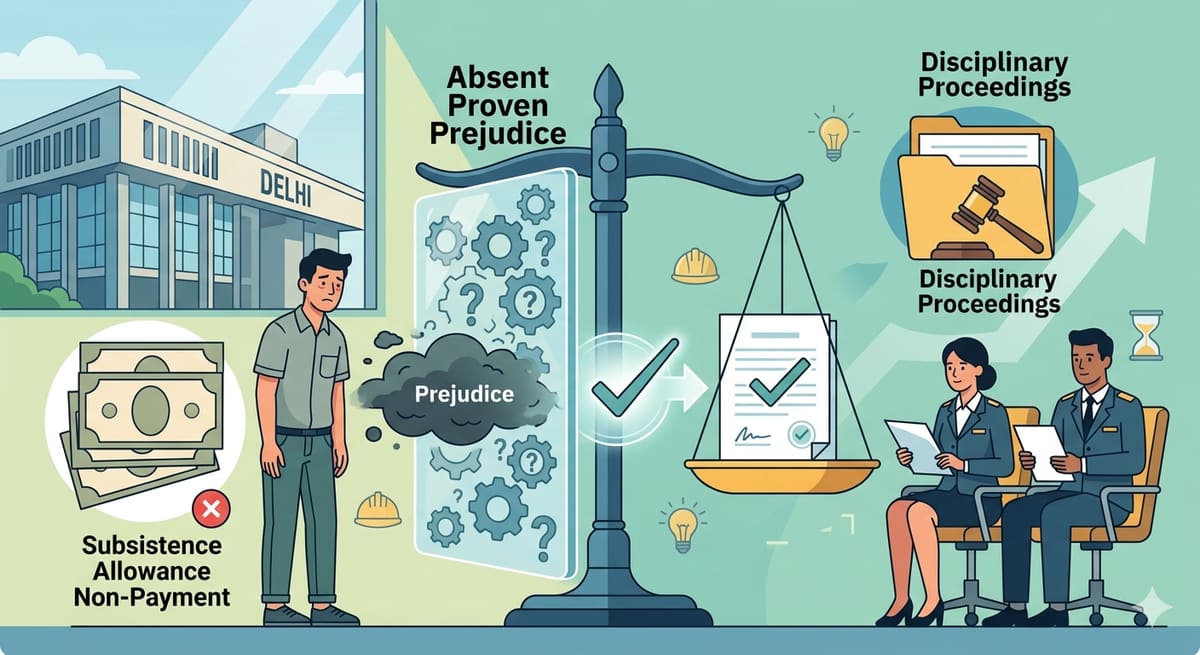
The Himachal Pradesh High Court has clarified a critical procedural safeguard in disciplinary proceedings against government employees. While non-supply of an inquiry report violates principles of natural justice, the Court held that this breach alone does not automatically invalidate the penalty. The employee must demonstrate specific prejudice caused by the non-supply and how it would have altered the outcome - a stringent test established in ECIL v. B. Karunakar. This judgment reinforces the burden on delinquent employees to substantiate procedural lapses with tangible evidence of disadvantage, offering crucial guidance for service law practitioners.
Background & Facts
The Dispute
The appellant, Meena Arora, a Trained Graduate Teacher (Non-Medical) at Government Middle School Kallari, GSSS Ghumarwin, District Bilaspur, was subjected to disciplinary proceedings under the Himachal Pradesh Government Servants (Discipline and Appeal) Rules. The dispute arose from a charge-sheet dated 6.4.2005, alleging contravention of Conduct Rules. An inquiry was conducted by Sh. Yogesh, Joint Director (Higher Education), culminating in an inquiry report dated 11.10.2006, which found the charges substantiated.
Key Facts
- 6.4.2005: Charge-sheet issued to the appellant
- 11.10.2006: Inquiry report submitted, upholding the charges
- 18.4.2007: Penalty of withholding three increments with cumulative effect imposed via memorandum
- 6.6.2007: Original Application (OA No. 1283/2007) filed before Himachal Pradesh State Administrative Tribunal, alleging non-supply of inquiry report and lack of show-cause notice. The Tribunal directed the Principal Secretary (Education) to treat the OA as a representation and decide it within six weeks
- 20.7.2007: Principal Secretary (Elementary Education) disposed of the representation, noting that an appeal against the penalty was pending and thus no further action was required
- 21.2.2011: Judgment in CWP-T No. 88/2009 (transferred from OA challenging the 20.7.2007 order) quashed the 20.7.2007 order and directed the Principal Secretary to decide the representation afresh
- 22.7.2011: Principal Secretary (Education) modified the penalty to withholding of one increment, finding the original penalty harsh
- 1.4.2023: Writ Court (CWPOA No. 730/2019) dismissed the appellant’s challenge to the 22.7.2011 order, holding the modified penalty lenient and procedurally sound
- 16.6.2023: Review petition dismissed
- 30.6.2026: Present Letters Patent Appeal (LPA No. 153/2024) filed
Procedural History
- OA No. 1283/2007 (6.6.2007): Treated as representation; stay granted on penalty
- Order dated 20.7.2007: Representation disposed of without substantive decision
- CWP-T No. 88/2009 (21.2.2011): Quashed 20.7.2007 order; directed fresh decision
- Order dated 22.7.2011: Penalty reduced to withholding one increment
- CWPOA No. 730/2019 (1.4.2023): Dismissed challenge to 22.7.2011 order
- Review Petition (16.6.2023): Dismissed
- LPA No. 153/2024 (3.7.2026): Present appeal dismissed
Relief Sought
The appellant sought quashing of the 22.7.2011 order and the 1.4.2023 judgment, arguing that the non-supply of the inquiry report vitiated the entire disciplinary process. She contended that the penalty was imposed without affording her a reasonable opportunity to defend herself, violating principles of natural justice.
The Legal Issue
The central question was whether the non-supply of an inquiry report to a delinquent employee before imposition of a disciplinary penalty automatically invalidates the penalty, or whether the employee must demonstrate specific prejudice resulting from the non-supply to warrant quashing.
Arguments Presented
For the Appellant
- Relied on ECIL v. B. Karunakar to argue that non-supply of the inquiry report is a breach of natural justice, entitling the employee to quashing of the penalty
- Contended that the memorandum dated 18.4.2007 was issued without furnishing the inquiry report or issuing a show-cause notice, rendering the penalty void ab initio
- Argued that the order dated 22.7.2011 (reducing the penalty) was passed without addressing the core procedural lapse, thereby perpetuating the injustice
For the Respondent
- Distinguished ECIL v. B. Karunakar, arguing that the appellant failed to prove prejudice caused by the non-supply of the inquiry report
- Highlighted that the appellant never sought the inquiry report during the proceedings and raised the plea belatedly in CWPOA No. 730/2019
- Emphasized that the order dated 22.7.2011 was a speaking order, passed after hearing the appellant in person, and the modified penalty was lenient and proportionate to the misconduct
- Submitted that the appellant acquiesced to the proceedings by not challenging the inquiry report’s non-supply earlier
The Court's Analysis
The Court anchored its reasoning in the seven incidental questions framed and answered in ECIL v. B. Karunakar, which established the following principles:
"When the enquiry officer is not the disciplinary authority, the delinquent employee has a right to receive a copy of the enquiry officer’s report before the disciplinary authority arrives at its conclusions with regard to the guilt or innocence of the employee. A denial of the enquiry officer’s report before the disciplinary authority takes its decision on the charges is a denial of reasonable opportunity to the employee to prove his innocence and is a breach of the principles of natural justice."
However, the Court clarified that non-supply of the report does not automatically invalidate the penalty. The employee must demonstrate:
- Prejudice caused by the non-supply, and
- That furnishing the report would have altered the result.
The Court observed:
"The theory of reasonable opportunity and the principles of natural justice have been evolved to uphold the rule of law and to assist the individual to vindicate his just rights. They are not incantations to be invoked nor rites to be performed on all and sundry occasions. Whether in fact, prejudice has been caused to the employee or not on account of the denial to him of the report, has to be considered on the facts and circumstances of each case."
Applying this test, the Court found that the appellant’s plea was bereft of details regarding:
- How the non-supply of the inquiry report prejudiced her defence, and
- What difference the report’s supply would have made to the outcome.
The Court noted:
"The plea of non-supply of the inquiry report so raised in CWPOA No. 730 of 2019 is bereft of details qua prejudice caused on account of its non-supply to the appellant/writ petitioner and the difference which the furnishing of the report would have made to the result."
Further, the Court highlighted that the appellant never pressed for the inquiry report during the proceedings (from 6.6.2007 to 22.7.2011) and acquiesced to the process by challenging only the consequential order dated 22.7.2011 rather than the original penalty dated 18.4.2007. This delay and selective challenge weakened her claim of prejudice.
The Verdict
The appeal was dismissed for lack of merit. The Court upheld the impugned judgment dated 1.4.2023, which had affirmed the order dated 22.7.2011 reducing the penalty to withholding one increment. No further relief was granted, and pending miscellaneous applications were disposed of.
What This Means For Similar Cases
Prejudice Must Be Proved, Not Presumed
Practitioners must note that non-supply of an inquiry report is not a per se ground for quashing disciplinary penalties. The burden lies on the employee to:
- Specifically allege and prove how the non-supply prejudiced their defence
- Demonstrate that furnishing the report would have materially altered the outcome
- Raise the plea at the earliest opportunity - belated claims may be rejected on grounds of acquiescence
Procedural Compliance Is Non-Negotiable
- Disciplinary authorities must strictly adhere to the requirement of supplying the inquiry report before imposing penalties, failing which the order may be vulnerable to challenge
- Employees must actively seek the report if not supplied and document their requests to avoid waiver arguments
- Tribunals/Courts will scrutinize whether the employee was given a reasonable opportunity to defend themselves, including access to the inquiry report
The Limits of Appellate Review
- Appellate forums will not interfere with disciplinary penalties merely on technical grounds unless substantial injustice is demonstrated
- Lenient penalties (e.g., reduction from three increments to one) are unlikely to be overturned unless the employee proves gross disproportion or arbitrariness
- Consent orders (e.g., treating an OA as a representation) do not cure procedural lapses unless the employee is afforded a full opportunity to address the charges