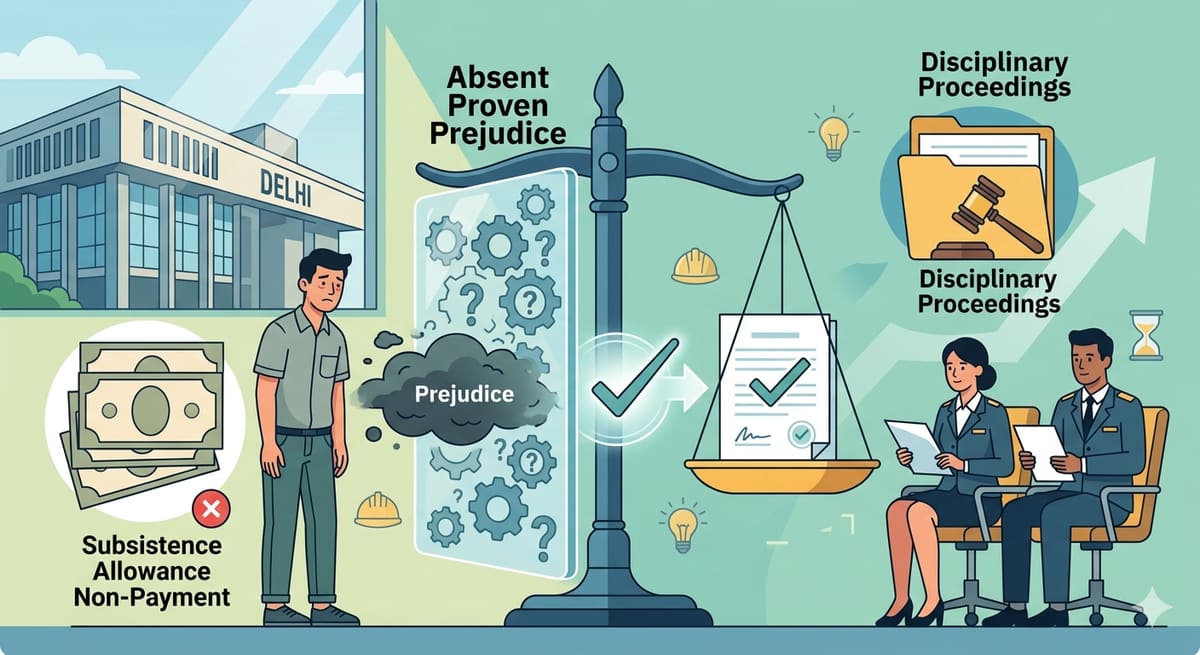
The Calcutta High Court has affirmed that suspension of a municipal employee pending disciplinary proceedings does not extinguish the statutory right to subsistence allowance. The judgment clarifies the procedural boundaries of disciplinary action under the West Bengal Municipal Employees’ Rules, 2010, and reinforces the principle that financial protection for suspended employees is not discretionary but mandatory.
Background & Facts
The Dispute
The petitioner, Aniruddha Thakur, is an elected councilor of Murshidabad Municipality. Allegations arose concerning non-implementation of a resolution passed by the municipality on 12.09.2023, which mandated an inquiry into irregularities in tender processes. The petitioner was accused of obstructing the inquiry and facilitating a cover-up. These allegations triggered a chain of administrative and legal actions.
Key Facts
- The petitioner was elected councilor of Murshidabad Municipality.
- On 12.09.2023, the municipal council passed a unanimous resolution directing an inquiry into financial irregularities in tenders.
- The inquiry was not conducted, prompting a Public Interest Litigation (WPA 13 of 2024) before the Calcutta High Court.
- On 18.01.2024, the Division Bench directed the Director of Local Bodies to appoint an officer to conduct an inquiry and take action as per law.
- The Director of Local Bodies, Government of West Bengal, issued an order on 13.12.2024, noting gross financial irregularities and directing initiation of disciplinary proceedings.
- An FIR was lodged on 03.01.2025 in connection with the alleged irregularities.
- On 26.12.2024, the Chairman of Murshidabad Municipality, acting as disciplinary authority, suspended the petitioner under Rule 5 of the West Bengal Municipal Employees’ (Classification, Control, Appeal and Conduct) Rules, 2010.
- On 27.11.2025, the Executive Officer issued a notice initiating disciplinary proceedings against the petitioner.
- The petitioner was not paid subsistence allowance during suspension.
Procedural History
- 12.09.2023: Municipal council passes resolution to investigate tender irregularities.
- 18.01.2024: Division Bench of Calcutta High Court, in WPA 13 of 2024, directs Director of Local Bodies to conduct inquiry.
- 13.12.2024: Director of Local Bodies issues order directing initiation of disciplinary proceedings.
- 26.12.2024: Chairman of Murshidabad Municipality issues order suspending petitioner under Rule 5 of the 2010 Rules.
- 03.01.2025: FIR registered against petitioner in connection with alleged financial misconduct.
- 27.11.2025: Executive Officer issues notice initiating disciplinary proceedings.
- 28.12.2025: Writ Petition (WPA 28832 of 2025) filed before Calcutta High Court.
- 01.04.2026: Hearing concluded; judgment delivered.
The Parties' Positions
For the Petitioner: Argued that suspension was arbitrary, that disciplinary proceedings were initiated by an incompetent authority (Executive Officer), and that denial of subsistence allowance violated Rule 4(3) of the 2010 Rules.
For the State and Municipality: Contended that suspension was lawful under Rule 5, as disciplinary proceedings were contemplated. The Executive Officer’s initiation of proceedings was acknowledged as procedurally flawed, and the municipality sought to withdraw it.
Relief Sought
The petitioner sought:
- Quashing of the suspension order dated 26.12.2024
- Quashing of the disciplinary proceeding notice dated 27.11.2025
- Direction to pay subsistence allowance, including arrears, from the date of suspension
- Costs
The Legal Issue
The central questions were: (1) Whether suspension of a municipal employee under Rule 5 of the West Bengal Municipal Employees’ Rules, 2010, is valid when disciplinary proceedings are merely contemplated; and (2) Whether denial of subsistence allowance under Rule 4(3) during suspension is lawful.
Arguments Presented
For the Petitioner
The petitioner relied on State of Punjab v. Baldev Singh and Union of India v. T.R. Sharma to argue that suspension is a precautionary measure and cannot be used to punish or penalize. He contended that Rule 4(3) mandates payment of subsistence allowance as a statutory right, irrespective of the nature of allegations. He further argued that initiation of proceedings by the Executive Officer, who is not the appointing or disciplinary authority under Rule 6, rendered the notice void.
For the Respondent
The State and Municipality submitted that suspension was justified under Rule 5, which permits suspension when a disciplinary proceeding is contemplated. They relied on K. Sankaranarayanan v. State of Tamil Nadu to assert that the authority has wide discretion in such matters. Regarding the Executive Officer’s notice, they conceded procedural irregularity and sought leave to withdraw it.
The Court's Analysis
The Court examined the provisions of the West Bengal Municipal Employees’ (Classification, Control, Appeal and Conduct) Rules, 2010, particularly Rules 4, 5, and 6. It held that Rule 5 explicitly empowers the disciplinary authority to suspend an employee when a disciplinary proceeding is contemplated or pending. The Court noted that the suspension order was issued after a show-cause notice and after the Director of Local Bodies had already directed disciplinary action, thereby satisfying the threshold under Rule 5.
"I am of the view that there is no scope to interfere with such order of suspension. It is well within the domain of the employer and the disciplinary authority to issue the order of suspension in contemplation of the disciplinary proceedings."
Regarding the initiation of proceedings, the Court accepted the municipality’s concession that the Executive Officer was not the competent authority under Rule 6, which vests disciplinary power in the appointing authority - the Chairman of the Municipality. The Court therefore set aside the notice dated 27.11.2025 with liberty to initiate a fresh proceeding.
On the issue of subsistence allowance, the Court emphasized the mandatory nature of Rule 4(3), which states that a suspended employee shall be paid subsistence allowance at a rate not less than half of the pay drawn before suspension. The Court rejected the argument that allegations of misconduct could justify withholding this benefit, noting that such allowance is a statutory safeguard, not a privilege.
The Verdict
The petitioner succeeded on two key grounds. The Court set aside the disciplinary proceeding notice dated 27.11.2025 with liberty to the Municipality to initiate a fresh proceeding through the competent authority. The suspension order dated 26.12.2024 was upheld. The Municipality was directed to pay the petitioner subsistence allowance, both current and arrears, at not less than half of his pre-suspension pay, within four weeks from the date of communication of this order.
What This Means For Similar Cases
Subsistence Allowance Is a Statutory Right, Not a Discretionary Benefit
- Practitioners must assert Rule 4(3) of municipal service rules as an absolute entitlement during suspension, regardless of the gravity of allegations.
- Denial of subsistence allowance on grounds of pending criminal proceedings or moral turpitude is legally untenable.
- Arrears must be calculated from the date of suspension, not from the date of petition.
Competent Authority Must Initiate Disciplinary Proceedings
- Only the appointing authority (e.g., Chairman of Municipality) may initiate disciplinary proceedings under Rule 6.
- Proceedings initiated by subordinate officers (e.g., Executive Officer) are void ab initio.
- Any such proceeding must be withdrawn and re-initiated by the correct authority; mere correction is insufficient.
Suspension Is Not Punitive - It Is Procedural
- Suspension under Rule 5 is valid even if no formal charge sheet has been issued, provided there is a reasonable contemplation of disciplinary action.
- Courts will not interfere unless the suspension is mala fide, disproportionate, or prolonged without cause.
- The existence of a parallel criminal investigation does not invalidate administrative suspension.