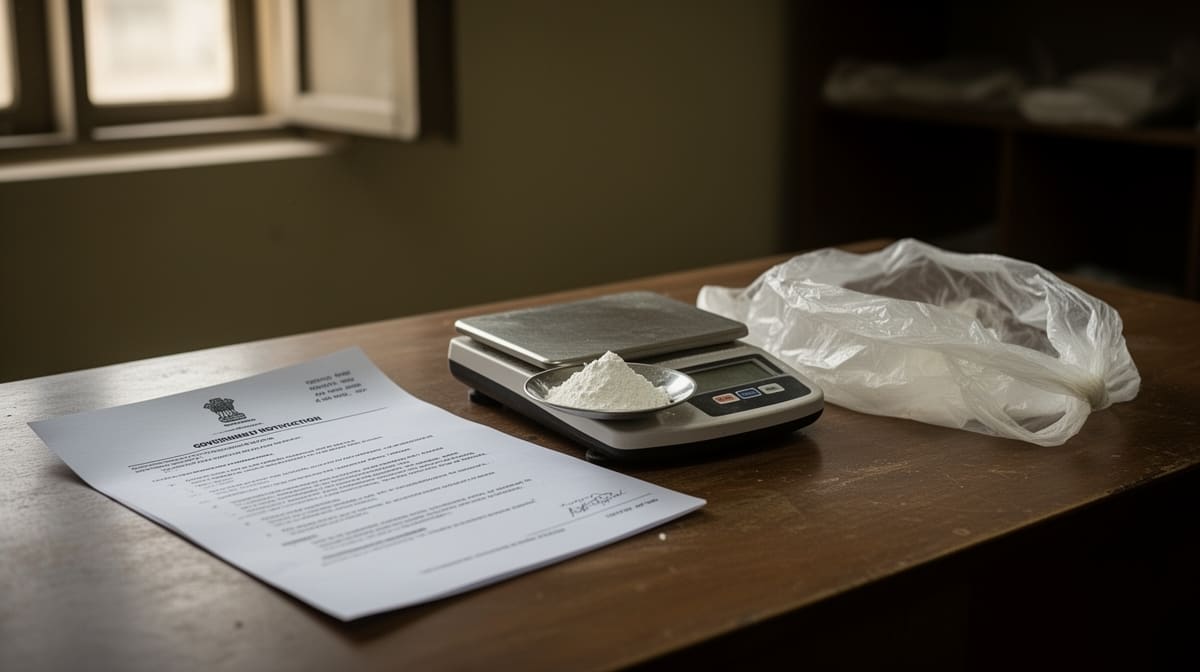
The Delhi High Court rejected a petition for statutory bail, holding that the seized contraband was methamphetamine in commercial quantity, thereby disallowing bail under the Narcotic Drugs and Psychotropic Substances Act, 1985. The decision underscores the primacy of forensic reports and statutory thresholds in bail determinations.
Background & Facts
The Dispute
The petitioner, Vishal, was arrested on 26.03.2026 for alleged possession of a narcotic substance. He contended that the seized material was methaqualone, an intermediate-quantity drug, and that the statutory period for filing a challan had expired, thus entitling him to statutory bail.
Key Facts
- Arrest date: 26.03.2026.
- Quantity seized: 99.25 grams of the contraband.
- Petitioner’s claim: The substance is methaqualone (intermediate quantity) and the filing period for a challan has lapsed.
- Prosecution’s evidence: A report from the Forensic Science Laboratory (FSL) dated 08.05.2026 stating that the exhibit contained methamphetamine.
- Statutory thresholds (NDPS Act, 1985):
- Metamphetamine - Small quantity: 2 gm; Commercial quantity: 50 gm.
- Methaqualone - Small quantity: 20 gm; Commercial quantity: 500 gm.
- Relevant provision: Section 36A(4) of the NDPS Act prescribes a 180-day period for filing a challan for commercial-quantity offences.
Procedural History
- 26.03.2026: Arrest of the petitioner.
- Application for statutory bail filed before the trial court (date not specified).
- Prosecution reply submitted, attaching the FSL report dated 08.05.2026.
- Petition (CRL.REV.P. 432/2026) filed before the Delhi High Court seeking statutory bail.
- 28.07.2026: Judgment delivered by Hon'ble Mr. Justice Manoj Jain dismissing the petition.
Parties' Positions
- Petitioner: Argues that the substance is methaqualone, falls within intermediate quantity, and the 180-day filing period has expired, warranting statutory bail.
- Respondent (State): Relies on the FSL report confirming methamphetamine, a commercial-quantity offence, and asserts that the filing period under Section 36A(4) has not elapsed, making bail untenable.
Relief Sought
The petitioner sought release on statutory bail, contending that the statutory conditions for bail were satisfied.
The Legal Issue
Whether the petitioner is entitled to statutory bail under the Narcotic Drugs and Psychotropic Substances Act, 1985 when the seized contraband is classified as methamphetamine in commercial quantity and the period for filing a challan under Section 36A(4) has not expired.
Arguments Presented
For the Petitioner
- Claims the seized substance is methaqualone, which, under the statutory schedule, would be an intermediate-quantity drug, thereby qualifying for statutory bail.
- Asserts that the 180-day period for filing a challan, prescribed for commercial-quantity offences, has already elapsed, removing the statutory bar to bail.
- Relies on the principle that statutory bail is a right when the statutory conditions are fulfilled.
For the Respondent
- Points to the forensic report dated 08.05.2026, which unequivocally identifies the substance as methamphetamine.
- Emphasises that 99.25 gm exceeds the commercial-quantity threshold of 50 gm for methamphetamine, invoking the stringent bail regime for commercial-quantity offences.
- Highlights that the 180-day filing period under Section 36A(4) remains unexpired, thereby precluding statutory bail.
- Argues that the High Court must give effect to the forensic opinion and the statutory scheme.
The Court's Analysis
The Court began by scrutinising the forensic evidence, noting that the FSL report, a document of the highest probative value, categorically stated that the seized exhibit contained methamphetamine. The Court observed that the petitioner’s insistence on treating the contraband as methaqualone was unsupported by any expert testimony or material evidence.
"On chemical, TLC and GC-MS examination, exhibit ‘S1’ was found to contain ‘Methamphetamine'."
The Court then turned to the statutory framework. Under Section 36A(4) of the Narcotic Drugs and Psychotropic Substances Act, 1985, a commercial-quantity offence attracts a mandatory period of 180 days for filing a challan. The Court calculated that the arrest on 26.03.2026 and the subsequent filing of the petition on 28.07.2026 fell well within this period, rendering the statutory bar to bail operative.
The distinction between small, intermediate, and commercial quantities is pivotal. The schedule in the NDPS Act lists 50 gm as the commercial-quantity threshold for methamphetamine. The seized 99.25 gm clearly exceeds this limit, placing the offence in the highest category, which under Section 37 of the NDPS Act mandates rigorous imprisonment of ten to twenty years and disallows statutory bail.
The Court further held that the statutory bail provision is not a discretionary power but a right that arises only when the statutory conditions are satisfied. Since the conditions - correct classification of the drug, commercial-quantity status, and an unexpired filing period - were not met, the petitioner could not be granted bail.
In concluding, the Court found no illegality or perversity in the trial court’s order and dismissed the petition in limine, thereby upholding the statutory scheme.
The Verdict
The petition was dismissed in limine. The Court held that because the seized substance was methamphetamine in commercial quantity (99.25 gm) and the 180-day period for filing a challan under Section 36A(4) of the NDPS Act had not expired, the petitioner was not entitled to statutory bail. No relief was granted.
What This Means For Similar Cases
Forensic Evidence Is Controlling
- Courts will treat a forensic laboratory report as conclusive unless successfully challenged.
- Parties must contest the forensic findings with expert testimony if they wish to alter the classification of the substance.
Commercial Quantity Triggers Strict Bail Regime
- Any seizure exceeding the commercial-quantity threshold for a narcotic automatically disqualifies the accused from statutory bail.
- Practitioners should assess the exact weight against the statutory schedule before filing bail applications.
Observe the 180-Day Filing Window
-
The period prescribed in Section 36A(4) of the NDPS Act is mandatory; bail cannot be granted if the period is still open.
-
Counsel must calculate the filing deadline precisely to avoid premature bail petitions.
-
Verify forensic reports early in the investigation.
-
Align bail arguments with the statutory quantity classifications.
-
File bail applications only after the 180-day period has elapsed for commercial-quantity offences.