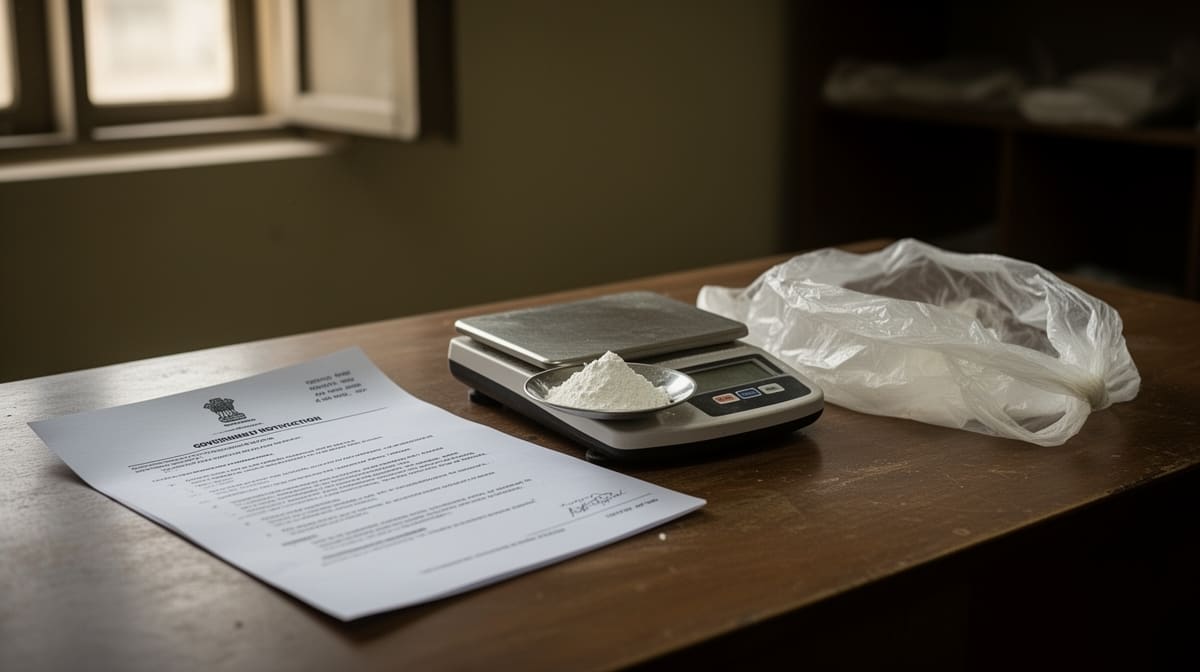
The Punjab and Haryana High Court has clarified that possession of a narcotic substance at the exact statutory threshold for commercial quantity does not trigger the stringent bail restrictions under Section 37 of the NDPS Act. This ruling provides critical relief to accused persons caught in the gray zone of quantified contraband, reinforcing that statutory definitions must be applied with precision, not presumption.
Background & Facts
The Dispute
The petitioner was arrested on 13.04.2025 following a secret tip-off at his shop in Moga, Punjab. Police recovered 250 grams of heroin from his person, allegedly including the weight of the transparent wax polythene packaging. He was formally arrested at the spot and made a disclosure statement implicating another individual. The FIR was registered under Section 21 of the NDPS Act, later amended to include Section 29. The prosecution contends the quantity qualifies as commercial, invoking the strict bail bar under Section 37.
Procedural History
- 13.04.2025: Petitioner arrested and remanded to judicial custody
- 17.02.2026: Petition filed under Section 483 of the Bharatiya Nagarik Suraksha Sanhita, 2023 seeking regular bail
- No prior bail application was rejected by lower courts; this is a direct High Court petition
Relief Sought
The petitioner seeks release on regular bail, arguing that the recovered quantity does not meet the legal definition of commercial quantity under the NDPS Act, and that prolonged pre-trial detention without trial conclusion serves no public interest.
The Legal Issue
The central question was whether possession of exactly 250 grams of heroin, including packaging, constitutes a "commercial quantity" under Section 2(vii-a) of the NDPS Act, thereby attracting the mandatory denial of bail under Section 37.
Arguments Presented
For the Petitioner
Learned counsel argued that Section 2(vii-a) defines commercial quantity as "any quantity greater than" the notified threshold. The Government’s 19.10.2001 notification specifies 250 grams as the commercial threshold for heroin. Since the recovered weight was exactly 250 grams and included the polythene, the actual heroin content was less than 250 grams. The petitioner relied on State of Punjab v. Baldev Singh to argue that statutory definitions must be interpreted strictly, and ambiguity must benefit the accused. He further cited his clean antecedents, completed investigation, and the likelihood of a prolonged trial.
For the Respondent
The State contended that the recovered quantity, even if including packaging, was presented as 250 grams in the charge sheet and should be treated as meeting the commercial threshold. It argued that Section 37 was designed to deter large-scale trafficking and that any deviation from the notified quantity would undermine legislative intent. The State relied on State of Maharashtra v. Mohd. Yusuf to assert that courts should not engage in technical interpretations that dilute the Act’s deterrent purpose.
The Court's Analysis
The Court undertook a textual and contextual analysis of Section 2(vii-a) and the 2001 notification. It emphasized that the statutory language is unambiguous: "any quantity greater than" the notified amount constitutes commercial quantity. The phrase "greater than" excludes equality. The Court noted that the prosecution itself admitted the weight included the polythene, making the actual heroin content less than 250 grams. The Court rejected the State’s argument that the packaging weight should be ignored, stating that the burden of proving the exact quantity of contraband lies with the prosecution, and the record must reflect precise measurement.
"The notification specifies 250 grams as the threshold for commercial quantity. The statute does not say '250 grams or more'. It says 'greater than'."
The Court further held that Section 37 applies only when the offense involves commercial quantity. Since the recovered substance did not meet that threshold, the mandatory denial of bail under Section 37 was inapplicable. The Court also considered the petitioner’s clean record, the completion of investigation, and the undue length of custody - over ten months without trial conclusion - as factors favoring bail. It clarified that its observations were strictly for bail purposes and would not prejudice the trial.
The Verdict
The petitioner won. The Court held that possession of exactly 250 grams of heroin, including packaging, does not constitute a commercial quantity under the NDPS Act, and therefore Section 37 does not bar bail. The petitioner was granted regular bail subject to personal and surety bonds, with liberty to the prosecution to seek cancellation if he commits another offense.
What This Means For Similar Cases
Commercial Quantity Must Exceed the Notified Threshold
- Practitioners must meticulously verify the exact weight of contraband excluding packaging in NDPS cases
- Prosecution must prove the quantity exceeds the notified limit; mere allegation of "approximately" is insufficient
- Any recovery at or below the threshold cannot trigger Section 37 bail restrictions
Bail Cannot Be Denied on Presumed Quantity
- Courts must rely on documented evidence, not prosecutorial assumptions
- If the charge sheet states "250 grams including packaging," the court must deduct packaging weight to determine actual contraband
- This ruling reinforces the principle that statutory thresholds are not flexible and must be applied as written
Pre-Trial Custody Must Be Justified Beyond Gravity of Allegation
- Even in serious drug cases, prolonged custody without trial conclusion requires justification
- Clean antecedents and completed investigation are material factors in bail decisions under Section 483 BNS
- Courts are now empowered to grant bail where Section 37 does not apply, regardless of public perception of the offense