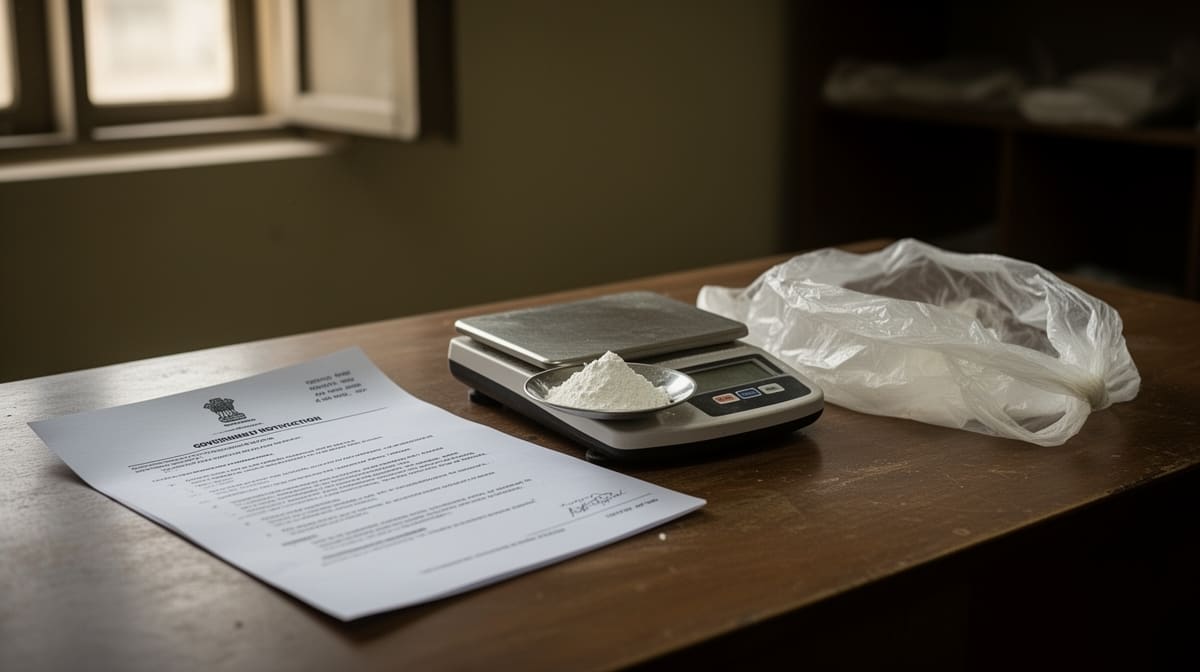
The Punjab and Haryana High Court has clarified that the invocation of Section 27A of the NDPS Act automatically triggers exclusive jurisdiction of a Special Court, irrespective of the quantity of contraband recovered. This ruling resolves a recurring conflict between procedural convenience and statutory mandate, reinforcing that legislative intent overrides judicial discretion in drug trafficking cases.
Background & Facts
The Dispute
The case arose from the recovery of 640 grams of ganja from respondent Vijender Singh on 31.07.2020 in Hisar. He disclosed that the contraband was procured from Jinesh, who was subsequently arrested. During investigation, the offence under Section 27A of the NDPS Act was added to the FIR, which prescribes a minimum punishment of ten years’ rigorous imprisonment.
Procedural History
- 31.07.2020: FIR registered under Sections 20 and 27A of the NDPS Act
- Initial Trial Court: Charges framed by JMIC, Hisar under Sections 20 and 27A
- JMIC’s Order: Committed case to Sessions Court, citing Section 36A(1) NDPS Act
- Special Court’s Order: Remanded case back to JMIC, holding that 640 grams constituted a "small quantity" warranting trial by Magistrate
- Petition Filed: State challenged the Special Court’s remand order as contrary to statutory mandate
Relief Sought
The State sought quashing of the Special Court’s order and directed that the case be tried exclusively by the Special Court, as mandated by Section 36A(1) of the NDPS Act.
The Legal Issue
The central question was whether the invocation of Section 27A of the NDPS Act, which prescribes a minimum sentence of ten years’ rigorous imprisonment, renders the case triable only by a Special Court under Section 36A(1), even if the quantity of contraband recovered is classified as "small".
Arguments Presented
For the Appellant/Petitioner
The State, supported by Amicus Curiae, argued that Section 36A(1) explicitly mandates that any offence under the NDPS Act punishable with imprisonment exceeding three years must be tried only by a Special Court. Since Section 27A prescribes a mandatory minimum of ten years, the quantum of contraband is irrelevant. Reliance was placed on the plain language of the statute and the legislative intent to create a deterrent regime for financiers and harbourers of drug trafficking.
For the Respondent/State
The accused contended that the recovery of 640 grams of ganja fell within the category of "small quantity" under the NDPS Act, which traditionally attracts lesser punishment under Section 20 (up to six months or one year). They argued that the Special Court’s discretion to remand the case to a Magistrate was justified under the principle of proportionality and judicial economy, citing past practices where quantity dictated jurisdiction.
The Court's Analysis
The Court undertook a strict textual interpretation of Section 36A(1), emphasizing its non-obstante clause: "Notwithstanding anything contained in the Code of Criminal Procedure, 1973." This clause overrides any procedural norms under CrPC that might otherwise permit Magistrate trials for lesser offences.
"Once the offence under Section 27A of the NDPS Act is invoked, it is apparent that the minimum sentence of imprisonment would be ten years making the case triable by a Special Court."
The Court rejected the argument that "small quantity" could override statutory classification. It held that Section 27A creates a distinct category of offence - financing or harbouring trafficking - which is not merely an aggravated form of simple possession under Section 20. The punishment is fixed and non-negotiable, irrespective of the amount seized.
The Court further distinguished this from cases where the charge under Section 27A was added merely as an afterthought without evidentiary basis. Here, the disclosure and arrest of Jinesh provided a prima facie basis for invoking Section 27A. The Special Court had no authority to reclassify the offence based on quantity; that determination is for the trial court at the stage of framing charges.
The Verdict
The State won. The Court held that Section 27A of the NDPS Act mandates trial exclusively before a Special Court, irrespective of the quantity of contraband recovered. The impugned order remanding the case to the JMIC was set aside, and the trial was directed to proceed before the Special Court.
What This Means For Similar Cases
Special Court Jurisdiction Is Mandatory, Not Discretionary
- Practitioners must immediately move to transfer any case involving Section 27A to the Special Court, regardless of whether the recovered quantity appears "small"
- Magistrates have no jurisdiction to proceed with trials where Section 27A is invoked, even if the accused is only a middleman
- Any order by a Special Court remanding such cases to Magistrates is void ab initio
Charge Framing Remains the Critical Threshold
- The Special Court may still discharge the accused under Section 27A if the evidence fails at the stage of framing charges
- In such cases, the matter may be remanded to the Magistrate for trial under Section 20 or other applicable provisions
- Defence counsel must now prepare for dual-stage challenges: first to the invocation of Section 27A, then to the sufficiency of evidence
Prosecution Strategy Must Align with Statutory Hierarchy
- Prosecutors must ensure that charges under Section 27A are supported by independent evidence of financing or harbouring - not merely association
- Merely naming a supplier does not automatically trigger Section 27A; the prosecution must establish a nexus between the accused and illicit financing
- Failure to establish this nexus may result in acquittal under Section 27A but conviction under Section 20, with jurisdiction shifting accordingly