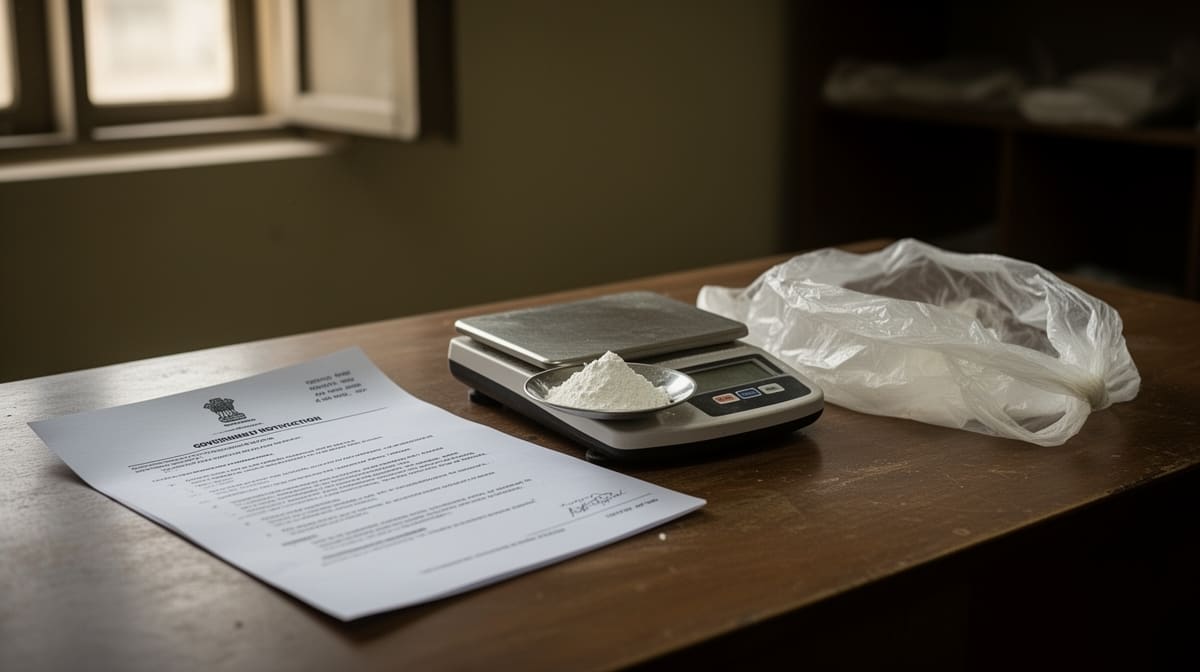
The Punjab and Haryana High Court has reaffirmed that possession of a minor quantity of narcotics, well below the commercial threshold, does not justify prolonged pre-trial incarceration absent compelling countervailing factors. This ruling underscores the principle that bail must be the norm, not the exception, even in stringent statutory regimes like the NDPS Act.
Background & Facts
The Dispute
The petitioner, Rinku, was arrested on 30 June 2025 in connection with FIR No. 70 of 2025 filed at Sultanwind Police Station, Amritsar, under Sections 21-B and 27-A of the Narcotic Drugs and Psychotropic Substances Act, 1985. The prosecution alleges that co-accused Sewa Singh, apprehended with 47.95 grams of heroin and ₹1,700, disclosed the petitioner’s involvement. Subsequently, 8.24 grams of heroin was recovered from the petitioner’s possession.
Procedural History
- 25 May 2025: FIR registered under NDPS Act
- 30 June 2025: Petitioner taken into custody
- 6 March 2026: Petition for regular bail filed under Section 483 of BNSS, 2023 (successor to Section 439 CrPC)
- 5 March 2026: State filed custody certificate and status report, submitted to court on the day of hearing
Relief Sought
The petitioner sought regular bail, arguing that the quantity of heroin recovered was marginally above the small quantity limit and far below the commercial quantity of 250 grams. He contended that the case rested solely on the disclosure statement of a co-accused, with no independent corroboration, and that statutory safeguards under Sections 42 and 50 of the NDPS Act were violated.
The Legal Issue
The central question was whether the mere possession of a quantity of heroin significantly below the commercial threshold, coupled with prolonged pre-trial detention and lack of corroborative evidence, warrants denial of regular bail under the NDPS Act.
Arguments Presented
For the Petitioner
Learned counsel argued that the recovered quantity of 8.24 grams falls within the "small quantity" category under the NDPS Act and is substantially below the 250-gram commercial threshold. He emphasized that the prosecution’s case relied exclusively on the uncorroborated disclosure statement of Sewa Singh, with no independent verification of the petitioner’s involvement. He further contended that Sections 42 and 50 of the NDPS Act, mandating notice to the accused and independent witness verification during search and seizure, were not complied with, rendering the recovery suspect. He cited State of Punjab v. Baldev Singh to argue that bail should be granted where the quantity is non-commercial and custody has exceeded six months.
For the Respondent
The State opposed bail on grounds of the gravity of the offence and the petitioner’s alleged prior criminal record. The State relied on paragraph 12 of its status report, asserting that the petitioner posed a risk of reoffending. However, it did not dispute the factual assertions regarding the quantity recovered, the absence of corroborative evidence, or non-compliance with procedural safeguards.
The Court's Analysis
The Court conducted a proportionality assessment, weighing the nature of the offence against the duration of custody and evidentiary weakness. It noted that the petitioner had been in custody for over eight months without trial, while the quantity involved - 8.24 grams - was not only below the commercial threshold but barely exceeded the small quantity limit. The Court observed that the prosecution’s case was built on a single disclosure statement, which under the NDPS Act, cannot alone sustain conviction without independent corroboration.
"Without expressing any opinion on the merits of the case, and considering the incarceration period already undergone inside jail by the petitioner as well as the fact that the quantity involved does not fall under the category of commercial quantity, this Court is of the considered view that further incarceration of the petitioner would not serve any useful purpose."
The Court further held that the absence of compliance with Sections 42 and 50, though not dispositive of guilt, contributed to the overall unreliability of the prosecution’s case. It emphasized that the NDPS Act, while stringent, does not override the fundamental right to liberty under Article 21. The Court rejected the State’s reliance on prior criminal history without specific evidence of recidivism or threat to public order.
The Verdict
The petitioner won. The Court granted regular bail, holding that possession of a non-commercial quantity of heroin, coupled with prolonged pre-trial detention and lack of corroborative evidence, justifies release on bail. The petitioner was ordered to furnish bail bonds to the trial court, subject to conditions against witness tampering and reoffending.
What This Means For Similar Cases
Bail Is Not Denied Solely on Statutory Severity
- Practitioners must argue that the NDPS Act’s punitive framework does not override the presumption of innocence or the right to liberty
- Courts must apply proportionality: quantity, custody duration, and evidentiary strength must be balanced
- A quantity below commercial threshold, even if above small quantity, should trigger a presumption in favor of bail
Disclosure Statements Alone Are Insufficient for Bail Denial
- Relying solely on a co-accused’s disclosure without independent verification weakens the prosecution’s case
- Courts should not treat disclosure as conclusive evidence for denying bail
- Petitioners should routinely challenge compliance with Sections 42 and 50 NDPS Act as grounds for bail
Custody Duration Triggers Reassessment of Bail Necessity
- Pre-trial detention exceeding six months in non-commercial NDPS cases demands judicial scrutiny
- Courts must ask: "Does continued detention serve any legitimate purpose?"
- Delay in trial, even if not attributable to the accused, becomes a material factor in bail decisions