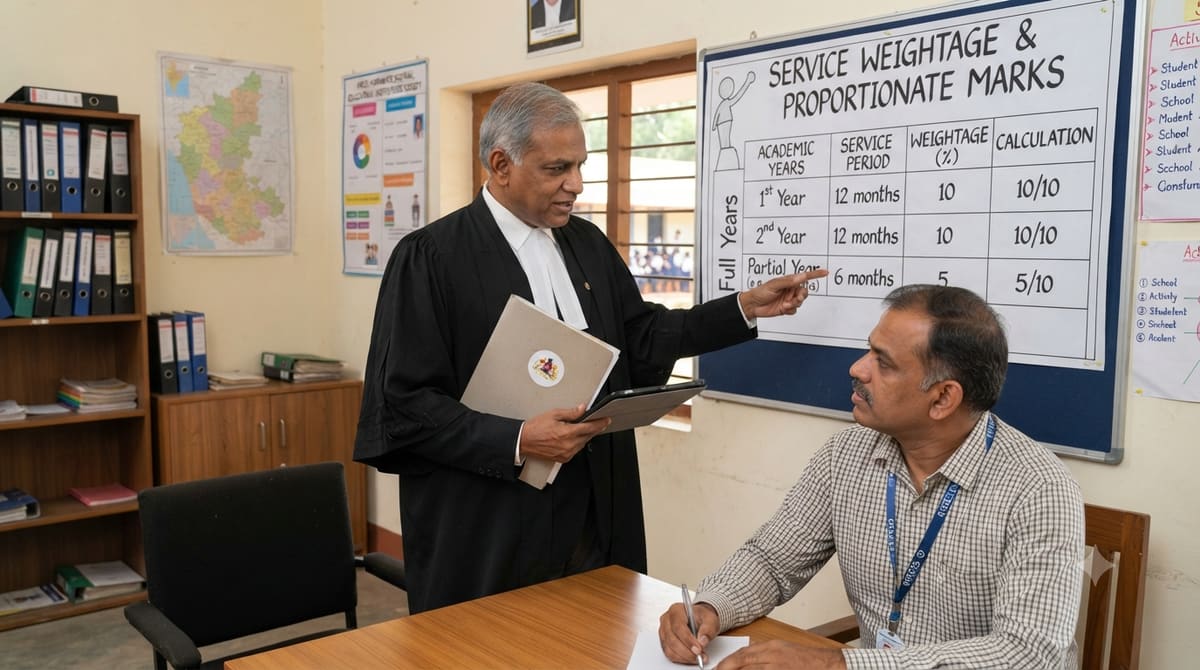
The Karnataka High Court has reaffirmed the principle of proportionate service weightage for contractual teachers in residential schools, directing the Karnataka Residential Educational Institutions Society (KREIS) to grant weightage even for partial academic years. This judgment settles a long-standing dispute about the interpretation of Regulation 2011, ensuring fair consideration for teachers who served during the 'no rule period' but were denied benefits due to technicalities in service duration calculation.
Background & Facts
The Dispute
The petitioners, 13 contractual teachers and principals working in various Karnataka residential schools (Morarji Desai Residential Schools, Kittur Rani Chennamma Schools, Ekalavya Model Residential Schools), sought proportionate service weightage for academic years 2007-2012. They were appointed during a 'no rule period' (2005-2010) when recruitment rules were absent, and their services were later regularized under the Karnataka Residential Educational Institutions Society (Cadre & Recruitment) Regulations, 2011 (hereinafter Regulations 2011).
Key Facts
- The petitioners were appointed through a competitive process (written test + interview) conducted by Zilla Panchayats under Government Orders dated 21.10.2009.
- Schools were later transferred to KREIS, which framed Regulations 2011, providing 5% weightage per completed academic year (max 40%) for contractual teachers.
- KREIS issued a Tippani (note) dated 02.12.2014 (Annexure-E1), interpreting "completed year" strictly, denying weightage for partial years.
- The petitioners filed representations between 06.06.2026 to 22.06.2026 seeking proportionate weightage, which were ignored.
Procedural History
- 27.04.2011: Recruitment notification issued by Deputy Commissioner (Annexure-A5).
- 13.07.2012: Single Judge in Vishwanath M.S. v. State of Karnataka (WP Nos. 20204-20364/2011) directed regularization and service weightage for teachers appointed post-2004-05.
- 28.02.2013: Division Bench in KREIS v. Mounesh (WA No. 5127/2012) upheld Single Judge’s order, confirming entitlement to weightage.
- 09.09.2013: Supreme Court dismissed SLP (SLP No. 30845/2013), affirming High Court’s directions.
- 02.12.2014: KREIS issued Tippani (Annexure-E1), denying weightage for partial years.
- 22.10.2019: Single Judge in Vishwanath M.S. v. State of Karnataka (WP Nos. 8113-8131/2015) quashed Annexure-E1 and directed proportionate weightage.
- 19.07.2023: Division Bench in KREIS v. Vishwanath M.S. (WA No. 360/2020) upheld Single Judge’s order on proportionate weightage.
- 07.07.2026: Present writ petition filed seeking compliance with earlier judgments.
Relief Sought
The petitioners sought:
- A writ of mandamus directing KREIS to grant proportionate service weightage for academic years 2007-2012.
- Consideration of representations dated 06.06.2026 to 22.06.2026 (Annexures T, T1-T9).
- Declaration of eligibility for selection against teaching posts.
The Legal Issue
The central question was whether Regulations 2011, which provide for 5% weightage per completed academic year, permit proportionate weightage for partial years (e.g., service less than 10 months in an academic year). Specifically:
- Does the term "completed year of service" in Regulations 2011 include proportionate weightage for partial academic years?
- Whether KREIS’s strict interpretation of "completed year" in Annexure-E1 violates Articles 14, 16, and 21 of the Constitution?
Arguments Presented
For the Petitioners
- Judicial Precedents: Relied on Vishwanath M.S. v. State of Karnataka (WP Nos. 8113-8131/2015), where the Single Judge and Division Bench held that proportionate weightage must be granted for partial years.
- Constitutional Violations: Argued that Annexure-E1’s strict interpretation denies equal protection (Article 14) and right to livelihood (Article 21).
- Service Recognition: Contended that their services were utilized by KREIS, and denying weightage for partial years is arbitrary.
- One-Time Measure: Emphasized that Regulations 2011 were framed as a one-time measure to regularize contractual teachers, and strict interpretation defeats this purpose.
For the Respondents
- Literal Interpretation: Argued that Regulations 2011 explicitly provide weightage only for "completed years", and partial years cannot be considered.
- Judicial Deference: Cited Supreme Court judgments (Manish v. Rohini Goyal, State of Punjab v. Singala, KSRTC v. Ashrafulla Khan) to argue that service weightage is discretionary and cannot be extended beyond the rules.
- Financial Implications: Highlighted that granting proportionate weightage would impose unintended financial burdens on the State.
- Procedural Compliance: Contended that KREIS followed due process in preparing the selection list, and the petitioners’ non-selection was based on merit.
The Court's Analysis
The Court conducted a three-pronged analysis:
1. Interpretation of "Completed Year of Service"
- Regulations 2011 do not define "completed year", leading to ambiguity.
- The Court noted that contractual teachers were paid only for 10 months in an academic year, with no salary for the remaining 2 months.
- Strict interpretation (as in Annexure-E1) would defeat the purpose of Regulations 2011, which were framed as a one-time measure to regularize contractual teachers.
- Proportionate weightage aligns with the equitable intent of the Regulations, ensuring fairness for teachers who served during the 'no rule period'.
2. Judicial Precedents and Finality
- The Court relied on three binding judgments:
- Vishwanath M.S. v. State of Karnataka (WP Nos. 8113-8131/2015, dated 22.10.2019): Quashed Annexure-E1 and directed proportionate weightage.
- KREIS v. Mounesh (WA No. 545/2021, dated 07.11.2022): Upheld service weightage for contractual teachers.
- KREIS v. Vishwanath M.S. (WA No. 360/2020, dated 19.07.2023): Affirmed proportionate weightage for partial years.
- These judgments attained finality, as the Supreme Court dismissed the SLP (SLP No. 30845/2013).
- The Court held that KREIS cannot indirectly circumvent these judgments by issuing Annexure-E1.
3. Constitutional Imperatives
- Article 14 (Equality): Annexure-E1’s strict interpretation created arbitrary classification between teachers with full years and partial years, violating equality.
- Article 16 (Equal Opportunity): Denying weightage to teachers appointed through the same competitive process was discriminatory.
- Article 21 (Livelihood): The petitioners’ right to livelihood was jeopardized by KREIS’s inaction, despite judicial directions.
"The impugned Tippani dated 02.12.2014 (Annexure-E1) is without any basis and in utter violation of Articles 14, 16, and 21 of the Constitution of India. The same cannot be sustained."
The Verdict
The Court allowed the writ petition and issued the following directions:
- Quashed Annexure-E1 (Tippani dated 02.12.2014) insofar as it denies proportionate weightage to the petitioners.
- Directed KREIS to:
- Grant 5% weightage for each academic year of service, irrespective of the date of appointment.
- Grant proportionate weightage for partial years (service less than one academic year).
- Recompute the selection list by including the petitioners’ weightage marks.
- Pass individual orders for each petitioner within 12 weeks from the receipt of this order.
- Declared the petitioners eligible for selection against teaching posts, subject to fulfilling other eligibility criteria.
What This Means For Similar Cases
Proportionate Weightage Is Mandatory for Partial Academic Years
- Regulations 2011 must be interpreted purposively to include proportionate weightage for partial years, especially where:
- Teachers were paid only for 10 months in an academic year.
- The intent of the Regulations was to regularize contractual teachers as a one-time measure.
- Practitioners should argue that strict literal interpretation defeats the equitable purpose of service weightage provisions.
Judicial Precedents Are Binding on Administrative Authorities
- Administrative bodies (like KREIS) cannot issue circulars/notes that indirectly nullify judicial orders.
- Key Takeaways:
- Annexure-E1 was quashed because it contradicted binding judgments (Vishwanath M.S., Mounesh).
- Non-compliance with judicial directions can lead to writ of mandamus for enforcement.
- State’s silence (e.g., not filing objections) can be construed as acceptance of the petitioners’ claims.
Service Regularization Under "One-Time Measures"
- Regulations framed as "one-time measures" (e.g., Regulations 2011) cannot be applied rigidly to deny benefits.
- Factors to consider:
- Length of service: Teachers with considerable service (even if partial) should not be denied weightage.
- Competitive selection: If appointed through due process (written test + interview), weightage must be granted.
- Financial implications: Courts may balance equities, especially if the State accepts the order (as in this case).
- Practitioners should cite WA No. 360/2020 (para 29) to argue that strict interpretation leads to injustice for qualified teachers.