The Madhya Pradesh High Court has reaffirmed that when a post for contractual teachers is formally created and recognized by the state, denial of consequential benefits - including regularization or benefit under Adhyapak Samvarg Rules - solely on the ground of non-clearing of an eligibility test, violates established judicial precedent. This judgment reinforces the principle that administrative action must align with prior judicial directives and statutory intent.
Background & Facts
The Dispute
The petitioner, Akash Aadiwasi, is a contractual teacher who served in government schools in Madhya Pradesh under the Contract Teacher Rules, 2005. Despite continuous service and the subsequent creation of a regular teaching post through official letter dated 27.09.2018, the state authorities refused to grant him regular appointment or extend the benefit of Adhyapak Samvarg (a scheme for absorption of long-serving contractual teachers) on the ground that he had not cleared the eligibility test prescribed under the amended provisions of the Madhya Pradesh Shikshak Chayan Adhiniyam, 1994.
Key Facts
- The petitioner was engaged as a contractual teacher on an ad hoc basis prior to 2005 and continued in service for over a decade.
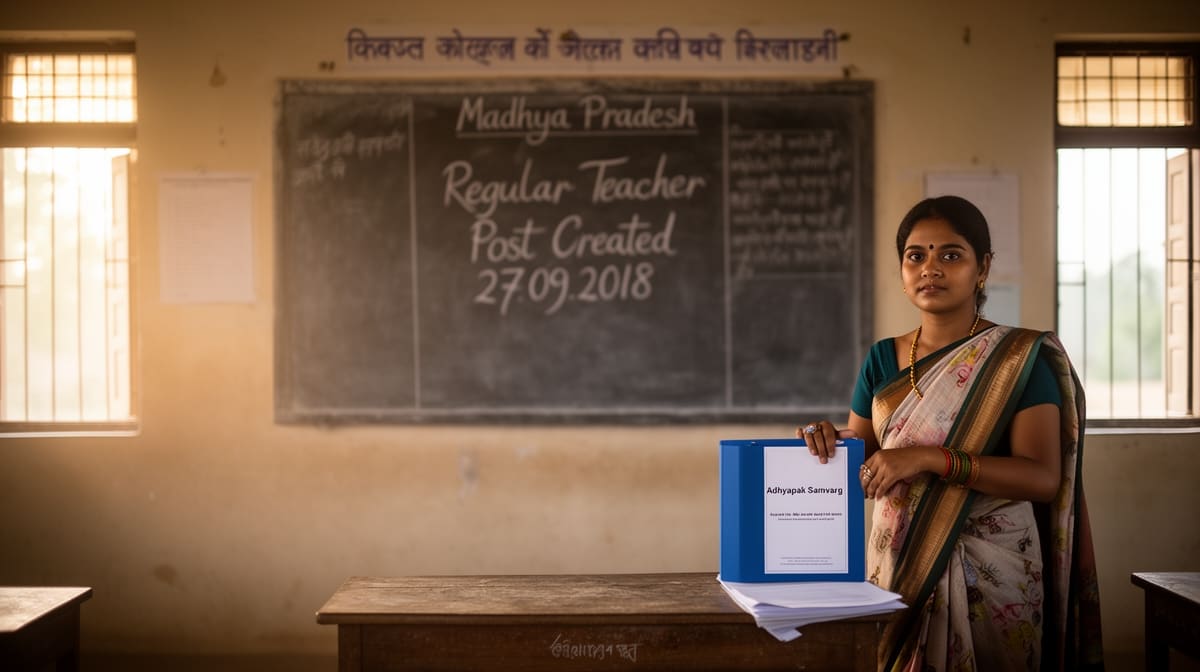
- A regular teaching post was created vide Office Order dated 27.09.2018, specifically for the category of long-serving contractual teachers.
- The petitioner applied for regularization under the Adhyapak Samvarg scheme, as per Rules framed in 2008.
- The respondent authorities rejected his application by order dated 15.11.2019 (Annexure P/1), citing non-compliance with the eligibility test under the amended 1994 Act.
- The petitioner had previously filed two writ petitions before this Court, which were decided in his favor in similar circumstances.
Procedural History
- 2005 onwards: Petitioner engaged as contractual teacher under Contract Teacher Rules, 2005.
- 27.09.2018: Government issued letter creating regular teaching posts for eligible contractual teachers.
- 15.11.2019: Impugned order passed by respondent no. 2 rejecting petitioner’s claim for regularization or Adhyapak Samvarg benefit.
- 2020: Coordinate Bench of this Court decided Kartar Singh Badretiya & others v. State of M.P. (W.P. No. 901/2020), holding that creation of post entitles long-serving teachers to regularization without fresh eligibility test.
- 2025: Another coordinate bench decided Anil Adiwasi v. State of M.P. (W.P. No. 45030/2025), applying the same principle.
- 2026: Present writ petition filed by Akash Aadiwasi, relying on the above precedents.
Relief Sought
The petitioner sought:
- Direction to permit him to discharge duties as per earlier court orders.
- Extension of Adhyapak Samvarg benefits under Rules 2008.
- Regular appointment as teacher without requiring clearance of eligibility test under the amended 1994 Act.
- Quashing of the impugned order dated 15.11.2019.
- Consequential benefits including pay, seniority, and pension.
The Legal Issue
The central question was whether a contractual teacher, who has served continuously and against whom a regular post has been created by the state, can be denied regularization or benefit under Adhyapak Samvarg Rules solely on the ground of non-clearing of a subsequent eligibility test, when prior judgments have held such denial to be violative of equality and reasonable classification.
Arguments Presented
For the Petitioner
Learned counsel submitted that the issue had already been conclusively settled by two coordinate benches of this Court in Kartar Singh Badretiya and Anil Adiwasi. He argued that the state cannot create a post for a category of employees and then impose a new, retrospective condition to exclude those who have already fulfilled the original criteria of long service. He relied on the doctrine of stare decisis and the principle that administrative action must conform to judicial precedent.
For the Respondent/State
The Government Advocate did not contest the applicability of the precedents but argued that the petitioner must still comply with the amended eligibility norms under the 1994 Act, as they represent the current statutory framework. However, no independent legal argument was advanced to distinguish the facts of this case from the prior judgments.
The Court's Analysis
The Court explicitly declined to re-examine the merits of the petitioner’s claim, noting that the issue had already been authoritatively decided by coordinate benches. The Court emphasized that judicial consistency is fundamental to the rule of law and that lower authorities cannot disregard binding precedents merely because of a change in statutory interpretation or policy.
"This Court has already laid down the law in the cases of Kartar Singh Badretiya and Anil Adiwasi. The respondents cannot now insist on a condition which has been held to be impermissible by this Court in identical circumstances."
The Court observed that the creation of a regular post under the 27.09.2018 letter constituted a recognition of the petitioner’s service as qualifying for regularization. To impose a new eligibility test at this stage would amount to arbitrary discrimination and violate Article 14 of the Constitution.
The Court further noted that the doctrine of consequential benefits - including seniority, pay fixation, and pension entitlements - flows naturally from regularization and cannot be withheld on technical grounds.
The Verdict
The writ petition was disposed of with directions to the respondents to consider the petitioner’s claim for regularization or benefit under Adhyapak Samvarg Rules, in light of the judgments in Kartar Singh Badretiya and Anil Adiwasi. The competent authority must decide the matter within 90 days of the petitioner furnishing certified copies of this order and the two precedent judgments. If found eligible, the petitioner shall be granted all consequential benefits, including pay, seniority, and pension, with effect from the date of creation of the post on 27.09.2018.
What This Means For Similar Cases
Consequential Benefits Are Inseparable from Regularization
- Practitioners must now argue that regularization under service rules automatically triggers entitlement to seniority, pay revision, and pension benefits from the date of post creation.
- Denial of such benefits on grounds of procedural delays or non-compliance with later tests is legally unsustainable after this judgment.
Precedent Overrides Administrative Policy Shifts
- Government departments cannot unilaterally impose new eligibility conditions to override binding court rulings on identical facts.
- Any attempt to distinguish prior judgments on grounds of statutory amendments must be substantiated with clear legislative intent - mere policy change is insufficient.
Procedural Compliance Must Follow Judicial Directives
-
Authorities must act within the framework of existing judicial precedents, even if administrative guidelines appear to conflict.
-
Petitioners in similar cases should immediately file applications before the competent authority, attaching certified copies of Kartar Singh Badretiya and Anil Adiwasi as binding authority.
-
Always demand written reasons if regularization is denied post this judgment.
-
File writ petitions under Article 226 if the authority fails to act within 90 days of receiving the order.