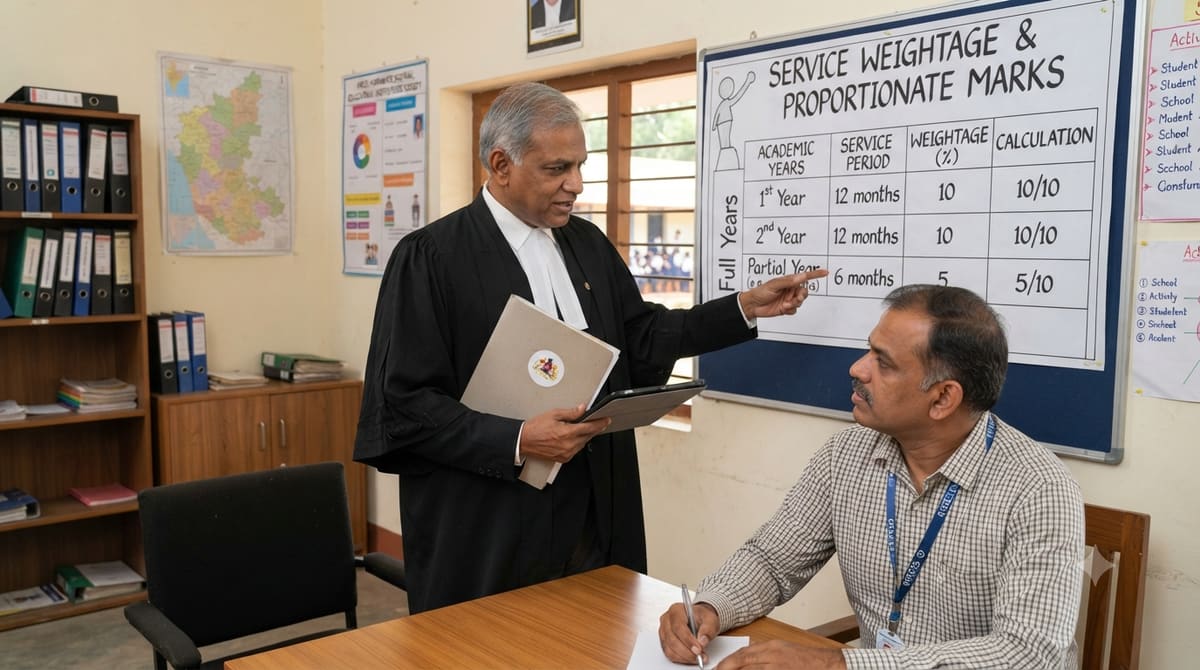
The Karnataka High Court has clarified the interpretation of 'completed year of service' under the Karnataka Residential Educational Institutions Society (Cadre & Recruitment) Regulations, 2011, directing that teachers who served partial academic years are entitled to proportionate weightage for service rendered. This judgment reinforces the principle that contractual employees recruited through due process cannot be denied benefits on technical grounds, especially when their initial appointment was legal and they possess the requisite qualifications.
Background & Facts
The Dispute
The petitioner, Rajeshwaramma, a Hindi teacher at Morarji Desai Residential School (MDRS), sought service weightage for her tenure during the academic years 2006-2007 and 2010-2011. She contended that the respondents - State of Karnataka and Karnataka Residential Educational Institutions Society (KREIS) - denied her weightage despite her service being recognized in earlier judicial precedents. She also sought age relaxation for recruitment, arguing that delays in the recruitment process were not attributable to her.
Key Facts
The petitioner was engaged as a contract teacher under KREIS, which manages residential schools for underprivileged students.
KREIS framed Cadre & Recruitment Regulations, 2011, providing 5% weightage for each completed year of service (capped at 40%).
The petitioner served during 2006-2007 and 2010-2011, but her service was not counted as a 'completed year' under the Regulations.
She filed representations on 15.06.2025 and 26.10.2025, seeking weightage and age relaxation, which were not addressed.
Procedural History
22.10.2019: Co-ordinate Bench in Vishwanath M.S. v. State of Karnataka (W.P. Nos. 8113-8131/2015) directed proportionate weightage for partial-year service.
07.11.2022: Division Bench in KREIS v. Mounesh (W.A. No. 545/2021) upheld the principle of proportionate weightage.
19.07.2023: Division Bench in KREIS v. Vishwanath M.S. (W.A. No. 360/2020) reaffirmed that partial-year service qualifies for proportionate weightage.
15.06.2025 & 26.10.2025: Petitioner submitted representations seeking relief, which remained pending.
07.07.2026: Present writ petition filed seeking mandamus to enforce earlier judicial directions.
Relief Sought
The petitioner sought:
Proportionate service weightage for 2006-2007 and 2010-2011 as per Vishwanath M.S. and Mounesh judgments.
Age relaxation for recruitment, citing delays not attributable to her.
Disposal of representations dated 15.06.2025 and 26.10.2025 within a fixed timeline.
The Legal Issue
The central question was whether 'completed year of service' under the Cadre & Recruitment Regulations, 2011 includes partial academic years, and if proportionate weightage must be granted for such service.
Arguments Presented
For the Petitioner
Relied on Vishwanath M.S. v. State of Karnataka (W.P. Nos. 8113-8131/2015), where the Court held that proportionate weightage must be granted for partial-year service.
Argued that KREIS misinterpreted the Regulations by denying weightage for incomplete years, despite the petitioner’s legal and qualified appointment.
Contended that delay in recruitment was not her fault, justifying age relaxation.
For the Respondents
KREIS argued that weightage is only for 'completed years', as defined in the Regulations.
Cited precedents (Manish v. Rohini Goyal, State of Punjab v. Singhal) to support a strict interpretation of 'completed year'.
Claimed that proportionate weightage would violate the Regulations and create financial implications for the State.
The Court's Analysis
The Court relied on three key judgments to resolve the dispute:
1. Vishwanath M.S. v. State of Karnataka (W.P. Nos. 8113-8131/2015)The Co-ordinate Bench held that 'completed year' is not defined in the Regulations, and contract teachers (paid for 10 months) cannot be denied weightage for partial service. The Court emphasized equity, noting that strict interpretation would deprive qualified teachers of benefits despite their legal recruitment.
2. KREIS v. Mounesh (W.A. No. 545/2021)The Division Bench upheld proportionate weightage, observing that contract teachers were recruited through competitive exams and interviews, and denying weightage would be unjust.
3. KREIS v. Vishwanath M.S. (W.A. No. 360/2020)The Division Bench reiterated that 'completed year' must be interpreted contextually, especially since contract teachers were not paid for 2 months annually. The Court held: "The expression 'each completed year of service' is not defined under the Regulations 2011. Given that employees were paid only for 10 months, strict interpretation would result in injustice to qualified teachers."
The Court distinguished the respondents’ cited precedents (Manish v. Rohini Goyal, State of Punjab v. Singhal), noting they were factually distinct and did not interpret the Regulations 2011.
The Verdict
The Court disposed of the petition with the following directions:
Respondents must consider the petitioner’s representations dated 15.06.2025 and 26.10.2025 within three months.
Proportionate weightage must be granted for partial academic years (2006-2007 and 2010-2011) in accordance with:
Vishwanath M.S. v. State of Karnataka (W.P. Nos. 8113-8131/2015, 22.10.2019).
KREIS v. Mounesh (W.A. No. 545/2021, 07.11.2022).
KREIS v. Vishwanath M.S. (W.A. No. 360/2020, 19.07.2023).
Age relaxation must be considered if delays in recruitment were not attributable to the petitioner.
What This Means For Similar Cases
Proportionate Weightage Is Mandatory for Partial-Year Service
Contractual employees (e.g., teachers, government staff) serving partial academic/financial years are entitled to proportionate weightage if:
Their initial appointment was legal (through competitive exams/interviews).
They possess requisite qualifications.
The Regulations do not explicitly exclude partial-year service.
Practitioners should argue:
Equity over technicality: Courts favor substantive justice when Regulations are ambiguous.
Contextual interpretation: If employees were paid for only part of the year, denying weightage would be unjust.
Strict Interpretation Yields to Equity
Statutory definitions (e.g., 'completed year') must be interpreted in context. If the legislative intent is unclear, courts will lean toward equity.
Key takeaway: Precedents on 'completed year' (e.g., Payment of Gratuity Act) may not apply if the factual matrix differs (e.g., contract teachers paid for 10 months).
Financial Implications Do Not Override Legal Rights
The State’s financial burden is not a valid defense to deny statutory/constitutional rights (e.g., Articles 14, 16, 21).
Practitioners should emphasize:
Judicial directions in earlier cases (Vishwanath M.S., Mounesh) bind the State.
Non-compliance with court orders violates constitutional guarantees of equality and non-arbitrariness.