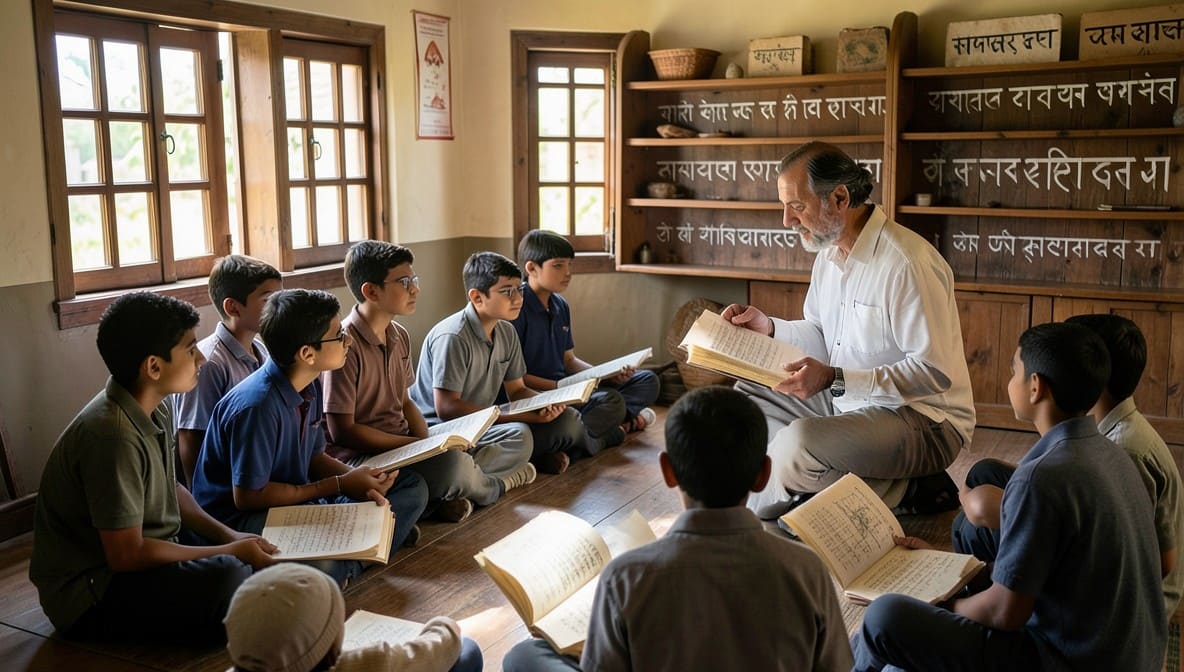
The Income Tax Appellate Tribunal, Panaji Bench, has clarified that the teaching of Vedas and ancient Aryan lore, when undertaken for public education without religious worship, qualifies as a charitable purpose under Section 80G of the Income Tax Act, 1961. This decision overturns a restrictive interpretation by the Commissioner of Income Tax (Exemptions) and affirms that cultural and educational activities rooted in Vedic tradition are not inherently religious.
Background & Facts
The Dispute
The appellant, Prachya Viddya Samvardhan, a society registered under the Societies Registration Act on 27.03.2017, sought regular approval under Section 80G(5) of the Income Tax Act, 1961, to enable donors to claim tax deductions for contributions. The society’s stated objectives include imparting education in Vedas, Sanskrit, ancient Indian Shastras, Yoga, and Aryan lore; establishing Gurukul-type Pathashalas; maintaining libraries; promoting cow protection; and conducting examinations in Vedic studies - all without discrimination based on caste, creed, or religion.
The Commissioner of Income Tax (Exemptions), Bangalore, denied the application dated 25.10.2023, holding that the society’s activities were religious in nature, thereby disqualifying it under Explanation 3 to Section 80G, which excludes entities engaged primarily in religious activities from claiming approval.
Key Facts
- The society was registered on 27.03.2017 with amended objects approved on 28.12.2020 and further revised on 15.03.2024.
- Registration under Section 12A of the Act was granted on 23.09.2021 for assessment years 2022-23 to 2026-27, valid until 26.10.2027.
- Provisional approval under Section 80G was granted on 26.10.2022 for A.Y. 2025-26.
- The society filed Form 10AB for regular Section 80G approval on 25.10.2023.
- The CIT(Exemptions) rejected the application on 24.04.2024, citing that teaching Vedas constituted religious activity.
- The CIT(Exemptions) acknowledged but declined to follow two prior decisions of the Coordinate Bench, Bangalore: Sri Ashvalayana Vrunda (ITA No.1084/Bang/2022) and Shri Shruthiparampara Gurukulam (ITA No.1082/Bang/2022), both dated 09.01.2023, which had granted similar approvals.
- On 19.03.2026, the same CIT(Exemptions) granted Section 80G approval to the appellant for A.Y. 2027-28 to A.Y. 2031-32, based on identical objects.
Procedural History
- 27.03.2017: Society registered under Societies Registration Act
- 23.09.2021: Section 12A registration granted
- 26.10.2022: Provisional Section 80G approval granted
- 25.10.2023: Application for regular Section 80G approval filed
- 24.04.2024: CIT(Exemptions) denied approval
- 21.05.2026: Hearing before ITAT Panaji
- 30.06.2026: ITAT judgment pronounced
The Parties' Positions
For the Appellant
The appellant argued that:
- The Vedas are not religious scriptures but repositories of universal knowledge (Veda means "knowledge" in Sanskrit).
- Teaching Vedas is akin to teaching classical Sanskrit literature, not worship or prayer.
- Activities are open to all, irrespective of caste, creed, or religion.
- UNESCO recognizes the Vedas as Intangible Cultural Heritage.
- The Coordinate Bench, Bangalore, had already ruled in similar cases that such activities are charitable.
- The same CIT(Exemptions) had approved the same objects for a later period (A.Y. 2027-28 to 2031-32), rendering the denial arbitrary.
For the Respondent
The Revenue contended that:
- The society’s activities involve propagation of Vedic rituals and Hindu philosophy, which fall under religious activity.
- Explanation 3 to Section 80G excludes entities whose primary purpose is religious.
- The Coordinate Bench decisions were under challenge in the Karnataka High Court and therefore not binding.
Relief Sought
The appellant sought:
- Setting aside of the CIT(Exemptions) order dated 24.04.2024
- Restoration of the provisional Section 80G approval dated 26.10.2022
- Grant of regular Section 80G approval for all assessment years
The Legal Issue
The central question was whether the teaching of Vedas and ancient Aryan lore, as part of a broader educational and cultural mission open to all, constitutes a "religious activity" under Explanation 3 to Section 80G of the Income Tax Act, thereby disqualifying the entity from charitable status.
Arguments Presented
For the Appellant
The appellant relied on the ratio of Sri Ashvalayana Vrunda and Shri Shruthiparampara Gurukulam (both ITAT Bangalore, 09.01.2023), where the Coordinate Bench held that:
- Recitation and teaching of Vedas do not involve worship or prayer.
- The Vedas are preserved in their original form for over millennia and are recognized by UNESCO as a global heritage of knowledge.
- The activities were non-discriminatory and educational, not sectarian.
- The term "religion" in Explanation 3 must be narrowly construed to exclude universal knowledge systems.
The appellant emphasized that the society’s amended objects explicitly prohibit profit-making and discrimination, and include welfare, libraries, yoga, and music - hallmarks of charitable activity.
For the Respondent
The Revenue argued that the society’s focus on Vedic studies inherently promotes Hindu religious tradition and thus falls within the exclusionary scope of Explanation 3. It contended that the Coordinate Bench decisions were sub judice and could not be relied upon. It also asserted that the grant of approval for a later period did not invalidate the denial for the current application.
The Court's Analysis
The Tribunal observed that the CIT(Exemptions) had granted Section 80G approval to the same society for A.Y. 2027-28 to 2031-32 on identical objects, thereby undermining the rationale for denial in the earlier application. The Tribunal noted that the same authority could not adopt contradictory positions without arbitrariness.
"The Vedas are the unadulterated treasure house of true knowledge. So much so that even UNESCO declared it as part of the Intangible cultural heritage in their true form up till now. Therefore, it cannot be said that Veda is confined to particular set of people belonging to a particular religion and thus Vedas are for the spiritual upliftment of the mankind."
The Tribunal held that the activities of the society - teaching Sanskrit, conducting examinations, establishing libraries, promoting yoga, and preserving ancient texts - are educational and cultural in nature. The mere fact that the subject matter originates from a particular tradition does not transform it into a religious activity under Section 80G. The Tribunal distinguished between religious worship and the dissemination of knowledge.
It further held that the pendency of appeals against the Coordinate Bench decisions did not render them irrelevant, especially where the reasoning was sound and consistent with the statutory purpose of Section 80G. The Tribunal emphasized that the burden lies on the Revenue to prove that the primary purpose is religious, not merely that the subject matter has religious origins.
The Verdict
The appeal was allowed. The ITAT set aside the CIT(Exemptions) order dated 24.04.2024, directed the restoration of the provisional Section 80G approval granted on 26.10.2022, and mandated the grant of regular approval under Section 80G(5) for all relevant assessment years. The order was to be implemented within 30 days of the judgment date.
What This Means For Similar Cases
Teaching Ancient Texts Is Not Automatically Religious
- Practitioners must argue that the nature of activity - not the origin of content - determines charitable status.
- Institutions teaching Sanskrit, Upanishads, Ayurveda, or Yoga must highlight non-sectarian access, educational outcomes, and public benefit.
- The mere mention of Vedic or Hindu terminology does not trigger Explanation 3 exclusion.
Consistency in Tax Authority Decisions Is Mandatory
- If a tax authority grants approval for identical objects in a later period, denial in an earlier period becomes arbitrary and unsustainable.
- Tax officers must provide clear, non-contradictory reasoning across applications.
- Prior approvals, even if provisional, create a strong presumption of eligibility.
UNESCO Recognition Supports Charitable Classification
-
International recognition of cultural heritage (e.g., UNESCO) can be cited to demonstrate universal, non-religious educational value.
-
This precedent opens the door for similar institutions teaching other ancient Indian knowledge systems (e.g., Natya Shastra, Charaka Samhita) to seek Section 80G approval.
-
The burden of proving religious intent lies with the Revenue.
-
Educational objectives must be clearly documented in trust deeds and operational activities.
-
Avoid language implying exclusivity or sectarian worship in public-facing materials.