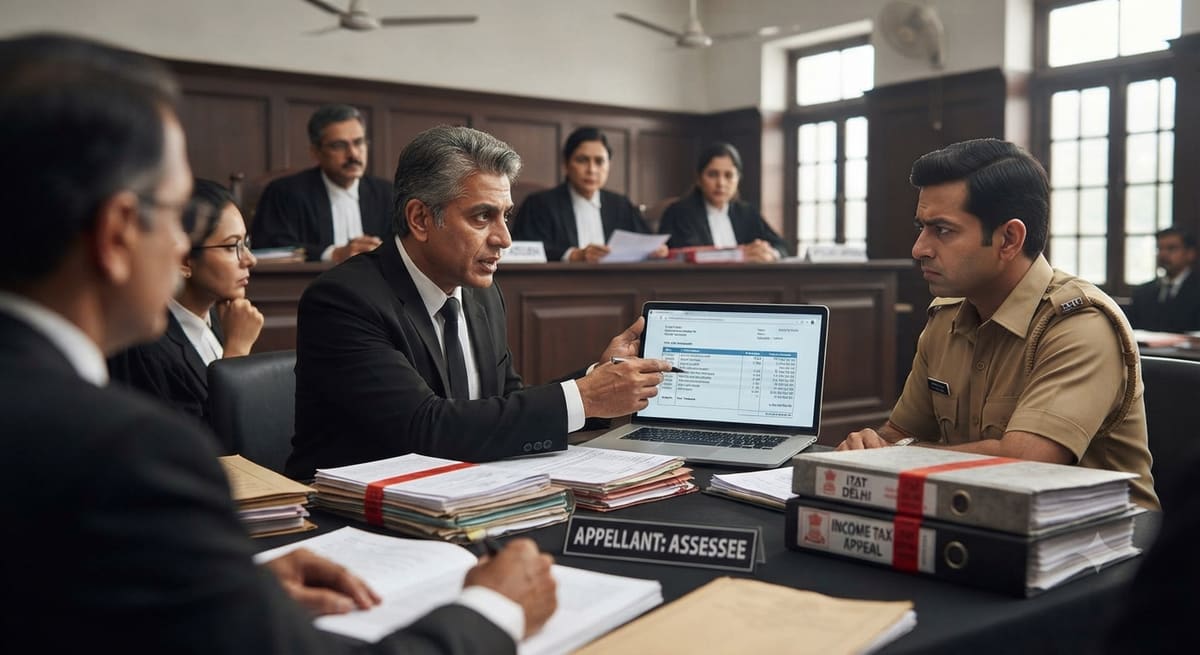
The Income Tax Appellate Tribunal, Kolkata, has reaffirmed that when an assessee fails to establish the genuineness of purchases linked to a known accommodation entry provider, the entire amount of such expenditure must be added as unexplained income under Section 69C of the Income Tax Act, irrespective of profit margins or sales linkage. This ruling reinforces the statutory intent to prevent tax evasion through paper transactions.
Background & Facts
The Dispute
The assessee, Anowar Hossain Mondal, a hardware dealer operating as 'New Bengal Hardware' in Guskara, Purba Burdwan, was assessed for AY 2018-19 after the Income Tax Department identified him as a recipient of fake GST invoices issued by M/s Rajbhar Trade Commercial. The supplier was flagged by the Investigation Wing as a non-existent entity used solely to generate accommodation entries for illicit input tax credit claims. The Department alleged that the assessee had claimed purchases worth ₹15,08,950 from this entity, which were not genuine and thus inadmissible as business expenses.
Key Facts
- The assessee filed his original return for AY 2018-19 on 10.10.2018 declaring income of ₹11,92,700, which was processed under Section 143(1) on 10.02.2019.
- On the basis of intelligence from DDIT(Inv.)-2(1), Kolkata, and DDIT(Inv.)-1(4), Kolkata, the Department identified M/s Rajbhar Trade Commercial as a paper entity with turnover of ₹60.68 crore but gross income of only ₹3,73,127 and no fixed assets.
- The supplier’s registered address was found non-functional during field inquiries; no physical infrastructure, stock, or operational capacity was verified.
- The assessee’s purchases from this entity amounted to ₹15,08,950 during FY 2017-18.
- The assessee submitted purchase invoices, bank payment proofs (RTGS), and confirmation letters but did not file them through the e-filing portal.
- The supplier did not respond to notices issued under Section 133(6); transport vehicles mentioned in invoices were either de-registered or non-operational.
- No delivery challans, weighment slips, or government contract documentation linking the purchases to actual usage were produced.
- The assessee’s gross profit rate was 6.87% and net profit rate 4.58%.
Procedural History
- 10.10.2018: Original return filed for AY 2018-19.
- 10.02.2019: Return processed under Section 143(1).
- 2021-2022: Investigation Wing flagged M/s Rajbhar Trade Commercial as a bogus entity.
- 2022: Notice issued under Section 148A(b); reassessment initiated under Section 147.
- 11.11.2022: Assessee filed revised return under Section 148 declaring income of ₹12,70,870.
- 10.03.2023: Assessing Officer passed assessment order disallowing ₹15,08,950 under Section 69C and adding ₹78,170 for interest income discrepancy.
- 04.11.2025: Commissioner of Income Tax (Appeals)-NFAC, Delhi dismissed the appeal, upholding the addition.
- 05.05.2026: ITAT Kolkata dismissed the assessee’s appeal, confirming the order.
Relief Sought
The assessee sought deletion of the addition of ₹15,08,950 under Section 69C and requested that only a reasonable profit margin (6% over declared profit) be added instead of the full purchase amount. He also sought relief from the interest income addition of ₹78,170.
The Legal Issue
The central question was whether the entire amount of purchases from a proven bogus supplier can be added as unexplained expenditure under Section 69C when the assessee fails to establish the genuineness of the transaction, even if sales are accepted and partial documentation exists.
Arguments Presented
For the Appellant/Petitioner
The assessee’s representative argued that:
- The purchases were supported by invoices, bank payment records, and supplier confirmations.
- The corresponding sales were accepted by the Department, indicating commercial legitimacy.
- Judicial precedents such as Vaman International Pvt. Ltd. and Mohammad Haji Adam & Co. permitted partial disallowance based on estimated profit margins.
- The addition of the full amount would result in an exorbitant profit rate, contrary to commercial realities.
- The assessee had submitted documents during the original assessment and should not be penalized for non-filing via e-portal.
For the Respondent/State
The Department contended that:
- The supplier was conclusively established as a non-existent accommodation entry provider with no physical presence, stock, or operational capacity.
- No corroborative evidence of physical delivery - such as delivery challans, transport receipts, or government contract records - was produced.
- The assessee failed to appear before the Assessing Officer during reassessment despite proper service of notices via post, email, and affixture.
- The Hon’ble Bombay High Court in Principal Commissioner of Income-tax v. Kanak Impex (India) Ltd. and Drisha Impex (P.) Ltd. held that once a purchase is found bogus, Section 69C mandates full addition, and profit estimation is impermissible.
- Section 69C is a deeming provision that bars deduction of unexplained expenditure; allowing partial relief would nullify its purpose.
The Court's Analysis
The Tribunal examined the nature of the supplier and the quality of evidence presented by the assessee. It noted that the supplier, M/s Rajbhar Trade Commercial, had been conclusively identified by the Investigation Wing as a non-existent entity with no fixed assets, no operational infrastructure, and no verifiable transport or stock. Notices under Section 133(6) remained unserved, and the vehicles referenced in invoices were either de-registered or non-operational.
"The appellant's reliance on Vaman International Pvt. Ltd. and Mohammad Haji Adam & Co. is distinguishable. In those cases, the purchases were partly proved through stock reconciliation and sales linkage, whereas in the present case, the supplier has been conclusively found to be a non-existent accommodation entry provider."
The Tribunal emphasized that mere existence of invoices and bank payments is insufficient to prove transactional genuineness. The Supreme Court in N.K. Proteins Ltd. v. DCIT had held that once accommodation entries are established, the entire amount is liable to be added. The Tribunal further relied on the Bombay High Court’s judgment in Kanak Impex (India) Ltd., which held that estimating a profit margin after finding purchases bogus effectively grants an implied deduction of the purchase amount, thereby rendering Section 69C redundant.
"If the approach of the Appellate Authorities of estimating the profit on such purchases is to be accepted, then, in effect, the consequence would be that even if assessee has failed to prove its claim of deduction of purchases, still by estimating profit, impliedly deduction of purchases is given."
The Tribunal rejected the argument that the assessee had discharged its burden through documents submitted during the original assessment, noting that reassessment proceedings are initiated precisely because previously accepted transactions are later found to be non-genuine. The assessee’s failure to appear during reassessment, despite proper notice, was deemed a conscious abandonment of the opportunity to discharge the onus.
The Court concluded that the Assessing Officer and the CIT(A) were fully justified in treating the entire ₹15,08,950 as unexplained expenditure under Section 69C, and that any attempt to estimate a profit margin would violate the statutory mandate.
The Verdict
The appeal was dismissed in toto. The Tribunal confirmed the addition of ₹15,08,950 under Section 69C as unexplained expenditure and upheld the addition of ₹78,170 for the interest income discrepancy. The assessment order dated 10.03.2023 was affirmed in full. No relief was granted on the grounds of profit estimation or partial disallowance.
What This Means For Similar Cases
Entire Bogus Purchase Amount Must Be Added Under Section 69C
- Practitioners must advise clients that even if sales are accepted and banking trails exist, failure to prove physical delivery, supplier existence, or transactional authenticity will result in full disallowance.
- Documentation submitted during original assessment cannot substitute for evidence required in reassessment proceedings triggered by new intelligence.
Profit Estimation Is Not a Substitute for Proving Genuineness
- Tribunals and courts will not permit partial additions based on estimated profit margins when the core issue is the non-genuineness of purchases.
- Any attempt to reduce the addition by applying a profit rate is legally impermissible under Section 69C, as it effectively grants a deduction for unexplained expenditure.
Non-Appearance in Reassessment Is Fatal
- Assessees who fail to appear during reassessment proceedings, even if notices are served via email or affixture, cannot later claim procedural unfairness.
- The burden of proof shifts decisively to the assessee once the Department establishes a supplier as a known accommodation entry provider.
Documentary Evidence Must Be Corroborated by Physical Proof
- Invoices and bank statements alone are insufficient. Delivery challans, transport records, weighment slips, and third-party confirmations are now essential for substantiating high-value purchases.
- For government contract-based businesses, work order-wise consumption registers and official certifications are critical to rebut allegations of bogus purchases.
Section 69C Is a Non-Negotiable Statutory Bar
- Section 69C is not a discretionary provision but a deeming fiction that operates automatically when no satisfactory explanation is offered.
- Courts will not allow judicial creativity to circumvent its application, even if the result appears harsh.
The Burden of Proof Is On the Assessee
- The onus to prove the genuineness of purchases lies entirely with the assessee once the Department establishes a prima facie case of accommodation entries.
- This burden cannot be discharged by relying on past submissions or general assertions of commercial legitimacy.
Judicial Precedents Are Binding on All Authorities
- The judgments in Kanak Impex, Drisha Impex, and Mrs. Premlata Tekriwal are now binding precedents for all Income Tax authorities.
- Any attempt to distinguish these cases on facts will be rejected if the supplier is conclusively identified as a paper entity.
Practical Takeaway for Practitioners
- Advise clients to maintain physical delivery records for all high-value purchases.
- Ensure immediate response to notices under Section 148A(b) and 148, even if the information appears baseless.
- Do not assume that prior acceptance of transactions shields against reassessment.
- Never rely solely on invoices and bank statements without corroborative evidence.
No Relief for Non-Filing via E-Portal
- Failure to upload documents on the e-filing portal does not invalidate submissions if physically presented, but it weakens credibility.
- The Tribunal noted that the assessee’s non-compliance with e-filing norms was not the primary issue; the absence of proof of delivery was.
Avoiding Section 69C Additions
- Conduct due diligence on suppliers before entering into transactions.
- Verify GSTIN validity, physical address, and operational status of vendors.
- Retain transport and delivery records for at least six years.
- Avoid transactions with suppliers flagged in Departmental alerts or known to be under investigation.
Conclusion
This judgment reinforces the Department’s aggressive stance against accommodation entries and clarifies that Section 69C operates as an absolute bar to deduction when the source of expenditure remains unexplained. Practitioners must now treat any association with a known bogus supplier as a high-risk exposure requiring immediate and robust evidentiary safeguards.