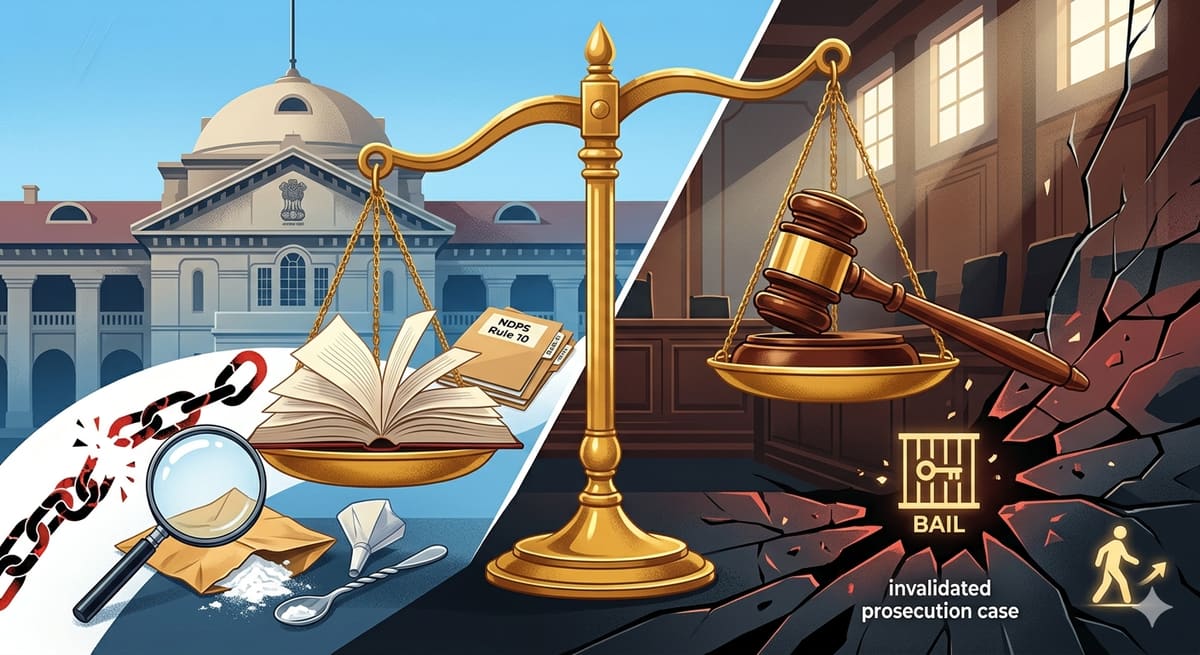
The Allahabad High Court has granted bail in a narcotics case after finding serious procedural lapses in the collection and sampling of seized ganja, underscoring that compliance with statutory safeguards under the NDPS Rules is not optional but essential to the integrity of the prosecution's case. This ruling reinforces the principle that technical violations in evidence handling can materially undermine the state's case at the pre-trial stage.
Background & Facts
The Dispute
The applicant, Adarsh Kumar Tiwari @ Raj, was arrested in connection with Crime No. 215 of 2026 registered at Police Station Kotwali, District Unnao, under Sections 8 and 20 of the Narcotic Drugs and Psychotropic Substances (NDPS) Act. The case arose from a raid at a railway crossing on 12.04.2026, during which the applicant and another individual, Jientra Tiwari @ Jitu, were apprehended while seated in a car. Twenty-five packets of ganja, each weighing two kilograms, were recovered from the vehicle. The packets were allegedly bundled into five groups of four packets each and one group of five packets, sealed in white cloth.
Key Facts
The First Information Report (FIR) was lodged on 12.04.2026 by a Sub Inspector of Police.
The seized material consisted of 25 packets of ganja, totaling 50 kilograms.
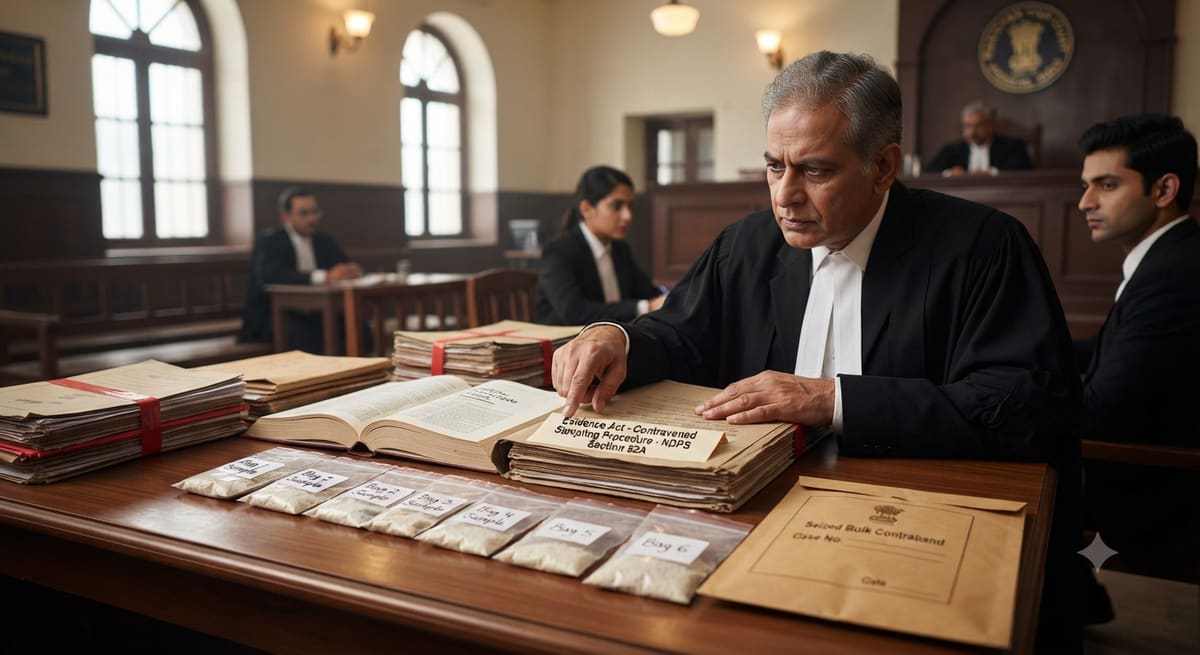
Six samples of ganja were sent for forensic examination, with weights recorded as: 49.5 grams, 497 grams, 49.3 grams, 49.8 grams, 49.9 grams, and 49.3 grams.
The applicant has no prior criminal record.
The applicant has been in judicial custody since 13.04.2026.
The affidavit filed in support of the bail application claims the applicant was falsely implicated.
Procedural History
12.04.2026: FIR registered at Police Station Kotwali, Unnao.
13.04.2026: Applicant arrested and taken into custody.
25.06.2026: Criminal Misc. Bail Application No. 4827 of 2026 filed before the Allahabad High Court, Lucknow Bench.
25.06.2026: Hearing conducted before Hon’ble Shree Prakash Singh, J.
Relief Sought
The applicant sought bail on the grounds of procedural irregularities in the seizure and sampling process, lack of criminal antecedents, and prolonged incarceration without trial. He requested release on personal bond with two sureties, subject to standard bail conditions.
The Legal Issue
The central question was whether material irregularities in the sampling and sealing of seized ganja under Rules 9, 10, and 11 of the Narcotic Drugs and Psychotropic Substances (Seizure, Storage, Sampling and Disposal) Rules, 2022, render the prosecution’s case so defective that bail should be granted despite the seriousness of the offence under the NDPS Act.
Arguments Presented
For the Appellant/Petitioner
Learned counsel for the applicant argued that the prosecution failed to comply with mandatory procedural requirements under the NDPS Rules. Specifically, the samples were not drawn in the presence of a Magistrate as required by Rule 9. Further, Rule 10 mandates that one sample in duplicate be drawn from each package or container, or from lots of not more than forty packets for ganja. With 25 packets recovered, at least 25 samples in duplicate (i.e., 50 samples) should have been prepared. Instead, only six samples were sent for testing, violating the requirement for representative sampling. The counsel contended that such non-compliance casts doubt on the authenticity and integrity of the seized material, thereby weakening the prosecution’s case at the threshold stage.
For the Respondent/State
The Additional Government Advocate opposed bail, acknowledging the sampling irregularities but argued that the substance was confirmed as ganja through forensic analysis. He submitted that the quantity seized was substantial and the offence under Sections 8 and 20 of the NDPS Act is grave, warranting denial of bail. He relied on the principle that serious drug offences are generally not conducive to bail, irrespective of procedural lapses.
The Court's Analysis
The Court undertook a detailed examination of Rules 9, 10, and 11 of the NDPS (Seizure, Storage, Sampling and Disposal) Rules, 2022. It noted that Rule 9 requires samples to be drawn in the presence of a Magistrate, a provision designed to ensure transparency and prevent tampering. The record showed no such presence, rendering the sampling process procedurally defective.
Rule 10(1) mandates that one sample in duplicate be drawn from each package or container. Rule 10(2) permits bundling of up to forty packets of ganja into a single lot for sampling, but only if the packages are identical in size, weight, and marking. Even under this exception, one sample in duplicate must be drawn per lot. With 25 packets recovered, the prosecution could have formed one lot of 25 packets and drawn two samples (one for analysis, one for preservation). Instead, only six samples were drawn, with no explanation for their selection or representativeness.
"The record reveals that although 25 packages are said to have been recovered from the car and as per Rule 10 a total of 50 samples were required to be drawn, merely six samples have been drawn. Samples have not been drawn in presence of the Magistrate."
The Court held that these violations are not mere technicalities but go to the root of evidentiary reliability. The failure to follow statutory procedures raises a legitimate doubt about whether the substance tested was indeed the substance seized. In cases under the NDPS Act, where the identity and quantity of the substance are central to the charge, such irregularities cannot be ignored.
The Court further noted that the applicant has no prior criminal history and has been in custody since 13.04.2026. While the offence is serious, the Court emphasized that bail is not a reward for innocence but a recognition of the presumption of innocence and the right to a fair trial. The procedural defects, combined with the absence of criminal antecedents, tipped the balance in favor of bail.
The Verdict
The bail application was allowed. The applicant, Adarsh Kumar Tiwari @ Raj, was directed to be released on bail upon furnishing a personal bond of Rs. 50,000 and two sureties each in the like amount, subject to the following conditions: (i) he shall not tamper with prosecution evidence; (ii) he shall not pressurize prosecution witnesses; and (iii) he shall appear before the trial court on every date fixed, unless exempted. The order was passed on 25.06.2026.
What This Means For Similar Cases
Procedural Compliance Is Non-Negotiable in NDPS Cases
Practitioners must now insist on strict adherence to Rules 9 - 11 of the NDPS (Seizure, Storage, Sampling and Disposal) Rules, 2022, at every stage of investigation.
Any deviation - such as failure to involve a Magistrate or sampling fewer than required - can be raised as a ground for bail or even discharge.
Forensic reports based on non-compliant samples may be challenged as inadmissible or unreliable.
Bail Cannot Be Denied Solely on Gravity of Offence When Evidence Is Compromised
Courts must weigh procedural integrity alongside the seriousness of the charge.
In NDPS cases, if the chain of custody or sampling is defective, the presumption of guilt weakens, making bail more tenable.
This judgment reinforces Arnesh Kumar v. State of Bihar by affirming that bail should not be denied merely because the offence is serious, especially when the prosecution’s case is undermined by its own procedural failures.
Defence Strategy Must Focus on Sampling Irregularities
Defence counsel should routinely demand production of the seizure memo, sample collection records, and Magistrate’s certification.
Where sampling is inadequate, file applications under Section 439 CrPC seeking bail on grounds of weak evidence.
Use this judgment to challenge the admissibility of forensic reports in trial courts and appellate forums.