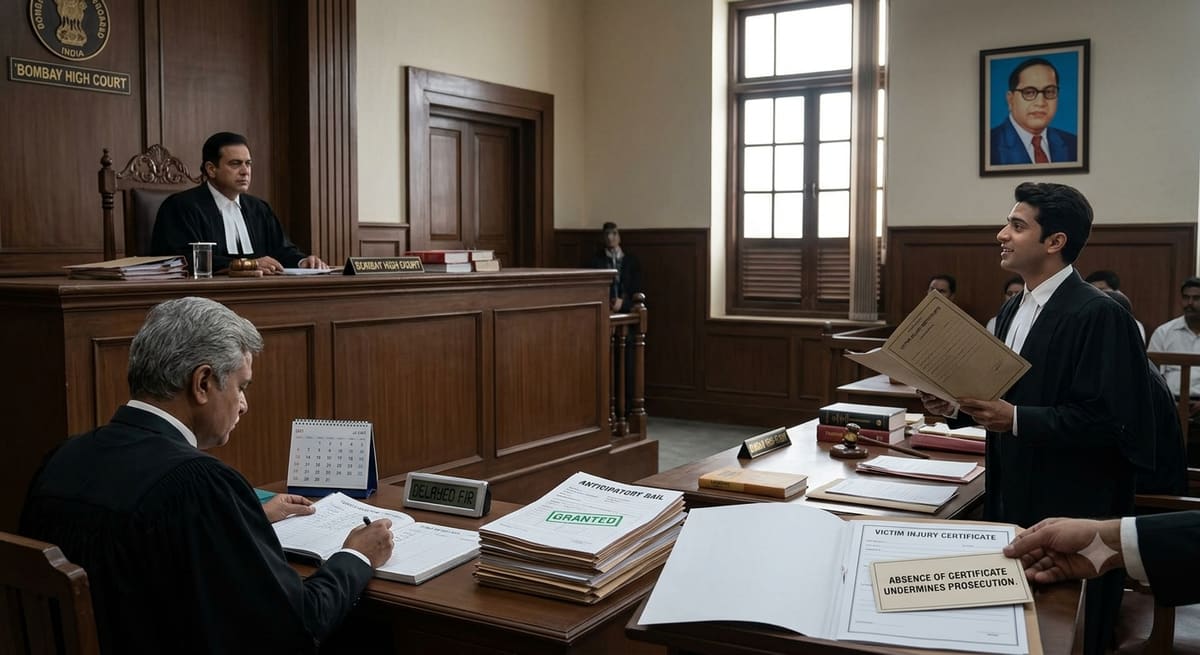
The Chhattisgarh High Court’s grant of anticipatory bail in a case involving allegations of outraging modesty underscores a critical principle: procedural delays and absence of corroborative medical evidence can significantly undermine the credibility of prosecution claims, even in serious offences under the Indian Penal Code. This order reinforces the judiciary’s cautious approach to pre-arrest detention when the foundation of the accusation appears fragile.
Background & Facts
The Dispute
The applicant, Dhananjay Mathur, Sarpanch of Gram Panchayat Pendritalab (N), is accused of outraging the modesty of a female contractual employee, an Aawaas Mitra under PM Aawas Yojna, on 19 January 2026. The prosecutrix alleges that while traveling between Village Tingipur and Junapara, the applicant made unwelcome advances and demanded undue favours. The FIR was registered on 31 January 2026 - twelve days after the alleged incident.
Procedural History
- 19 January 2026: Alleged incident occurred
- 24 January 2026: Applicant filed a complaint against the prosecutrix for alleged corruption and illegal geo-tagging under PM Aawas Yojna
- 31 January 2026: FIR registered under Sections 74 and 75(2) IPC
- February 2026: Anticipatory bail application filed under Section 482 of the Bhartiya Nagarik Suraksha Sanhita, 2023
Relief Sought
The applicant seeks anticipatory bail, arguing that the FIR is retaliatory, the delay is unexplained, and the MLC report shows no physical injuries, indicating the allegation lacks credibility.
The Legal Issue
The central question was whether anticipatory bail can be granted in cases under Sections 74 and 75(2) IPC where there is a significant delay in lodging the FIR and no medical evidence of assault, despite the seriousness of the alleged offence.
Arguments Presented
For the Appellant/Petitioner
Learned counsel argued that the prosecutrix, a major and educated woman, failed to report the incident immediately, despite having access to authorities. The 12-day delay, coupled with the applicant’s prior complaint against her for corruption, suggested mala fide intent. The MLC report confirmed no internal or external injuries, weakening the claim of physical coercion or assault. Reliance was placed on Arnesh Kumar v. State of Bihar to argue that arrest is not automatic even in serious cases, and that the court must examine the prima facie credibility of allegations before permitting detention.
For the Respondent/State
The State contended that the prosecutrix’s statement under Section 183 of the BNS was sufficient to establish a prima facie case. It argued that delay in filing an FIR is not fatal if the explanation is reasonable, and that the nature of the offence - outraging modesty - often involves psychological trauma that may delay reporting. The State further submitted that the gravity of the offence warranted denial of anticipatory bail.
The Court's Analysis
The Court did not evaluate the truth of the allegations but focused on the reliability of the complaint. It noted that the prosecutrix was a mature, educated woman who did not report the incident for twelve days, despite the alleged encounter occurring in daylight on a public route. The absence of any injury in the MLC report was a material circumstance that cast doubt on the veracity of the claim. The Court observed that the timing of the FIR - immediately after the applicant filed a corruption complaint - suggested a retaliatory motive. The Court emphasized that anticipatory bail is not a privilege but a safeguard against arbitrary arrest, particularly where the prosecution’s case rests on uncorroborated testimony and lacks physical or documentary support. The Court distinguished this case from those involving immediate reporting and visible injuries, holding that the combination of delay and absence of injury created reasonable doubt about the motive and credibility of the accusation.
"Considering the facts and circumstances of the case... particularly the fact that the prosecutrix is a major woman aged about 35 years and that there is a delay of 12 days in lodging the FIR, without commenting anything on merit, I am inclined to grant anticipatory bail."
The Verdict
The applicant won. The Chhattisgarh High Court granted anticipatory bail, holding that delay in FIR and absence of medical injury, in the context of a retaliatory complaint, sufficiently undermine the credibility of the prosecution’s case to justify pre-arrest release. The applicant was released on personal bond and surety, subject to strict conditions.
What This Means For Similar Cases
Delay in FIR Can Undermine Prima Facie Case
- Practitioners must now systematically challenge the timing of FIRs in modesty cases, especially where the complainant is educated and has access to legal recourse
- A delay exceeding 7 - 10 days without plausible explanation should be raised as a ground for bail or discharge
- Courts are increasingly treating unexplained delay as a red flag, even in non-bailable offences
Absence of Medical Evidence Is Material
- In cases involving physical contact or assault, MLC reports are no longer ancillary - they are central to credibility assessment
- Absence of injuries, even in non-violent modesty cases, weakens the prosecution’s narrative and supports bail applications
- Defence counsel should routinely seek MLC reports at the earliest stage and highlight them in bail hearings
Retaliatory Allegations Trigger Judicial Scrutiny
- Where a complaint follows a prior grievance filed by the accused, courts will examine whether the FIR is an instrument of revenge
- This creates a new threshold: applicants must now plead and prove a plausible motive for false implication
- Courts may now require the prosecution to explain the temporal proximity between the accused’s complaint and the FIR