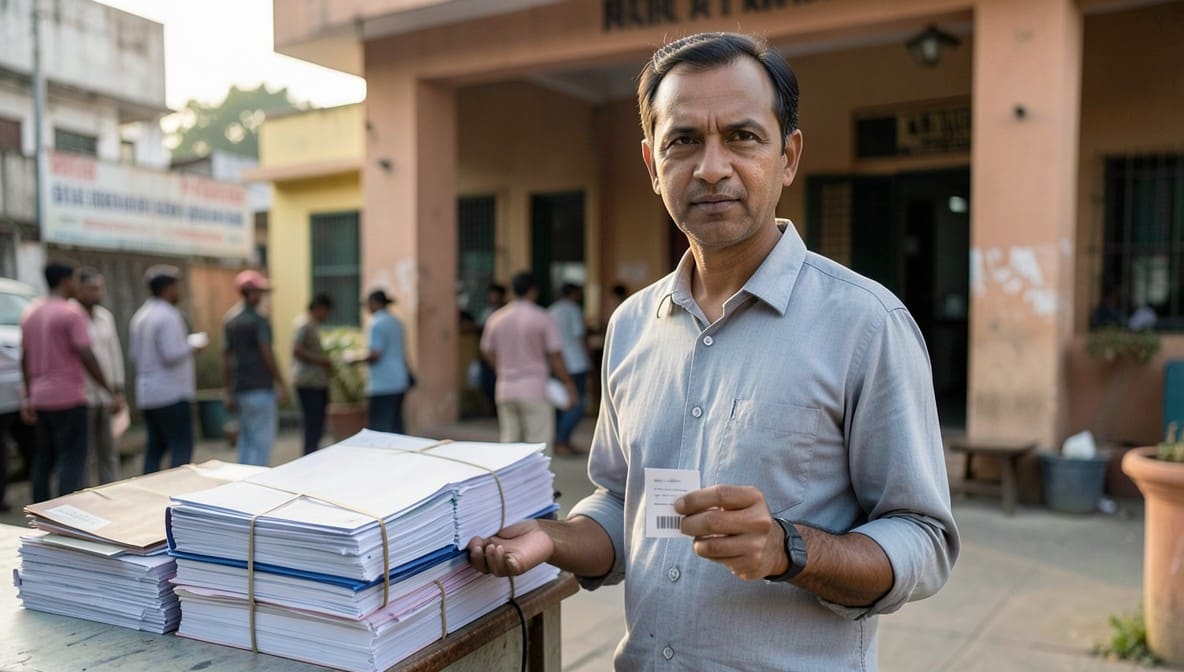
The Allahabad High Court has clarified that an indigent accused granted bail in multiple criminal cases need not furnish separate sureties and bonds for each case. In a significant procedural relief, the Court held that a single personal bond and one surety, when properly executed, can be deemed valid across all pending bail orders, preventing unjust detention due to financial incapacity.
Background & Facts
The Dispute
The applicant, Vinod Kumar Srivastava, was granted bail in seven separate criminal cases arising from alleged offences under Section 409 I.P.C (criminal breach of trust by a public servant or agent), with two cases also involving Section 420 I.P.C (cheating). Despite being granted bail in all seven matters by the trial courts, he remained in custody because he was unable to furnish separate sureties and personal bonds for each case.
Key Facts
- The applicant is a person of limited financial means and cannot afford to provide multiple sureties
- The seven cases are:
- Case Crime No. 574 of 2021, under Section 409 I.P.C., Police Station Akbarpur, Ambedkar Nagar
- Case Crime No. 228 of 2022, under Sections 409/420 I.P.C., Police Station Tanda, Ambedkar Nagar
- Case Crime No. 0171 of 2021, under Section 409 I.P.C., Police Station Bhiti, Ambedkar Nagar
- Case Crime No. 0275 of 2021, under Section 409 I.P.C., Police Station Rajesultanpur, Ambedkar Nagar
- Case Crime No. 0177 of 2021, under Section 409 I.P.C., Police Station Bewana, Ambedkar Nagar
- Case Crime No. 0276 of 2021, under Section 409 I.P.C., Police Station Rajesultanpur, Ambedkar Nagar
- Case Crime No. 90 of 2022, under Section 409 I.P.C., Police Station Kotwali Bikapur, Ayodhya
- All bail orders were passed by the trial courts between 2021 and 2022
- The applicant has been in custody since the bail orders were issued due to inability to comply with duplicate surety requirements
- He submitted representations to the trial courts, which were rejected on technical grounds
Procedural History
- 2021 - 2022: Bail granted in all seven cases by respective trial courts
- 2023 - 2025: Applicant repeatedly sought relief from trial courts to accept single surety across cases; all requests denied
- 2026: Application under Section 482 CrPC filed before the Allahabad High Court, Lucknow Bench
- 12 June 2026: Hearing conducted before Hon’ble Justice Praveen Kumar Giri
Relief Sought
The applicant sought direction to the trial courts to accept a single personal bond and one surety in lieu of seven separate sureties and bonds, arguing that the requirement was oppressive, disproportionate, and violative of Article 21 of the Constitution.
The Legal Issue
Can a court under Section 482 CrPC direct that a single personal bond and one surety, furnished in one case, be treated as valid for all pending bail orders against the same accused, to prevent prolonged detention due to financial hardship?
Arguments Presented
For the Applicant
Learned counsel argued that the requirement to furnish separate sureties in each case, despite identical conditions and the same accused, is arbitrary and violates the principle of proportionality. He relied on the Supreme Court’s order in Hani Nishad @ Mohammad Imran @ Vikky v. State of Uttar Pradesh (SLP(Crl.) No. 8914-8915/2018), where the apex court permitted a single surety and personal bond to operate across multiple cases. He emphasized that the applicant’s continued incarceration is not due to flight risk or tampering with evidence, but purely due to indigence, which cannot be a ground for denying liberty.
For the Respondent
The State did not oppose the prayer in substance. The Additional Government Advocate acknowledged the applicant’s financial condition and the precedent set by the Supreme Court. The State did not contest the legal proposition but deferred to the Court’s discretion.
The Court's Analysis
The Court examined the nature of bail under Section 439 CrPC and the scope of inherent powers under Section 482 CrPC. It noted that bail is not a matter of right but a mechanism to ensure presence during trial without unnecessary deprivation of liberty. The Court observed that requiring multiple sureties in identical circumstances, where the accused is the same and the offences are of similar nature, serves no legitimate purpose other than imposing an undue financial burden.
"The requirement of separate sureties in each case, where the accused is the same and the conditions of bail are substantially identical, amounts to a procedural formality that defeats the very object of bail - to secure the presence of the accused without subjecting him to prolonged incarceration due to economic incapacity."
The Court distinguished between the purpose of surety - which is to ensure appearance and prevent flight - and the mechanical multiplication of sureties across cases. It held that if one surety and personal bond are sufficient to guarantee compliance in one case, they are equally sufficient in others, provided the accused is not a repeat offender or a flight risk.
The Court also relied on Bacchi Devi v. State of U.P. (2025 SCC OnLine All 5286), where a similar relaxation was granted in multiple bail cases, affirming that courts must exercise their inherent powers to prevent abuse of process and ensure justice.
The Verdict
The applicant succeeded. The Court directed that the applicant shall furnish a personal bond of Rs. 50,000 and one surety of the like amount in one case, and such bond and surety shall be deemed valid and operative in all seven pending bail cases. The trial courts are directed to accept this single surety arrangement and release the applicant forthwith. The applicant shall be released within 48 hours of compliance.
What This Means For Similar Cases
Single Surety Can Cover Multiple Bail Orders
- Practitioners representing indigent accused in multiple bail cases may now file applications under Section 482 CrPC seeking consolidation of surety requirements
- Courts must evaluate whether the surety condition serves a substantive purpose or is merely procedural overreach
- The burden shifts to the prosecution to demonstrate why separate sureties are necessary - mere multiplicity of cases is insufficient
Financial Hardship Is a Legitimate Ground for Relief
- Continued detention due to inability to pay duplicate sureties violates Article 21
- Courts must consider economic status as part of the bail assessment, not as a barrier to liberty
- This precedent applies equally to cases under Section 409 I.P.C., Section 420 I.P.C., and other non-violent economic offences
Procedural Flexibility Under Section 482 CrPC
- Section 482 CrPC empowers High Courts to prevent abuse of process and secure ends of justice
- This judgment reinforces that procedural rigidity cannot override substantive justice
- Similar applications may now be filed across India, citing this judgment as binding precedent within the Allahabad jurisdiction and persuasive elsewhere