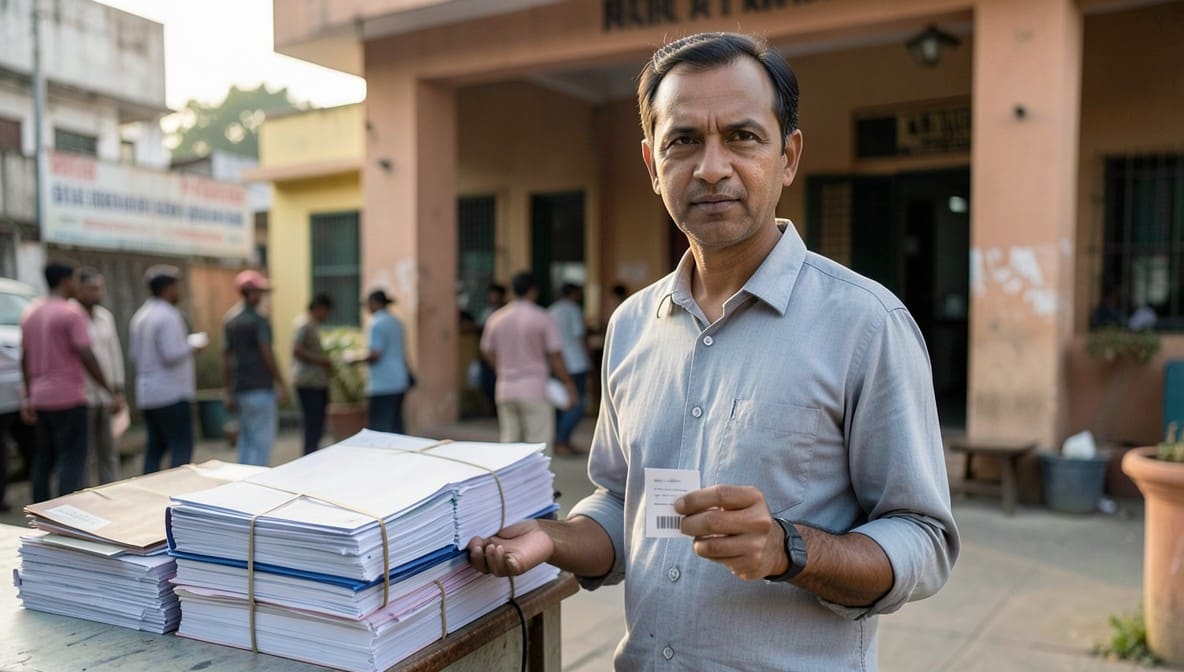
The Allahabad High Court has established a critical procedural safeguard for indigent accused facing multiple criminal cases: a single personal bond and two sureties, furnished in one case, may be accepted as valid across all pending bail-granted matters. This ruling prevents the disproportionate burden of duplicate sureties, which effectively amounts to de facto detention despite judicial release.
Background & Facts
The Dispute
The applicant, Madan Nag, was granted bail in twelve separate criminal cases but remained in judicial custody because the trial court insisted on separate sureties and personal bonds for each case. Despite being released on bail in each matter, the applicant could not comply with the cumulative surety requirements due to financial hardship, rendering the bail orders practically unenforceable.
Key Facts
- The applicant was granted bail in twelve cases registered across Police Stations Kotwali Nagar and Safdarganj, District Barabanki
- The cases involve charges under Sections 419, 420, 467, 468, 471, 120B, 406, 504, 506, 34, and 3(1) of the U.P. Gangster Act and SC/ST Act
- The twelve cases are:
- Crime No. 927/2022 (IPC 419, 420, 467, 468, 471, 120B)
- Crime No. 932/2022 (IPC 419, 420, 467, 468, 471, 120B)
- Crime No. 933/2022 (IPC 419, 420, 467, 468, 471, 120B)
- Crime No. 988/2022 (IPC 406, 419, 420, 467, 468, 471, 506)
- Crime No. 931/2022 (IPC 419, 420, 467, 468, 471, 120B)
- Crime No. 415/2023 (IPC 419, 420, 467, 468, 471, 120B, 406)
- Crime No. 1098/2022 (IPC 419, 420, 467, 468, 471, 504, 506)
- Crime No. 1256/2022 (IPC 419, 420, 467, 468, 471)
- Crime No. 429/2022 (IPC 419, 420, 467, 468, 471)
- Crime No. 502/2022 (IPC 34, 419, 420, 467, 468, 471)
- Crime No. 851/2023 (U.P. Gangster Act, Section 3(1))
- Crime No. 262/2022 (IPC 419, 420, 467, 468, 471, 504, 506; SC/ST Act, Section 3(1), 3(2))
- The applicant is described as a poor person unable to arrange separate sureties for each case
- The trial court refused to accept a consolidated surety arrangement despite bail being granted in all matters
Procedural History
- 2022-2023: Bail granted in all twelve cases by the trial court
- 2026: Applicant filed Application U/s 482 CrPC before the Allahabad High Court, Lucknow Bench
- 30.04.2026: Hearing conducted before Hon’ble Shree Prakash Singh, J.
Relief Sought
The applicant sought direction to the trial court to accept a single personal bond and two sureties in lieu of twelve separate surety arrangements, arguing that the requirement was oppressive and rendered bail illusory.
The Legal Issue
Can a court insist on separate sureties and personal bonds for each bail order when an accused faces multiple cases arising from similar facts, and does such insistence violate the principle of proportionality under Article 21 of the Constitution?
Arguments Presented
For the Appellant/Petitioner
The applicant’s counsel argued that requiring twelve separate surety arrangements for twelve bail orders, all stemming from related transactions and the same accused, amounted to a de facto denial of bail. He relied on Hani Nishad @ Mohammad Imran @ Vikky v. State of Uttar Pradesh (SLP(Crl.) No. 8914-8915/2018), where the Supreme Court permitted a single personal bond and two sureties to operate across multiple cases. He emphasized that the applicant’s indigence rendered compliance impossible, and the trial court’s insistence was arbitrary and violative of the right to liberty.
For the Respondent/State
The State did not oppose the relief sought. The Additional Government Advocate conceded that the applicant’s financial condition and the multiplicity of cases warranted a pragmatic solution, and did not contest the applicability of the Supreme Court’s precedent in Hani Nishad.
The Court's Analysis
The Court observed that the purpose of bail is to secure the accused’s presence during trial without subjecting them to unnecessary detention. Requiring twelve separate sureties for twelve bail orders, where the accused is the same and the charges are factually interconnected, defeats the very object of bail. The Court noted that the Supreme Court in Hani Nishad had already recognized this practical reality, holding that a single bond and two sureties could be accepted across multiple cases to prevent the abuse of procedural requirements.
"The requirement of separate sureties in each case, when the accused is the same and the bail has already been granted, operates as a disguised form of detention, especially when the accused is indigent."
The Court further held that such a requirement lacks statutory basis under Section 436 or 437 CrPC, which govern bail conditions. While courts may impose conditions, they must be reasonable and proportionate. Imposing twelve sets of sureties for twelve related cases is neither reasonable nor proportionate. The Court emphasized that the principle of audi alteram partem and the right to liberty under Article 21 demand a balanced approach.
The Court also rejected the notion that each case must be treated in isolation when the accused’s financial capacity and the factual nexus between cases are identical. The trial court’s insistence was found to be mechanical and contrary to judicial discretion under Section 482 CrPC, which empowers the High Court to prevent abuse of process.
The Verdict
The applicant succeeded. The Court directed that the applicant shall furnish a personal bond of Rs. 1,00,000 and two sureties of the like amount in one case, and such bond and sureties shall be deemed valid and operative in all twelve pending cases where bail has been granted. The trial court is directed to accept this consolidated arrangement forthwith and release the applicant from custody without delay.
What This Means For Similar Cases
Surety Requirements Must Be Proportionate
- Practitioners may now argue that multiple bail orders arising from interconnected offences do not justify cumulative surety burdens
- Courts must assess financial capacity and factual nexus before imposing duplicate sureties
- A single bond and two sureties may be submitted across multiple cases if the accused is the same and the offences are factually related
Indigence Cannot Be a Ground for De Facto Detention
- The Court’s reasoning reinforces that poverty cannot be used to negate judicial bail orders
- Courts must consider economic reality when imposing bail conditions
- Failure to accommodate indigent accused may constitute a violation of Article 21
Precedent from Supreme Court Is Binding at High Court Level
- Hani Nishad is now binding precedent for all courts in Uttar Pradesh
- Trial courts must follow the Supreme Court’s directive on consolidated sureties
- Applications under Section 482 CrPC are viable remedies when trial courts impose unreasonable surety conditions