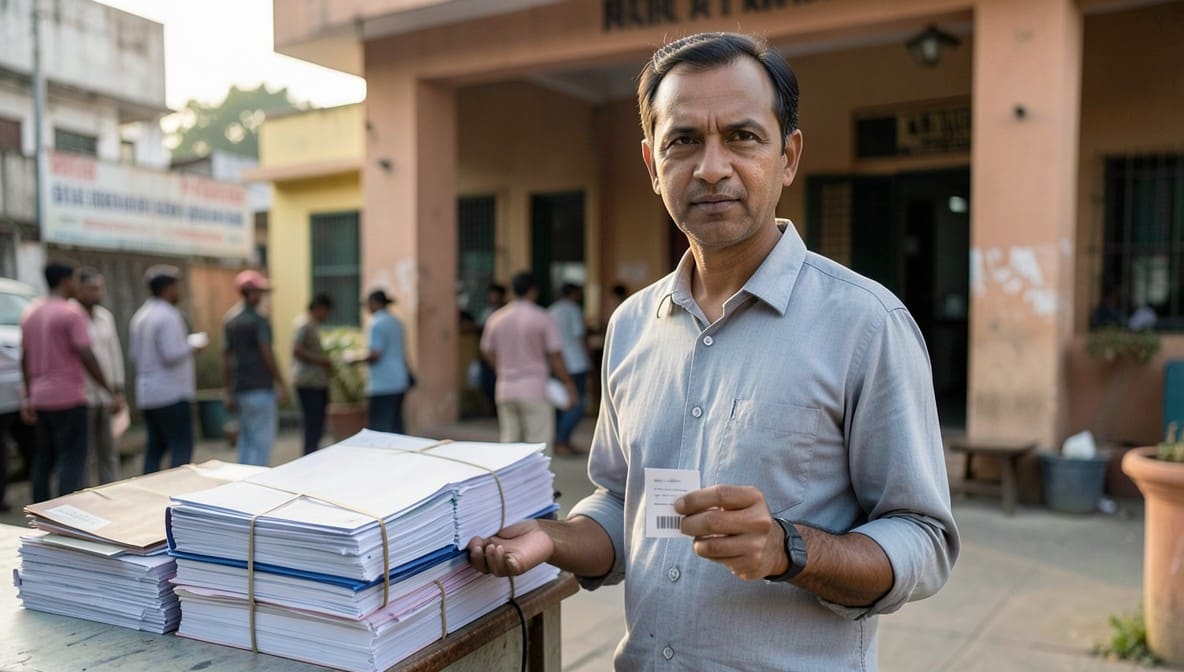
The Rajasthan High Court has clarified that financial indigence cannot be a barrier to bail, holding that imposing surety requirements on impoverished accused violates the principle of equitable access to liberty. In a significant procedural ruling, the Court waived the condition of two sureties for a petitioner unable to furnish them, reinforcing that bail is a right, not a privilege contingent on economic status.
Background & Facts
The Dispute
The petitioner, Lemba S/o Haruk, aged about 30 years, resident of Baawdi Dooda, PS Anand Puri, District Banswara, Rajasthan, was arrested in connection with a criminal case. He filed a bail application before the High Court, which was granted on 01.08.2025 subject to two conditions: furnishing a personal bond of Rs. 50,000 and two sureties of Rs. 25,000 each. Despite the grant of bail, the petitioner remained in custody because he could not arrange the required sureties.
Key Facts
The petitioner is a daily wage laborer with no regular income
Revenue records show no agricultural land held in his name
He resides in a rural area with limited economic opportunities
The petitioner submitted documents from the Patwari and Gram Panchayat Administrator dated 15.07.2026, attesting to his indigent status
The State, through the SHO of PS Anand Puri, submitted a report dated 22.12.2025 confirming the petitioner’s poor financial condition
The petitioner has been in judicial custody since arrest, with no trial or charge sheet details disclosed in the order
Procedural History
Date of arrest: Not specified in judgment
01.08.2025: High Court granted bail subject to personal bond of Rs. 50,000 and two sureties of Rs. 25,000 each
15.07.2026: Petitioner filed Criminal Miscellaneous Application No. 330/2026 seeking waiver of surety condition
15.07.2026: Documents from Patwari and Gram Panchayat Administrator uploaded to court record
15.07.2026: Judgment delivered by Justice Mukesh Rajpurohit
Relief Sought
The petitioner sought waiver of the requirement to furnish two sureties, requesting release on personal bond of Rs. 50,000 alone, citing inability to arrange sureties due to extreme poverty.
The Legal Issue
The central question was whether a court may waive the condition of furnishing sureties in a bail order when the accused establishes indigence, without compromising public interest or flight risk.
Arguments Presented
For the Petitioner
Learned counsel argued that the surety condition was practically impossible for the petitioner to fulfill, rendering the bail order illusory. He relied on the principle that bail is a rule and jail an exception, and that financial hardship must not be used to deny liberty. He submitted official documents from local revenue authorities confirming the petitioner’s destitute status.
For the Respondent
The Public Prosecutor opposed the waiver but submitted a report from the SHO dated 22.12.2025 corroborating the petitioner’s impoverished condition. While opposing the prayer formally, the State did not contest the factual assertion of indigence.
The Court's Analysis
The Court observed that the purpose of sureties is to ensure appearance before court and compliance with bail conditions, not to impose economic barriers. The Court noted that the petitioner had already furnished a personal bond of Rs. 50,000, which itself serves as a financial deterrent against absconding. The Court emphasized that the State’s own report confirmed the petitioner’s financial incapacity, making the surety condition arbitrary and discriminatory.
"The condition of furnishing two sureties, while intended to ensure compliance, becomes oppressive and contrary to the spirit of bail when imposed on an indigent accused who has already offered a personal bond."
The Court held that the requirement of sureties is discretionary and not mandatory under Section 437 and Section 439 of the CrPC. Where the accused demonstrates genuine inability to arrange sureties, and where the personal bond is sufficient to secure appearance, the court must exercise its discretion in favor of liberty. The Court further noted that the petitioner’s continued detention despite the grant of bail amounted to a de facto denial of liberty, which is constitutionally impermissible under Article 21.
The Verdict
The petitioner succeeded. The Court allowed the application and waived the condition of furnishing two sureties. The petitioner was ordered released on bail on furnishing a personal bond of Rs. 50,000 only. All other conditions imposed in the order dated 01.08.2025 remain unchanged. The order was declared part and parcel of the earlier bail order. The petitioner was directed to be released forthwith upon compliance with the personal bond.
What This Means For Similar Cases
Surety Requirements Must Be Proportionate
Practitioners must now argue that surety conditions are not automatic and must be tailored to the accused’s economic reality
Courts cannot impose surety requirements that effectively negate bail for indigent accused
A personal bond alone may suffice if the accused’s financial status is verified by official documentation
Documentation of Indigence Is Critical
Petitioners must submit certified reports from Patwari, Gram Panchayat, or municipal authorities to substantiate claims of poverty
State agencies’ own reports confirming indigence can be used to neutralize opposition
Courts are now bound to consider such evidence as conclusive unless contradicted by credible contrary proof
Bail Is Not Conditional on Wealth
The judgment reinforces that Article 21 guarantees liberty irrespective of economic status
Financial hardship cannot be used as a proxy for flight risk or danger to society
This ruling applies equally to bailable and non-bailable offenses where bail is granted under Section 439 CrPC