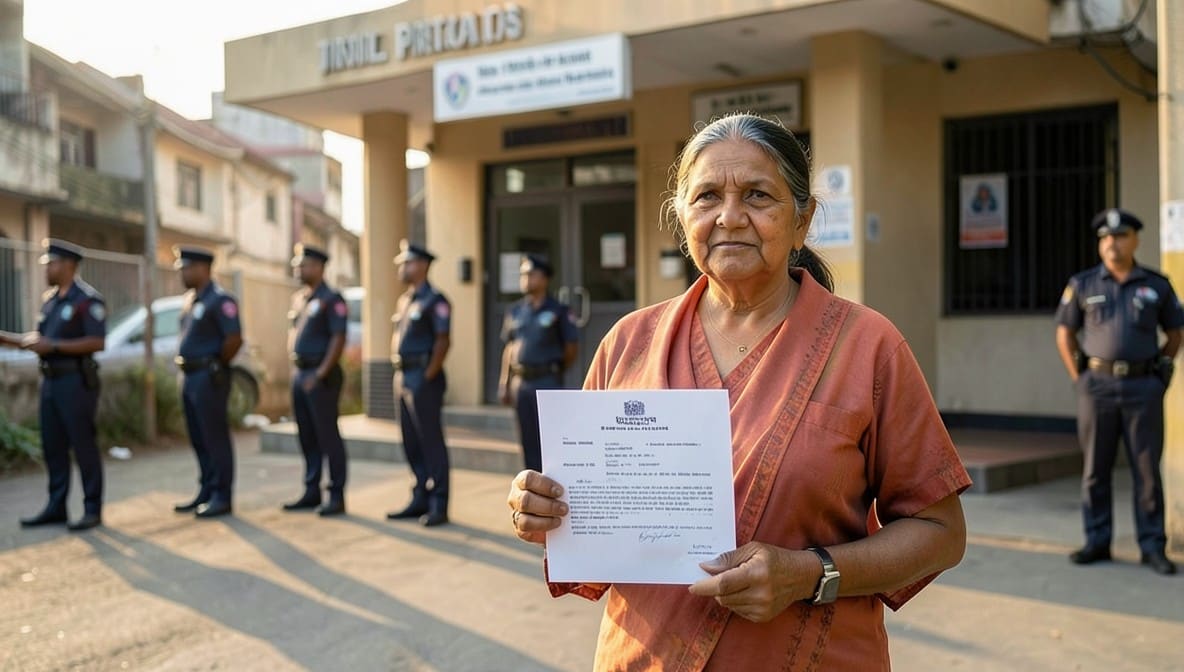
The Karnataka High Court has affirmed that anticipatory bail may be granted to women accused of non-capital offences under the Bharatiya Nyaya Sanhita, 2023, where allegations are limited and do not indicate common intention for serious harm. This order reinforces the principle that pre-arrest liberty must be balanced against procedural fairness and gender-sensitive considerations.
Background & Facts
The Dispute
The petitioner, Devamma, wife of Hanamanth Itagi, aged approximately 55 years, is accused in Crime No. 95/2026 registered on 20.04.2026 at Shahapur Police Station, Yadgiri District, under Sections 115(2), 84, 109, 352, 351(2) read with Section 3(5) of the Bharatiya Nyaya Sanhita, 2023 (BNS, 2023). The complaint alleges that the petitioner pulled the victim by holding her hair, slapped her on the cheek, and dragged her. The primary act of violence - stabbing the victim on the left abdomen - is attributed to another individual, Devraj. No allegation of common intention or participation by the petitioner in the stabbing is made.
Key Facts
- The petitioner is a woman aged about 55 years, with no prior criminal record.
- The alleged acts against her are confined to pulling hair, slapping, and dragging - acts falling under Section 351(2) and 352 of BNS, 2023, punishable with imprisonment up to three years.
- The offence of stabbing under Section 115(2) is attributed solely to Devraj.
- The complaint does not establish any conspiracy, common intention, or active participation by the petitioner in the stabbing.
- Crime No. 95/2026 was registered on 20.04.2026; investigation is ongoing.
- The petitioner has not been arrested as of the date of the order.
Procedural History
- 20.04.2026: Crime No. 95/2026 registered at Shahapur Police Station, Yadgiri.
- 05.05.2026: Criminal Petition No. 200628 of 2026 filed before the Karnataka High Court, Kalaburagi Bench, seeking anticipatory bail under Section 482 of BNSS, 2023 read with Section 438 of CrPC.
- 05.05.2026: Hearing conducted before Justice T.M. Nadaf.
The Parties' Positions
For the Petitioner
Sri Basavaraj C. Jaka, Advocate, submitted that:
- The petitioner is a woman with no history of violence.
- The allegations against her are minor and do not involve the grave offence of stabbing.
- There is no evidence of common intention between the petitioner and Devraj.
- The petitioner has no motive to flee or tamper with evidence.
- Granting anticipatory bail is warranted under the principles of personal liberty and gender sensitivity.
- The petitioner seeks protection from arbitrary arrest and incarceration.
For the Respondent
Sri Jamadar Shahabuddin, High Court Government Pleader, opposed the bail plea on the grounds that:
- The investigation is still in progress.
- Granting anticipatory bail may enable the petitioner to influence witnesses or obstruct the investigation.
- The seriousness of the overall case, even if the petitioner’s role is limited, warrants denial of pre-arrest liberty.
Relief Sought
The petitioner seeks anticipatory bail in the event of her arrest in Crime No. 95/2026, with conditions to ensure cooperation with the investigation and prevent interference.
The Legal Issue
The central question was whether anticipatory bail under Section 482 of BNSS, 2023 can be granted to a woman accused of minor physical assault, where the most serious offence is attributed to another accused and no common intention is established.
Arguments Presented
For the Petitioner
The petitioner’s counsel relied on the principle that personal liberty under Article 21 is the rule and incarceration the exception. He cited Arnesh Kumar v. State of Bihar to argue that arrest must not be automatic, especially for non-heinous offences. He emphasized that the petitioner’s alleged acts - pulling hair and slapping - are not punishable with life imprisonment or death, and that the absence of common intention negates liability for the stabbing. He further argued that the petitioner’s age, gender, and lack of criminal antecedents make her a low flight risk.
For the Respondent
The State contended that the nature of the offence, even if partially attributed, warrants caution. It argued that the investigation is at a critical stage and that granting anticipatory bail may lead to witness tampering. The State did not dispute the factual limitations of the petitioner’s role but insisted on the need for judicial restraint until the investigation concludes.
The Court's Analysis
The Court examined the nature of the allegations against the petitioner and distinguished them from the more serious offence committed by the co-accused. It noted that the complaint does not allege any conspiracy, joint action, or shared intent between the petitioner and Devraj. The Court observed that the petitioner’s conduct, as described, falls within the ambit of simple assault under Section 351(2) and Section 352 of BNS, 2023, which are non-bailable but not life-or-death offences.
"The allegations found against the petitioner is that she pulled the victim by holding her hair and slapped on her cheek and dragged the victim, except this there are no other allegations, which would attract the major offence."
The Court further noted that Section 437 of CrPC and Section 480 of BNSS, 2023 provide for liberal bail considerations for women, especially where the offence is not of the gravest nature. It held that the apprehension of witness tampering, while valid in principle, could be mitigated through specific, enforceable conditions.
The Court emphasized that anticipatory bail is not a denial of justice but a safeguard against arbitrary detention, particularly when the accused is a woman with no prior record and the allegations are factually circumscribed. It declined to prejudge the merits of the case but found sufficient grounds to grant pre-arrest liberty subject to stringent conditions.
The Verdict
The petition was allowed. The petitioner is granted anticipatory bail in the event of her arrest in Crime No. 95/2026. She shall execute a personal bond of Rs. 25,000 with one surety of like amount, appear before the Investigating Officer within 15 days, mark attendance every alternative Sunday from 11.00 a.m. to 2.00 p.m., and file a regular bail application within 15 days of release. She shall not tamper with witnesses, leave the jurisdiction without permission, or commit similar offences. Violation of any condition shall render her liable for cancellation of bail.
What This Means For Similar Cases
Gender and Limited Allegations Can Justify Anticipatory Bail
- Practitioners may now argue that gender and the non-grave nature of alleged acts are sufficient grounds for anticipatory bail under BNSS, 2023, even where co-accused face serious charges.
- Where the accused’s role is clearly separable from the gravest offence, courts must not conflate liability.
Conditions Can Mitigate Investigative Risks
- Courts may impose targeted conditions - such as weekly attendance, no contact with witnesses, and mandatory court appearances - to address concerns of interference without denying liberty.
- The burden to prove risk of tampering must be specific, not speculative.
BNSS 2023 Does Not Curtail Pre-Arrest Liberty
- The transition from CrPC to BNSS does not alter the foundational principle that bail is the rule, jail the exception.
- Section 482 of BNSS, 2023, preserves the spirit of Section 438 CrPC, and courts must interpret it liberally in favor of personal liberty.