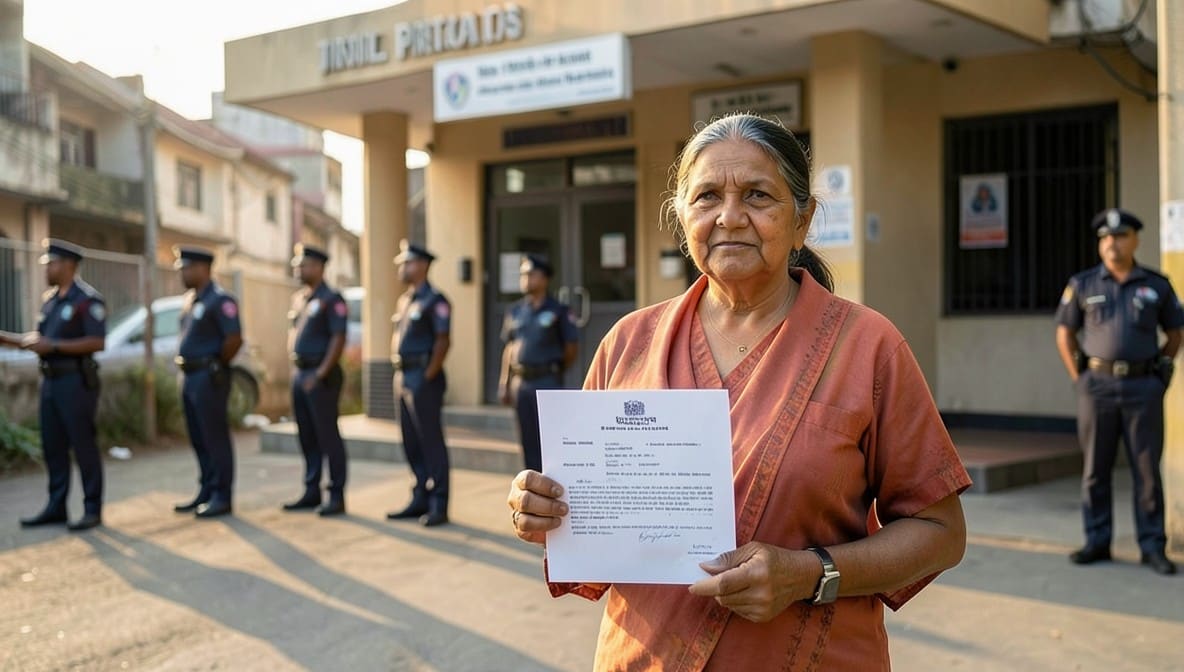
In a significant ruling under the Bhartiya Nyaya Sanhita, 2023 (BNSS), the Bombay High Court has underscored that even in cases involving grave offences, a woman accused may be entitled to bail if the investigation is complete and parity with co-accused is established. The judgment reaffirms the discretionary power of courts under Section 480 of the BNSS (corresponding to Section 437(1) of the CrPC) to grant bail to women, balancing the gravity of the offence with the principles of justice and parity.
Background & Facts
The Dispute
The applicant, Bharti Ravindra Dube, was accused in Crime No. 720 of 2025 registered at Shevgaon Police Station, District Ahilyanagar, for offences under Sections 103(1), 3(5), and 238 of the Bhartiya Nyaya Sanhita, 2023. The case pertains to the alleged murder of the deceased, Sachin, with whom the applicant had a physical relationship. The prosecution alleged that frequent disputes arose due to the applicant’s relationships with other individuals, leading to the murder and subsequent destruction of evidence.
Key Facts
- The FIR was registered on 17.08.2025, and the applicant was arrested on 18.08.2025.
- The chargesheet was filed on 15.11.2025, marking the completion of the investigation.
- The prosecution’s case relied on circumstantial evidence, including the "last seen together" theory and the applicant’s alleged involvement in pointing out the crime scene.
- The applicant contended that no incriminating material was recovered from her possession, and the allegations failed to establish a prima facie case.
- Co-accused No. 3, Afroz Khan, had already been granted bail by the Sessions Court, forming the basis for the applicant’s plea of parity.
Procedural History
- 17.08.2025: FIR registered under Sections 103(1), 3(5), and 238 of the BNSS.
- 18.08.2025: Applicant arrested.
- 15.11.2025: Chargesheet filed.
- 2026: Bail Application No. 394 of 2026 filed before the Bombay High Court, Aurangabad Bench.
- 11.06.2026: Bail application allowed.
Relief Sought
The applicant sought regular bail on the grounds that:
- The allegations failed to establish a prima facie case against her.
- The investigation was complete, and no risk of tampering with evidence existed.
- Parity with co-accused No. 3, who had been granted bail, warranted similar relief.
- Further incarceration as an under-trial prisoner was unwarranted given the prolonged trial timeline.
The Legal Issue
The central question was whether a woman accused of grave offences under the Bhartiya Nyaya Sanhita, 2023, including murder, could be granted bail under Section 480 of the BNSS (corresponding to Section 437(1) of the CrPC), particularly when the investigation was complete and parity with co-accused had been established.
Arguments Presented
For the Applicant
- The allegations in the FIR failed to establish a prima facie case against the applicant.
- No incriminating material was recovered from her possession.
- The investigation was complete, and the chargesheet had been filed, reducing the risk of evidence tampering.
- Co-accused No. 3, Afroz Khan, had already been granted bail by the Sessions Court, entitling the applicant to similar relief on the principle of parity.
- Further incarceration was unwarranted as the trial was unlikely to conclude within a reasonable period.
For the Respondent/State
- The prosecution had collected overwhelming incriminating material, including the applicant being last seen with the deceased and her subsequent involvement in pointing out the crime scene.
- The gravity of the offence and the active role attributed to the applicant disentitled her to bail.
The Court's Analysis
The Court undertook a detailed examination of the principles governing bail under Section 480 of the BNSS, which mirrors Section 437(1) of the CrPC. The provision grants courts the discretion to admit women to bail even in cases involving offences punishable by death or life imprisonment, recognizing their unique social and domestic circumstances.
"The prosecution's case rests predominantly on circumstantial evidence and the theory of last seen together. Pertinently, prima facie, in absence of chain of seamless incriminating material as against the applicant, as such, request of admitting the applicant to bail deserves consideration."
The Court observed that the "last seen together" circumstance and the applicant’s alleged involvement in pointing out the crime scene were matters of circumstantial evidence that required strict scrutiny during the trial. It emphasized that the absence of a seamless chain of incriminating material against the applicant warranted consideration of her bail plea.
Further, the Court relied on the principle of parity, noting that co-accused No. 3, who faced similar allegations, had already been granted bail by the Sessions Court. This principle mandated that the applicant be treated similarly, absent any distinguishing factors.
The Court also highlighted the completion of the investigation and the filing of the chargesheet as critical factors reducing the risk of evidence tampering. It noted that the applicant, being a woman with no criminal antecedents and having been in custody for a sufficient period, merited bail. The apprehension of witness tampering could be adequately addressed through stringent bail conditions.
The Verdict
The Bombay High Court allowed the bail application, directing the release of the applicant, Bharti Ravindra Dube, on furnishing a personal recognizance bond of Rs. 50,000 with one or two local solvent sureties of the like amount. The Court imposed the following conditions:
- The applicant shall not pressurize prosecution witnesses or tamper with evidence.
- The applicant shall attend the trial on each date unless exempted by the trial Court and shall not leave the jurisdiction of the concerned Police Station until the conclusion of the trial.
- The applicant shall submit her Aadhar and PAN cards to the Investigating Officer, along with her detailed address, phone numbers, and those of two near relatives.
- Breach of any condition would entitle the prosecution to seek cancellation of bail.
The Court clarified that its observations were limited to the bail application and would not influence the trial Court’s findings.
What This Means For Similar Cases
Discretion Under Section 480 BNSS: A Balancing Act
- Courts must balance the gravity of the offence with the unique social and domestic position of women accused. Even in cases involving offences punishable by death or life imprisonment, Section 480 of the BNSS empowers courts to grant bail to women, provided the investigation is complete and no risk of evidence tampering exists.
- Practitioners should emphasize the completion of investigation and the filing of the chargesheet as critical factors reducing the justification for continued incarceration.
Parity Principle: A Non-Negotiable Consideration
- The principle of parity mandates that co-accused facing similar allegations be treated equally. If one co-accused has been granted bail, others are entitled to the same relief unless distinguishing factors exist.
- Courts are likely to scrutinize the seamlessness of the evidence chain against the applicant. Gaps in circumstantial evidence, such as the "last seen together" theory, may weaken the prosecution’s opposition to bail.
Circumstantial Evidence: A Double-Edged Sword
- While circumstantial evidence can be compelling, it must form an unbroken chain to sustain opposition to bail. Courts are inclined to grant bail where the evidence is prima facie insufficient to establish guilt.
- The theory of last seen together and pointing out the crime scene are matters for trial and do not, by themselves, justify denial of bail if the investigation is complete and no further evidence is likely to emerge.
Conditions of Bail: Ensuring Compliance
- Courts are increasingly imposing stringent conditions to address concerns of witness tampering or absconding. These may include:
- Submission of identity documents (Aadhar, PAN cards).
- Restrictions on travel outside the jurisdiction.
- Regular attendance at trial.
- Practitioners should be prepared to argue for proportionate conditions that do not unduly restrict the applicant’s liberty while addressing the prosecution’s concerns.