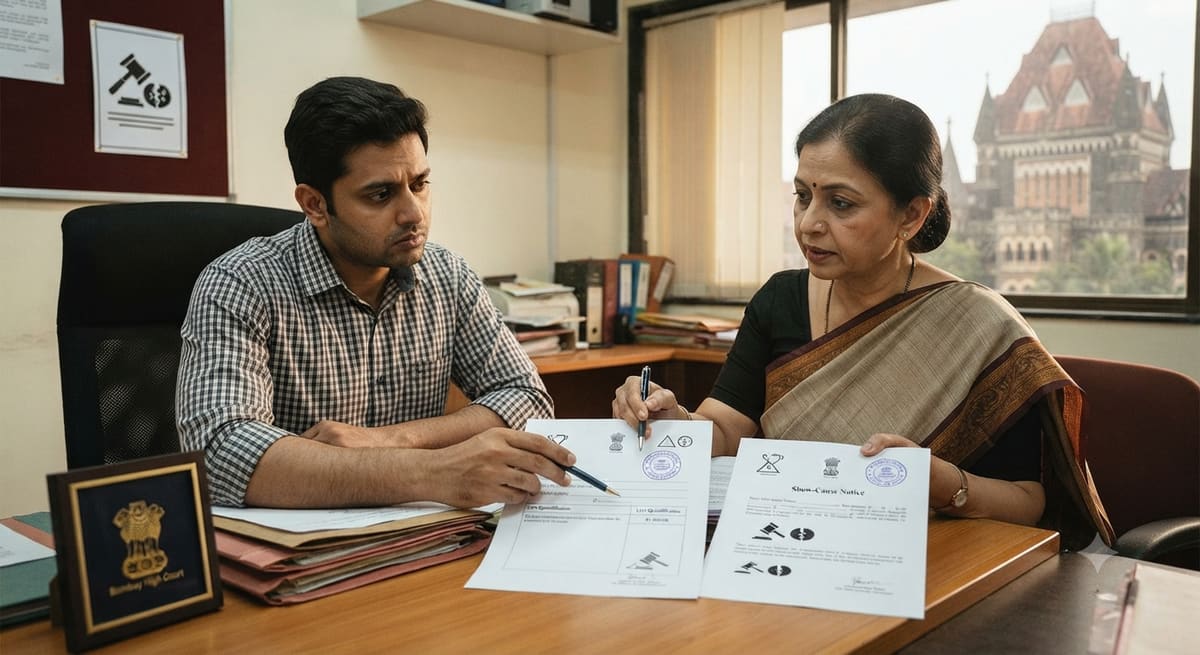
The Calcutta High Court has clarified that an employer may forfeit gratuity under the Payment of Gratuity Act, 1972 based on proven misconduct in a departmental proceeding, even in the absence of a criminal conviction. This ruling reinforces the independence of service discipline from criminal proceedings and affirms that statutory forfeiture mechanisms are triggered by internal findings of gross negligence, not judicial outcomes.
Background & Facts
The Dispute
The Institution of Engineers (India) (IEI), a statutory body established under Royal Charter in 1935, suffered a financial fraud amounting to approximately Rs. 35 Crores between 2019 and 2020. The respondent, Respondent No. 6, was serving as Director (Finance) at the time. The fraud involved the issuance of forged Fixed Deposit (FD) certificates by a branch manager of Allahabad Bank (now Indian Bank), Bowbazar Branch, who conspired to siphon funds through fraudulent RTGS transactions. IEI’s funds were transferred to unauthorized accounts under fictitious entities, despite no formal bank account being opened in IEI’s name.
Key Facts
- The fraud was detected in October 2020, leading to a complaint filed with Muchipara Police Station on 31.10.2020.
- FIR No. 205/2020 was registered on 02.11.2020 under Sections 120B, 420, 467, 471, and 409 IPC.
- Respondent No. 6 was named as an accused in the FIR due to alleged negligence in authorizing FD investments without verifying bank account details.
- A Departmental Enquiry Committee was constituted on 03.12.2020.
- Respondent No. 6 was placed under suspension on 31.12.2020.
- A Charge Sheet dated 24.02.2021 was issued, alleging gross negligence under Clauses 5(i), 5(xi), and 5(xxxiii) of Appendix IV of IEI’s Service Rules.
- The Enquiry Committee submitted its report on 22.04.2021, upholding the charges.
- On 29.04.2021, Respondent No. 6 was dismissed from service for major misdemeanours.
- The dismissal order explicitly cited a quantified loss of Rs. 35 Crores due to his failure to open a proper bank account and verify transaction authenticity.
- On 08.03.2022, IEI formally rejected Respondent No. 6’s claim for gratuity, citing Clause 3 of Appendix III of the Service Rules.
- Respondent No. 6 filed Form N on 18.10.2022 seeking gratuity.
- The Controlling Authority, by order dated 30.12.2023, directed payment of Rs. 9,98,662/-, holding that IEI failed to follow Form-M procedures under Rule 8 of the Payment of Gratuity (Central) Rules, 1972.
- The Appellate Authority (Deputy Chief Labour Commissioner), by order dated 28.04.2025, upheld the Controlling Authority’s order, observing that no Form-M notice was issued and that criminal proceedings had not established Respondent No. 6’s involvement.
- On 01.05.2025, IEI was issued a show-cause notice to pay Rs. 13,23,228/- (including interest) or face enforcement.
- The Enforcement Directorate’s report (March 2024) confirmed that none of the 10 persons named in the chargesheet were IEI employees or corporate members.
- Samrat Paul, the bank branch manager, was arrested and named Accused No. 3 in the criminal case.
- IEI’s bank records confirmed no account was opened in its name; all transactions were routed through third-party accounts.
Procedural History
- 31.10.2020: Complaint filed with Muchipara Police Station.
- 02.11.2020: FIR No. 205/2020 registered.
- 03.12.2020: Departmental Enquiry Committee constituted.
- 31.12.2020: Respondent No. 6 placed under suspension.
- 24.02.2021: Charge Sheet issued.
- 22.04.2021: Enquiry Committee report submitted.
- 29.04.2021: Dismissal order passed.
- 08.03.2022: Gratuity claim rejected by IEI via letter.
- 18.10.2022: Form N filed by Respondent No. 6.
- 30.12.2023: Controlling Authority ordered gratuity payment.
- 28.04.2025: Appellate Authority upheld Controlling Authority’s order.
- 01.05.2025: Show-cause notice issued to IEI.
- 16.03.2026: Judgment reserved.
- 30.03.2026: Judgment delivered by Calcutta High Court.
The Parties' Positions
Petitioner (IEI): Argued that dismissal for gross negligence causing Rs. 35 Crores loss justified forfeiture of gratuity under Section 4(6)(b)(ii) of the Payment of Gratuity Act, 1972. Contended that Section 4(6) operates automatically upon proven misconduct, and that the letter dated 08.03.2022 served as statutory notice. Relied on Western Coal Fields Ltd. v. Manohar Govinda Fulzele and State of J&K v. Farid Ahmad Tak to assert that disciplinary findings suffice without criminal conviction.
Respondent No. 6: Argued that since no criminal conviction was obtained and the Enforcement Directorate found no involvement of IEI personnel, the disciplinary proceeding was flawed. Claimed violation of natural justice due to non-issuance of Form-M and absence of opportunity to contest forfeiture.
Relief Sought
The petitioner sought:
- Setting aside of orders dated 30.12.2023 and 28.04.2025.
- Declaration that Form N dated 18.10.2022 was illegal and void.
- Setting aside of the show-cause notice dated 01.05.2025.
- Return of two demand drafts dated 29.01.2024 (No. 895212) and 30.08.2024 (No. 229879), totaling Rs. 13,23,228/-, deposited with the Controlling Authority.
The Legal Issue
Can an employer forfeit gratuity under Section 4(6)(b)(ii) of the Payment of Gratuity Act, 1972 based solely on a departmental finding of misconduct involving gross negligence that caused substantial financial loss, even if no criminal conviction follows?
Arguments Presented
For the Appellant/Petitioner
The petitioner relied on Western Coal Fields Ltd. v. Manohar Govinda Fulzele (2025 SCC Online SC 345), where the Supreme Court held that Section 4(6)(b)(ii) does not require a criminal conviction. The term "offence involving moral turpitude" refers to any act punishable under law, not necessarily one resulting in a court verdict. The standard of proof in disciplinary proceedings - preponderance of probabilities - is distinct from the criminal standard of beyond reasonable doubt. The letter dated 08.03.2022, rejecting gratuity and citing Appendix III of the Service Rules, constituted adequate notice under the Act. The failure to issue Form-M was a procedural irregularity, not a jurisdictional defect, and could be cured. The disciplinary proceeding was fair, with full opportunity to defend, and the loss of Rs. 35 Crores was quantified and proven.
For the Respondent/State
Respondent No. 6 contended that forfeiture of gratuity requires strict compliance with Rule 8 of the Central Rules, 1972, mandating issuance of Form-M with reasons and opportunity to be heard. Since no such notice was issued, the forfeiture was void. He cited Union Bank of India v. C.G. Ajay Babu to argue that forfeiture is invalid unless the misconduct is established in a court of law. He emphasized that the Enforcement Directorate’s report exonerated IEI employees, and the criminal case was dropped against him, rendering the disciplinary action unjust.
The Court's Analysis
The Court undertook a rigorous analysis of the interplay between disciplinary proceedings and statutory forfeiture under the Payment of Gratuity Act. It noted that the Appellate Authority erred in conflating the standards of criminal and departmental proceedings. The Court observed:
"The standard of proof in a disciplinary proceeding is preponderance of probabilities, not proof beyond reasonable doubt. Acquittal in a criminal case has no bearing on the validity of a departmental finding of misconduct."
The Court examined State of Jammu and Kashmir v. Farid Ahmad Tak and The State of Rajasthan v. Heem Singh, reaffirming that disciplinary authorities are empowered to act independently of criminal outcomes. The Court held that Section 4(6)(b)(ii) is triggered when the employee is terminated for misconduct constituting an offence involving moral turpitude - a determination left to the employer based on the nature of the act, not its criminal adjudication.
The Court further held that while Form-M under Rule 8 is mandatory, its non-issuance does not invalidate the substantive right of forfeiture where the employer has otherwise communicated the forfeiture and the employee has been heard in the disciplinary proceeding. The letter dated 08.03.2022, which explicitly rejected gratuity and cited the Service Rules, served as functional notice. The failure to issue Form-M was a curable procedural lapse, not a jurisdictional defect.
The Court rejected the argument that the Enforcement Directorate’s report absolved Respondent No. 6. It noted that the ED’s finding of no internal involvement did not negate the proven negligence in IEI’s internal procedures. The disciplinary authority had quantified the loss, provided full opportunity to defend, and concluded that the conduct amounted to gross negligence warranting dismissal.
The Court emphasized that judicial review in service matters must respect the autonomy of the employer in maintaining discipline, provided natural justice is observed - which it was in this case.
The Verdict
The petitioner succeeded. The Calcutta High Court set aside the orders dated 30.12.2023 and 28.04.2025, and the show-cause notice dated 01.05.2025. The Court held that the forfeiture of gratuity under Section 4(6)(b)(ii) of the Payment of Gratuity Act, 1972 was valid, as the dismissal was based on proven gross negligence causing a quantified loss of Rs. 35 Crores. The two demand drafts dated 29.01.2024 (No. 895212) and 30.08.2024 (No. 229879), totaling Rs. 13,23,228/-, were ordered to be returned to the petitioner forthwith. The petitioner was directed to issue Form-M within four weeks to regularize the procedural compliance.
What This Means For Similar Cases
Disciplinary Findings Trump Criminal Acquittals
- Employers may forfeit gratuity based on departmental findings of misconduct, even if the employee is acquitted in a criminal trial.
- The standard of proof in disciplinary proceedings (preponderance of probabilities) is sufficient to trigger forfeiture under Section 4(6)(b)(ii).
- Practitioners must argue that criminal acquittal does not invalidate a well-conducted departmental inquiry.
Notice Requirements Are Functional, Not Absolute
- While Form-M is mandatory, its absence does not automatically nullify forfeiture if the employee was otherwise informed and heard.
- A written communication rejecting gratuity, citing relevant rules and reasons, can satisfy the notice requirement.
- Procedural lapses are curable if the substantive right to forfeiture is otherwise valid.
Quantified Loss Is Critical
- Employers must clearly quantify financial loss in disciplinary orders to justify forfeiture.
- Vague allegations of negligence are insufficient; specific amounts and causal links are required.
- This judgment reinforces the need for meticulous documentation in departmental proceedings to support forfeiture claims.