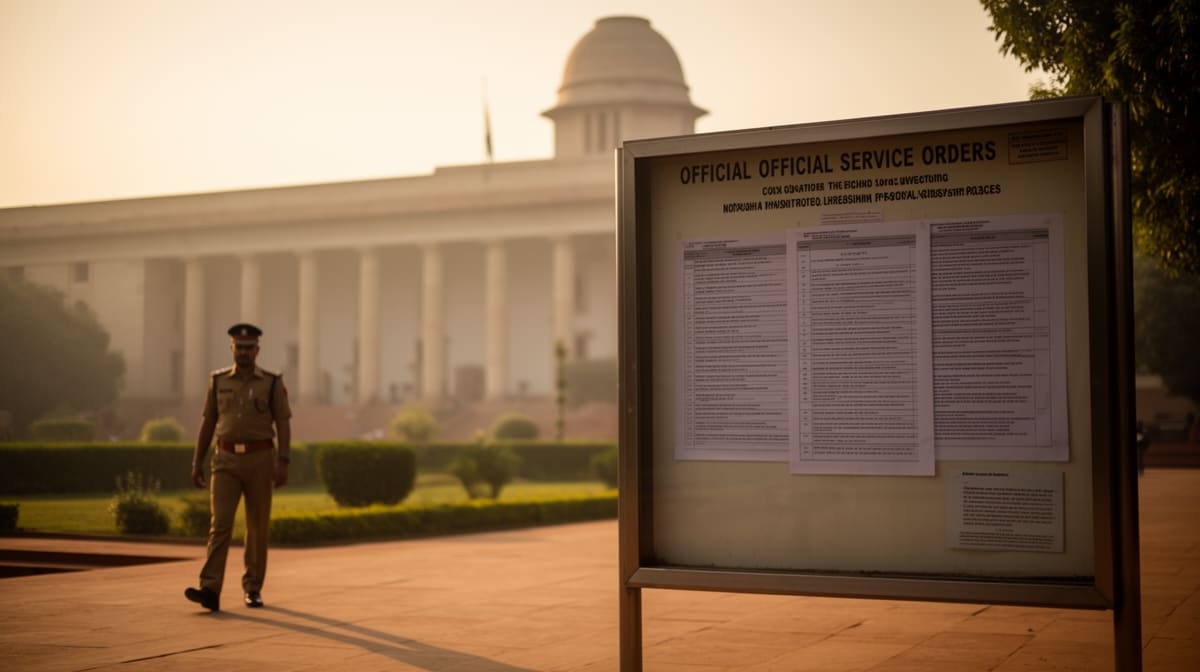
The Rajasthan High Court has clarified a critical distinction in government service law: the imposition of a penalty for withholding an annual grade increment cannot be equated with withholding promotion. This ruling overturns administrative circulars that treated incremental penalties as automatic barriers to career advancement, reinforcing the principle that penalties must be applied as prescribed, not extended by inference.
Background & Facts
The Dispute
The petitioners, government employees in the Rajasthan Police Department, challenged administrative orders and a circular dated 04.06.2008 that denied them promotion on the grounds of having been subjected to the penalty of "withholding annual grade increment" or "censure". The respondents, representing the State of Rajasthan and police hierarchy, relied on this circular to exclude the petitioners from consideration under the Seniority-Cum-Merit system for promotion.
Key Facts
- The petitioners were subjected to disciplinary penalties, including "censure" and "withholding of annual grade increment", as per orders dated 30.05.2013, 27.12.2013, and 26.10.2015
- These penalties were imposed under the provisions of the Central Civil Services (Classification, Control and Appeal) Rules, 1965, particularly Rule 14
- The Department of Personnel issued Circular No. 04.06.2008, which mandated that government servants penalized with "censure" or "withholding increment" would be ineligible for promotion under Seniority-Cum-Merit criteria
- The petitioners were denied promotion despite being otherwise eligible on merit and seniority
- No separate order of "withholding promotion" was ever issued against either petitioner
Procedural History
- 04.06.2008: Department of Personnel, Government of Rajasthan, issued Circular directing denial of promotion to employees penalized with "censure" or "withholding increment"
- 30.05.2013: Deputy Commissioner of Police, Jaipur, imposed penalty of "censure" and "withholding annual grade increment" on petitioner Mohd. Umar Khan
- 27.12.2013: Commissioner of Police, Jaipur, confirmed the penalty
- 26.10.2015: Joint Secretary, Government of Rajasthan (Appeal), upheld the penalty
- 2018: Coordinate Bench of Rajasthan HC in Raghuveer Singh v. State of Rajasthan (S.B. Civil Writ Petition No. 20358/2018) delivered judgment on identical issue on 05.12.2022
- 2026: Present writ petitions (No. 3956/2026 and 3928/2026) filed before Rajasthan HC, seeking quashing of the 2008 Circular and consequential promotion benefits
Relief Sought
The petitioners sought:
- Quashing of the Circular dated 04.06.2008 to the extent it denies promotion on account of "censure" or "withholding annual grade increment"
- Quashing of all penalty orders that treated withholding increment as equivalent to withholding promotion
- Declaration that they are entitled to promotion consideration as if no such penalty had been imposed
- Consequential benefits including back pay, seniority, and promotion with effect from the date they would have been promoted
- Direction to complete promotion exercise within a stipulated time
The Legal Issue
The central question was whether Rule 14 of the CCS (Classification, Control and Appeal) Rules, 1965 permits the automatic denial of promotion to a government servant merely because a penalty of "withholding annual grade increment" has been imposed, or whether "withholding promotion" must be imposed as a distinct and separate penalty.
Arguments Presented
For the Petitioner
Learned counsel relied on the binding precedent of Raghuveer Singh v. State of Rajasthan (2022), arguing that the language of Rule 14 uses the word "or" between "withholding annual grade increment" and "withholding promotion", indicating that these are two distinct penalties. The petitioner contended that the 2008 Circular illegally conflated these penalties, violating the principle of legality and Article 14 of the Constitution. The argument emphasized that the rule framers intentionally separated the two penalties to avoid cumulative punishment without explicit sanction.
For the Respondent
The State did not contest the applicability of the Raghuveer Singh judgment. No independent legal submission was made to defend the 2008 Circular’s interpretation. The respondents conceded that the circular’s application in the present cases was inconsistent with the binding precedent.
The Court's Analysis
The Court explicitly adopted the reasoning from Raghuveer Singh v. State of Rajasthan, holding that the interpretation of Rule 14 is unambiguous. The use of the conjunctive "or" in the rule demonstrates that the rule framers intended "withholding annual grade increment" and "withholding promotion" to be mutually exclusive penalties.
"The language of the said rule clearly speaks that rule framers were of the view that while in case of imposing penalty of 'withholding annual grade increment', the same itself will not adversely affect the avenue of promotion, if the Government servant is otherwise found suitable."
The Court rejected the State’s administrative practice of treating incremental withholding as a de facto promotion bar, noting that such an interpretation would render the explicit inclusion of "withholding promotion" as a separate penalty redundant. The circular, by imposing a collateral consequence not authorized by the rules, amounted to an unauthorized extension of penalty and violated the principle of proportionality.
The Court further held that the circular was not merely erroneous but unconstitutional, as it created an arbitrary classification without legislative backing, violating Article 14. The absence of any express provision in the CCS Rules authorizing automatic denial of promotion on account of withholding increment rendered the circular ultra vires.
The Verdict
The writ petitions are allowed. The Circular dated 04.06.2008, to the extent it denies promotion on account of "censure" or "withholding annual grade increment", is quashed and set aside. The penalty orders dated 30.05.2013, 27.12.2013, and 26.10.2015 are also set aside to the extent they were used to deny promotion. The petitioners are entitled to all consequential benefits as if no such penalty had been imposed. The respondents shall complete the promotion exercise and extend all benefits within three months from today.
What This Means For Similar Cases
Penalty Distinctions Are Statutorily Mandated
- Practitioners must challenge any administrative order that treats "withholding increment" as equivalent to "withholding promotion" under Rule 14
- Any denial of promotion based solely on a lesser penalty must be contested as ultra vires and arbitrary
- The burden now shifts to the employer to prove that a separate, explicit order of "withholding promotion" was passed under Rule 14
Circulars Cannot Override Statutory Rules
- Administrative circulars that expand the scope of penalties beyond statutory text are void
- The Raghuveer Singh precedent now binds all departments under the State of Rajasthan
- Similar circulars in other states must be reviewed for consistency with their respective service rules
Promotion Eligibility Must Be Based on Merit and Seniority Alone
- Employees penalized with "censure" or "withholding increment" retain full eligibility for promotion if otherwise qualified
- Promotion committees must exclude any consideration of incremental penalties when applying Seniority-Cum-Merit criteria
- Back pay and seniority adjustments must be calculated from the date the employee would have been promoted absent the illegal bar