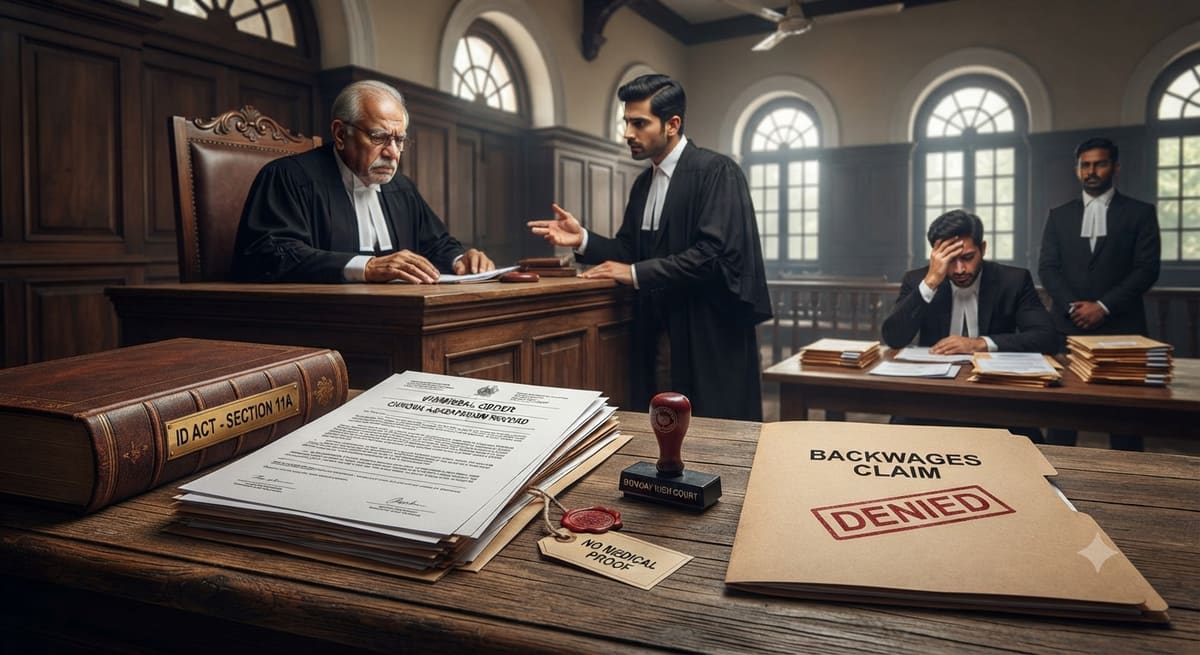
The Bombay High Court has clarified a critical procedural requirement under Section 33(2)(b) of the Industrial Disputes Act, 1947 (ID Act): wages paid for compliance must be additional to the employee’s regular salary, not deducted from it. This judgment underscores that even employees found guilty of grave misconduct - such as corruption - cannot escape dismissal on hyper-technical grounds if the employer has substantially complied with the statutory mandate. The ruling provides a nuanced approach to balancing procedural compliance with substantive justice, particularly in cases involving serious disciplinary violations.
Background & Facts
The Dispute
The petitioner, Municipal Corporation of Greater Mumbai (MCGM), dismissed the respondent, a clerk in its Octroi Department, after a departmental enquiry found him guilty of grave misconduct. The respondent had colluded with others to divert an octroi refund of Rs. 4,10,885 - due to M/s. Modest Maritime Services Pvt. Ltd. - to a third-party account (M/s. Dilip Engineering Construction Company). He subsequently withdrew Rs. 1,50,000 in cash from this account, which was handed over to him. The enquiry officer recommended his removal from service, and the disciplinary authority passed an order of dismissal on 30 November 2006.
Key Facts
- Employment: Respondent joined MCGM as a Clerk on 24 October 1996.
- Chargesheet: Issued on 21 March 2003, alleging conspiracy to defraud MCGM by diverting octroi refunds.
- Enquiry: Conducted between 2003 - 2006; respondent found guilty of misconduct.
- Dismissal Order: Passed on 30 November 2006 (Order No. ChOE/DE/JYD/1071).
- Wages Offered: MCGM attempted to serve the dismissal order and offered Rs. 14,468 (one month’s wages) at the workplace. The respondent refused both.
- Transmission of Wages: MCGM dispatched the dismissal order via RPAD and remitted Rs. 14,468 via money-order to the respondent’s residential address on the same day.
- Approval Application: Filed under Section 33(2)(b) of the ID Act as Application (IT) No. 21 of 2006 before the Industrial Tribunal, Mumbai.
Procedural History
- 12 June 2004: Respondent filed Complaint (ULP) No. 346 of 2004 before the Labour Court, challenging the show-cause notice. Interim relief was refused.
- 15 November 2006: Labour Court dismissed the complaint, upholding the fairness of the enquiry.
- 30 November 2006: Dismissal order passed; MCGM filed Application (IT) No. 21 of 2006 for approval under Section 33(2)(b).
- 7 May 2010: Industrial Tribunal rejected the approval application, holding that MCGM had made deductions (PF, IT, LIC, etc.) while paying wages for November 2006 and failed to include the respondent’s annual increment.
- 5 January 2012: Industrial Tribunal dismissed Review Application (IT) No. 1 of 2010, which sought to bring on record the payment of Rs. 14,468 via money-order.
- 5 July 2017: Bombay High Court admitted the writ petition (WP No. 10116 of 2015) and stayed coercive action.
- 7 July 2026: Judgment delivered, allowing the petition.
The Parties’ Positions
For the Petitioner (MCGM):
- Argued that the Industrial Tribunal erred in rejecting approval despite the respondent’s guilt being upheld.
- Contended that Section 33(2)(b) requires payment of additional one month’s wages, not wages for the month of dismissal.
- Submitted that Rs. 14,468 was offered separately via money-order, which the respondent did not dispute.
- Relied on Supreme Court judgments (S. Ganapathy v. Air India) to argue that minor deficits should not defeat approval, especially in cases of grave misconduct.
For the Respondent:
- Contended that MCGM failed to comply with Section 33(2)(b) as deductions (PF, IT, LIC) were made from the wages paid for November 2006.
- Argued that the respondent’s annual increment (due in October 2006) was not included in the wages paid.
- Relied on judgments (Jaipur Zila Sahakari Bhoomi Vikas Bank v. Ram Gopal Sharma) to assert that strict compliance with Section 33(2)(b) is mandatory.
Relief Sought
The petitioner sought:
- Quashing of the Industrial Tribunal’s orders dated 7 May 2010 and 5 January 2012.
- Grant of approval to the dismissal order dated 30 November 2006.
- Reinstatement of the respondent’s removal from service.
The Legal Issue
The central question was whether the Industrial Tribunal could reject approval under Section 33(2)(b) of the ID Act for dismissal of an employee found guilty of corruption, solely on the ground that the employer:
- Paid wages for the month of dismissal (November 2006) instead of additional one month’s wages; and
- Made deductions (PF, IT, LIC) or failed to include the annual increment in the wages paid.
Arguments Presented
For the Petitioner
- Separate Payment of Wages: MCGM argued that Rs. 14,468 was offered separately via money-order, distinct from the November 2006 salary. The Industrial Tribunal erred in treating the November salary as compliance with Section 33(2)(b).
- Minor Deficits: Cited S. Ganapathy v. Air India (1993) to argue that minor deficits (e.g., statutory deductions) should not defeat approval, especially when grave misconduct is proved.
- Increment Dispute: Contended that the respondent’s increment was withheld by a competent authority and released only on 14 August 2007, long after the dismissal. Thus, non-payment of increment did not violate Section 33(2)(b).
For the Respondent
- Strict Compliance: Argued that Section 33(2)(b) mandates full payment of one month’s wages without deductions. Any shortfall, including non-payment of increment, vitiates compliance.
- Precedents: Relied on judgments like Jaipur Zila Sahakari Bhoomi Vikas Bank v. Ram Gopal Sharma (AIR 2002 SC 643) to assert that non-compliance with Section 33(2)(b) is fatal to the approval application.
The Court's Analysis
The Court conducted a detailed examination of Section 33(2)(b) of the ID Act, which provides:
"During the pendency of any such proceeding in respect of an industrial dispute, the employer may [...] for any misconduct not connected with the dispute, discharge or punish, whether by dismissal or otherwise, that workman: Provided that no such workman shall be discharged or dismissed, unless he has been paid wages for one month and an application has been made by the employer to the authority before which the proceeding is pending for approval of the action taken by the employer."
Key Findings:
-
Additional Wages Required: The Court held that the wages under Section 33(2)(b) must be additional to the employee’s regular salary for the month of dismissal. The Industrial Tribunal erred in treating the November 2006 salary as compliance with the proviso.
"The wages contemplated in the Proviso to Section 33(2)(b) is not the normal salary payable in respect of the month in which dismissal/discharge is effected. Proviso to Section 33(2)(b) contemplates payment of additional wages of one month."
-
Ignoring Evidence of Separate Payment: The Industrial Tribunal failed to consider MCGM’s evidence that Rs. 14,468 was offered separately via money-order. The respondent did not deny receipt of this amount, only vaguely alleging that it was not full wages.
-
Hyper-Technical Approach Criticized: The Court criticized the Industrial Tribunal’s hyper-technical approach, which ignored the respondent’s grave misconduct (corruption and forgery) and focused solely on procedural lapses. The Court emphasized that Section 33(2)(b) is intended to provide solace to dismissed employees, not to reward corrupt employees with reinstatement.
-
Precedents on Minor Deficits: The Court relied on S. Ganapathy v. Air India to hold that minor deficits (e.g., statutory deductions) should not defeat approval. The Tribunal could have directed MCGM to deposit the deficit amount rather than rejecting approval outright.
-
Increment Dispute Irrelevant: The Court held that non-payment of increment was a separate dispute and did not violate Section 33(2)(b), as the respondent was entitled only to wages ordinarily received, not disputed entitlements.
The Verdict
The Court allowed the writ petition and set aside the Industrial Tribunal’s orders dated 7 May 2010 and 5 January 2012. The approval application (Application (IT) No. 21 of 2006) was granted, and the dismissal order dated 30 November 2006 was upheld. The Court did not award costs.
What This Means For Similar Cases
Section 33(2)(b) Requires Additional Wages, Not Salary Deductions
- Employers must pay one month’s wages separately under Section 33(2)(b), distinct from the employee’s regular salary for the month of dismissal.
- Treating the salary for the month of dismissal as compliance with Section 33(2)(b) is erroneous and may lead to rejection of approval.
Minor Deficits Do Not Defeat Approval in Cases of Grave Misconduct
- Tribunals should adopt a substantive approach rather than a hyper-technical one, especially when grave misconduct (e.g., corruption) is proved.
- Minor deficits (e.g., statutory deductions) can be rectified by directing the employer to deposit the deficit amount, rather than rejecting approval outright.
- The objective of Section 33(2)(b) is to provide solace to dismissed employees, not to reward misconduct with reinstatement.
Burden of Proof Lies on the Employee to Dispute Wages
- Once the employer pleads and proves payment of one month’s wages, the burden shifts to the employee to demonstrate that the amount paid was not full wages.
- Vague allegations (e.g., "deductions were made") without evidence or pleadings are insufficient to defeat approval.
Practical Takeaways for Employers and Practitioners
- Document Compliance: Employers must meticulously document the payment of one month’s wages under Section 33(2)(b), including proof of transmission (e.g., money-order receipts).
- Separate Payment: Ensure that wages under Section 33(2)(b) are paid separately from the employee’s regular salary to avoid disputes.
- Deposit Deficit Amounts: If minor deficits exist, offer to deposit the deficit amount before the Tribunal to preempt rejection.
- Highlight Misconduct: In cases involving grave misconduct, emphasize the substantive justice of dismissal over procedural lapses.