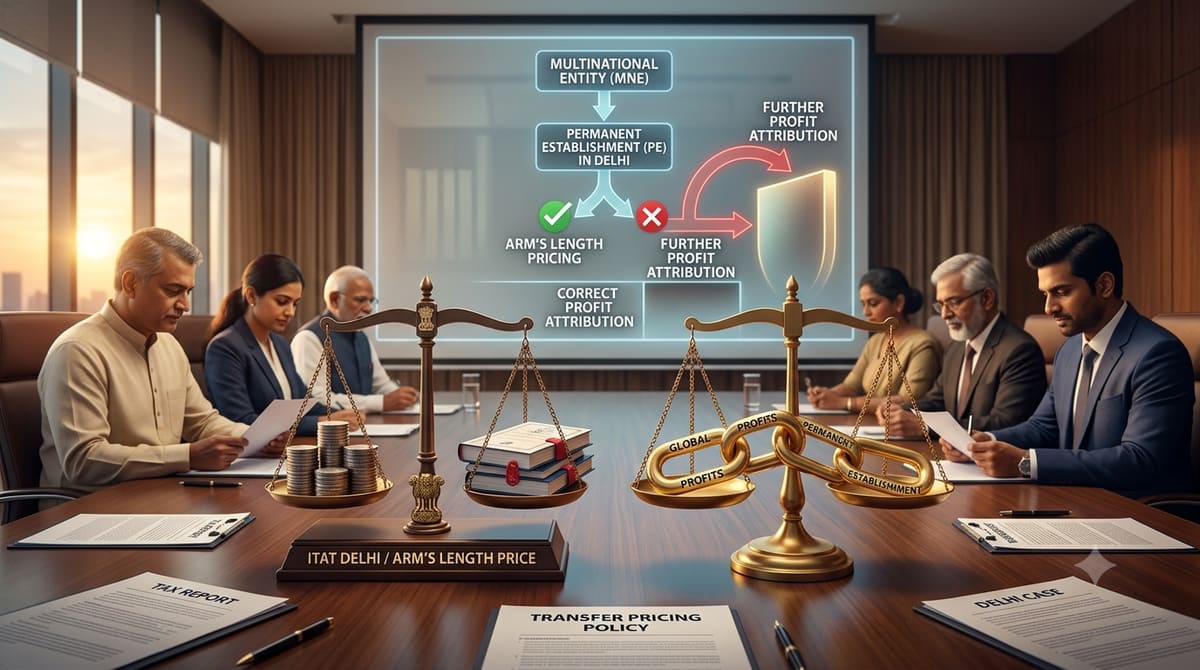
The Income Tax Appellate Tribunal, Delhi, has decisively reaffirmed that presumptive taxation under Section 44BB of the Income Tax Act cannot be applied in the absence of a Permanent Establishment in India, even where offshore supply of goods is linked to a project in the country. This ruling clarifies the limits of the Revenue’s power to attribute income to non-resident entities based on speculative or conclusory assertions.
Background & Facts
The Dispute
The appellant, Baker Hughes Energy Technology UK Ltd., a UK-based company, entered into a contract with ONGC and other consortium members on 05.11.2018 for the offshore supply of Subsea Production System (SPS) components, including Subsea Trees, Manifolds, and Control Systems, for oil exploration in the Krishna-Godavari basin. The contract explicitly assigned manufacturing and supply duties to the appellant, while all onshore activities - including installation, project management, transportation, and field support - were allocated to other consortium members.
For Assessment Year (A.Y.) 2022-23, the appellant filed its income tax return on 31.12.2022 declaring income of Rs. 3,22,67,490. The Assessing Officer (AO) selected the case for scrutiny and, relying on the existence of a Project Office (PO) in India, proposed an addition of Rs. 99,50,84,946 under Section 44BB, treating 10% of the total contract value (Rs. 9,95,08,49,464) as deemed profit attributable to a Fixed Place Permanent Establishment (PE) and a Deemed PE under Article 5 of the India-UK Double Taxation Avoidance Agreement (DTAA).
Key Facts
- The appellant’s sole activity in India was limited to logistical coordination through a PO in New Delhi.
- The PO did not engage in manufacturing, installation, or any substantive activity related to the contract.
- The scope of work under Annexures 1 and 2 of the contract confirmed that the appellant was not involved in onshore operations.
- ONGC, in response to a notice under Section 133(6), confirmed that the appellant’s role was confined to manufacturing and supply of components.
- The appellant had no employees, offices, or fixed assets in India beyond the PO.
- The PO was remunerated at arm’s length price for its administrative services, which were already taxed in India.
Procedural History
- 05.11.2018: Contract executed between Baker Hughes and ONGC consortium.
- 31.12.2022: Appellant filed return for A.Y. 2022-23 declaring income of Rs. 3,22,67,490.
- 26.03.2024: Draft assessment order issued proposing addition of Rs. 99,50,84,946 under Section 44BB.
- 30.12.2024: Dispute Resolution Panel (DRP) issued directions, noting factual similarity with A.Y. 2020-21 and 2021-22, and directed AO to verify whether appeals were pending against ITAT’s prior orders in favour of the appellant.
- 16.01.2025: Final assessment order passed under Section 143(3) r.w.s. 144C(13), assessing income at Rs. 1,02,73,52,436.
- 25.03.2026: Hearing before ITAT Delhi.
- 27.05.2026: Judgment pronounced.
The Parties' Positions
For the Appellant: The PO was purely auxiliary, providing logistical support only. No PE existed under Article 5 of the DTAA. The supply of goods occurred entirely outside India. The addition under Section 44BB was legally unsustainable without a PE. The ITAT’s prior orders in A.Y. 2020-21 and 2021-22, which deleted identical additions, were binding and factually identical.
For the Revenue: The PO constituted a Fixed Place PE because it provided non-auxiliary services in connection with exploration and extraction of mineral oil. The proviso to Article 5(2) created a Deemed PE. Section 44BB applied as the appellant was engaged in ‘services’ in India. The facts of the current year were distinguishable from prior years.
Relief Sought
The appellant sought deletion of the addition of Rs. 99,50,84,946, reversal of the assessment order dated 16.01.2025, and consequential relief including deletion of interest under Section 234B and penalty proceedings under Section 270A.
The Legal Issue
The central question was whether Section 44BB of the Income Tax Act can be invoked to tax presumptive income from offshore supply of goods where no Permanent Establishment exists in India under the India-UK Tax Treaty, and whether the Revenue has discharged its burden of proving the existence of a PE.
Arguments Presented
For the Appellant
The appellant relied on the ITAT’s own prior orders in ITA No. 521/Del/2023 (A.Y. 2020-21) and ITA No. 3279/Del/2023 (A.Y. 2021-22), both of which held that Section 44BB cannot apply without a PE. It emphasized that the factual matrix - contract terms, ONGC’s confirmation, and the nature of the PO - was identical. The appellant cited ADIT v. E-Funds (2018) 13 SCC 294 to assert that the burden of proving PE lies squarely on the Revenue, which had failed to produce any evidence of control, authority, or substantive activity by the appellant in India. The PO’s role was purely auxiliary under Article 5(3) of the DTAA.
For the Respondent
The Revenue contended that the PO’s involvement in logistical coordination, documentation, and liaison with ONGC constituted non-auxiliary services under Article 5(1) and triggered a Deemed PE under the proviso to Article 5(2) due to its connection with mineral oil exploration. It argued that the ITAT’s prior orders were distinguishable because the AO in the current year had documented additional facts. The Revenue also asserted that Section 44BB applies to any income attributable to activities in India, regardless of PE status.
The Court's Analysis
The Tribunal conducted a meticulous review of the contract, ONGC’s response under Section 133(6), and the prior ITAT orders. It observed that the Revenue had not adduced any evidence to show that the appellant exercised control over onshore operations, maintained a fixed place of business, or performed activities beyond logistical support.
"Not a single piece of evidence has been brought on record by the Assessing Officer to establish that the assessee had any kind of PE in India in the year under consideration."
The Tribunal held that the DRP itself had acknowledged the factual identity between the current year and the prior years. The AO’s attempt to distinguish the facts was found to be arbitrary and unsupported. The Tribunal reiterated the principle from E-Funds that the burden of proving PE rests with the Revenue, and mere presence of a PO does not equate to a PE unless it performs non-auxiliary functions.
The Tribunal further clarified that Section 44BB is a presumptive provision that applies only when a non-resident has a PE in India. Without a PE, the provision cannot be invoked. The Revenue’s reliance on the proviso to Article 5(2) was rejected because the appellant’s activities did not constitute ‘services’ in connection with exploration or extraction; it merely supplied equipment manufactured abroad.
The Tribunal also noted that the arm’s length remuneration paid to the PO was already taxed in India, and no further attribution was warranted.
The Verdict
The appellant succeeded. The Tribunal deleted the addition of Rs. 99,50,84,946 made under Section 44BB. The assessment order dated 16.01.2025 was set aside. The interest under Section 234B and penalty proceedings under Section 270A were held to be consequential and were accordingly dropped. The Tribunal directed the AO to reassess the income based on the return filed by the appellant, i.e., Rs. 3,22,67,490.
What This Means For Similar Cases
No PE, No Section 44BB
- Practitioners must argue that Section 44BB is inapplicable unless a Permanent Establishment is first established under the relevant DTAA.
- Presumptive taxation cannot be used as a substitute for proving the existence of a PE.
- Revenue authorities cannot rely on speculative or conclusory assertions to invoke Section 44BB.
Burden of Proof Lies with the Revenue
- The Revenue must produce concrete evidence - contractual terms, site records, employee details, control mechanisms - to prove PE.
- Mere existence of a liaison office or logistical support unit does not constitute a PE.
- ONGC or third-party confirmations under Section 133(6) are critical evidence that must be weighed.
Precedent Binding in Identical Facts
- When a coordinate bench of the ITAT has decided an issue in favour of the assessee on identical facts, the AO and DRP are bound to follow it.
- Attempts to distinguish facts without evidentiary basis are legally unsustainable.
- Taxpayers should cite prior ITAT orders in identical circumstances as binding authority.