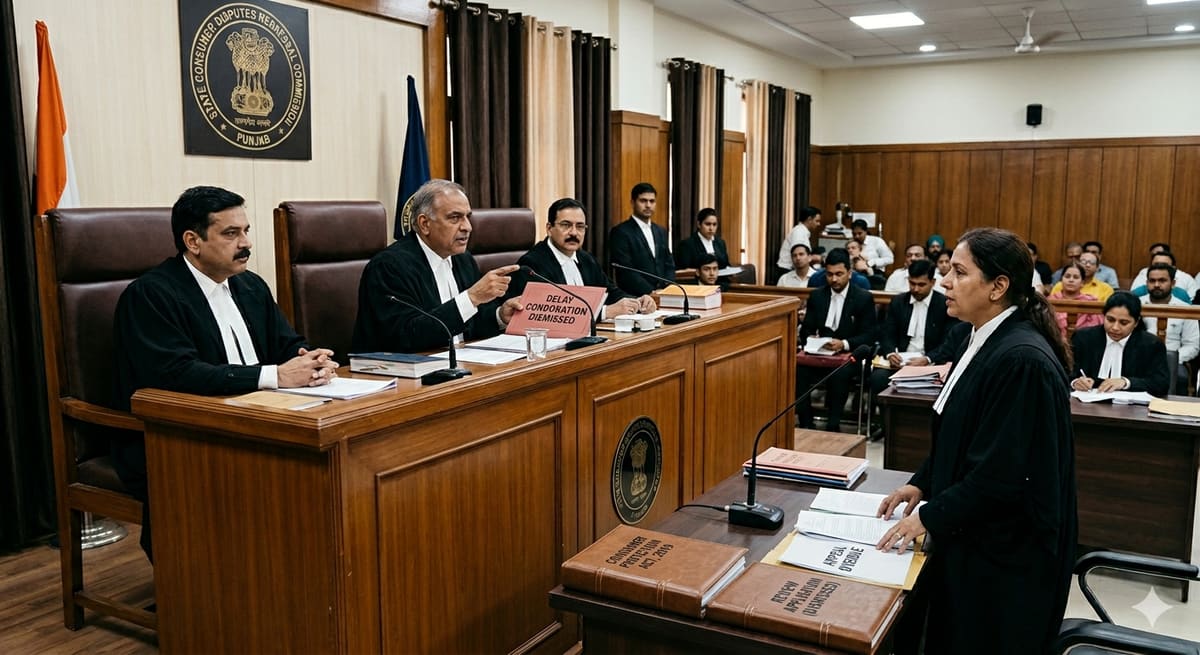
The State Consumer Dispute Redressal Commission, Maharashtra, has demonstrated the judiciary's balanced approach in condoning a 530-day delay in filing an appeal under the Consumer Protection Act, 2019. While emphasizing that 'sufficient cause' must receive liberal construction, the Commission underscored the need to prevent mechanical rejections, particularly when a public statutory body is deprived of its right to contest an ex-parte order on merits. The ruling, however, imposes costs to balance the inconvenience caused to the respondent, setting a precedent for future delay condonation applications involving public authorities.
Background & Facts
The Dispute
The case involves a long-standing dispute between the Konkan Housing & Area Development Board (MHADA), a statutory public body, and Mr. Ramesh Janu Kolhatkar, the original complainant. The dispute pertains to the allotment of a plot, which was cancelled by MHADA on 13.10.2010 due to non-payment of the balance amount by the complainant. Despite MHADA's readiness to refund the amount paid, the complainant delayed seeking legal recourse until 2018, when he filed a consumer complaint before the District Consumer Redressal Commission, Mumbai Suburban District.
Key Facts
- 29.12.2001: MHADA issued a letter to the complainant demanding payment of the balance amount for the allotted plot.
- 13.10.2010: MHADA cancelled the allotment due to non-payment and directed the complainant to apply for a refund.
- 10.04.2015: The complainant filed an appeal seeking reinstatement of the plot, which was rejected by MHADA via a letter dated 08.05.2015.
- 2018: The complainant filed Complaint No. 471/2018 before the District Consumer Redressal Commission.
- 19.10.2021: The District Commission passed an ex-parte order against MHADA, granting relief to the complainant.
- 30.01.2023: The complainant, for the first time, informed MHADA of the ex-parte order via a letter.
- 03.05.2023: MHADA applied for certified copies of the proceedings.
- 04.05.2023: MHADA received the documents and sought legal assistance.
- June 2023: MHADA filed the present First Appeal No. SC/27/FA/526/2023 along with a Delay Condonation Application (Misc. Application No. SC/27/MA/303/2023).
Procedural History
- Complaint No. 471/2018: Filed by the complainant before the District Consumer Redressal Commission, Mumbai Suburban District.
- 19.10.2021: District Commission passed an ex-parte order against MHADA.
- 30.01.2023: Complainant informed MHADA of the ex-parte order for the first time.
- 03.05.2023: MHADA applied for certified copies of the proceedings.
- 04.05.2023: MHADA received the documents and sought legal advice.
- June 2023: MHADA filed First Appeal No. SC/27/FA/526/2023 and Misc. Application No. SC/27/MA/303/2023 for condonation of delay.
- 02.07.2026: SCDRC Maharashtra passed the present order on the delay condonation application.
The Parties' Positions
For the Appellant (MHADA)
- Contended that the complainant served notices to the incorrect department, leading to the ex-parte order being passed without MHADA's knowledge.
- Argued that MHADA was never intimated about the ex-parte order until 30.01.2023, and only received the proceedings on 04.05.2023.
- Submitted that MHADA had always been ready and willing to refund the amount paid by the complainant, as evidenced by its letters dated 13.10.2010 and 08.05.2015.
- Relied on the Supreme Court's decision in Sheo Raj Singh v. Union of India (2023) 10 SCC 531 to argue that mechanical rejections of delay applications should be avoided where a meritorious case is visible.
- Prayed for condonation of the 530-day delay in filing the appeal.
For the Respondent (Complainant)
- Opposed the delay condonation application, arguing that the appeal was barred by limitation.
- Submitted that the impugned order was passed on 29.10.2021, but the appeal was filed only in June 2023, resulting in a delay of 561 days.
- Contended that MHADA failed to explain the delay sufficiently, as required under Section 41 of the Consumer Protection Act, 2019.
- Argued that MHADA's statement - that it sought legal advice and applied for certified copies - was insufficient to justify the delay.
- Prayed for dismissal of the appeal with costs.
Relief Sought
The appellant (MHADA) sought condonation of the 530-day delay in filing the appeal against the ex-parte order dated 19.10.2021 (treated as 29.10.2021 for limitation purposes). Upon condonation, MHADA intended to contest the merits of the District Commission's order.
The Legal Issue
The central question before the Commission was whether the appellant had established 'sufficient cause' under Section 41 of the Consumer Protection Act, 2019 to condone the 530-day delay in filing the appeal. Specifically, the Commission had to determine:
- Whether the appellant's explanation - regarding lack of knowledge of the ex-parte order due to incorrect notice service - constituted a valid 'sufficient cause.'
- Whether the principles of liberal construction of 'sufficient cause,' particularly in cases involving public bodies, justified condonation of the delay.
- Whether the imposition of costs could balance the inconvenience caused to the respondent while allowing the appeal to proceed on merits.
Arguments Presented
For the Appellant
- Incorrect Notice Service: MHADA argued that the complainant served notices to the wrong department, leading to the ex-parte order being passed without its knowledge. This constituted a valid 'sufficient cause' for the delay.
- Meritorious Case: Cited Sheo Raj Singh v. Union of India to emphasize that delay applications should not be rejected mechanically if a meritorious case is visible on record.
- Public Interest: Highlighted that MHADA is a public statutory body, and denying it the opportunity to contest the ex-parte order would result in irreparable loss and implications for public assets.
For the Respondent
- Limitation Bar: Contended that the appeal was barred by limitation, as it was filed 561 days after the impugned order.
- Insufficient Explanation: Argued that MHADA's explanation - seeking legal advice and applying for certified copies - did not constitute 'sufficient cause' under Section 41 of the Consumer Protection Act, 2019.
- Deliberate Delay: Alleged that MHADA's delay was deliberate, as it sought to benefit from the added interest accruing due to the delay.
The Court's Analysis
The Commission undertook a detailed analysis of the principles governing delay condonation under Section 41 of the Consumer Protection Act, 2019. The key observations were:
-
Liberal Construction of 'Sufficient Cause': The Commission noted that the expression 'sufficient cause' must receive a liberal construction, particularly when no negligence, inaction, or mala fides is attributable to the party seeking condonation. This principle is well-settled in Indian jurisprudence and was reiterated in Sheo Raj Singh v. Union of India.
"It is a settled position of law that the expression 'sufficient cause' must receive a liberal construction when no negligence, inaction, or mala fides is imputable to the party seeking condonation."
-
Ex-Parte Order Against Public Body: The Commission observed that the impugned order was passed ex-parte against a public statutory body. MHADA had raised a material contention that notices were served to an incorrect department, preventing it from representing itself before the District Commission. This factual matrix weighed in favor of condoning the delay, as denying MHADA the opportunity to contest the order would result in hardship and implications for public assets.
-
Meritorious Case on Record: Following the Supreme Court's decision in Sheo Raj Singh, the Commission held that mechanical rejections of delay applications should be avoided where a meritorious case is visible on the face of the record. The Commission noted that MHADA had a prima facie case to succeed in the appeal, and dismissing the application at the threshold would be unjust.
-
Balancing Inconvenience: While condoning the delay, the Commission acknowledged the inconvenience caused to the respondent, who had been forced to defend the delay condonation application. To balance the equities, the Commission imposed monetary costs of Rs. 3,000 on MHADA, payable to the respondent within 30 days.
The Verdict
The State Consumer Dispute Redressal Commission, Maharashtra, allowed Miscellaneous Application No. SC/27/MA/303/2023 for condonation of delay, subject to the following conditions:
- The appellant (MHADA) was directed to pay costs of Rs. 3,000 to the respondent within 30 days from the date of the order (02.07.2026).
- Upon compliance with the payment of costs and filing of the receipt on record, the 530-day delay in filing First Appeal No. SC/27/FA/526/2023 stood condoned.
- The matter was listed for hearing on the admission of the appeal on 11.08.2026.
What This Means For Similar Cases
Liberal Construction of 'Sufficient Cause' for Public Bodies
- Public Statutory Bodies: This judgment reinforces that public statutory bodies (e.g., MHADA, municipal corporations, government departments) are entitled to a liberal construction of 'sufficient cause' when seeking condonation of delay. Courts are likely to be more lenient where the delay arises from administrative lapses (e.g., incorrect notice service) rather than deliberate inaction.
- Ex-Parte Orders: Where an ex-parte order is passed against a public body due to procedural irregularities (e.g., notices served to incorrect departments), the body may successfully argue that it was deprived of its right to be heard, justifying condonation of delay.
Mechanical Rejections to Be Avoided
- Meritorious Cases: Following Sheo Raj Singh v. Union of India, courts are discouraged from mechanically rejecting delay applications where a meritorious case is visible on record. Practitioners should emphasize the strength of their case on merits while seeking condonation.
- Threshold Consideration: Delay condonation applications should not be dismissed at the threshold merely because the delay is substantial. Instead, courts are encouraged to adjudicate the dispute on merits where possible.
Costs as a Balancing Mechanism
- Monetary Costs: Where delay is condoned, courts may impose monetary costs on the applicant to balance the inconvenience caused to the respondent. In this case, the Commission imposed Rs. 3,000 as costs, payable within 30 days.
- Compliance Timeline: Practitioners should note that compliance with cost directions is a precondition for the delay to be formally condoned. Failure to comply may result in the appeal being dismissed.
Practical Takeaways for Practitioners
- Documentary Evidence: When seeking condonation of delay, applicants should document all steps taken (e.g., applications for certified copies, legal consultations) to demonstrate due diligence.
- Public Interest Argument: Public bodies should highlight the public interest implications of denying them an opportunity to contest an ex-parte order, such as loss of public assets or administrative injustice.
- Respondent's Strategy: Respondents opposing delay condonation should focus on proving negligence, inaction, or mala fides on the part of the applicant, as these factors weigh against liberal construction of 'sufficient cause.'