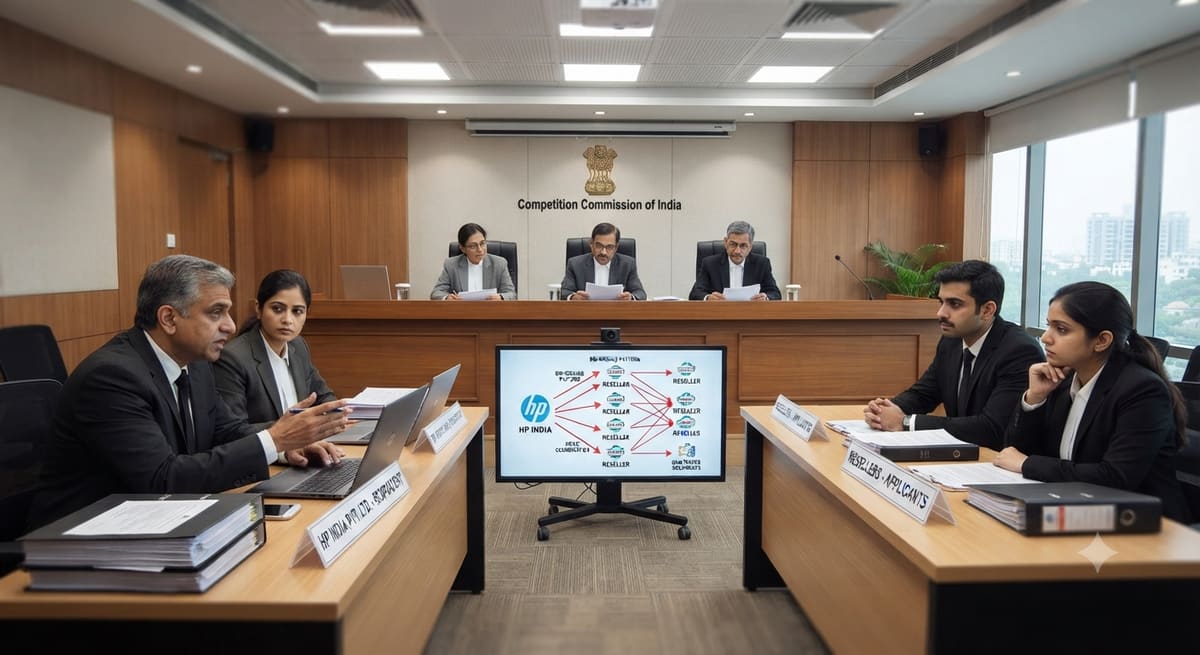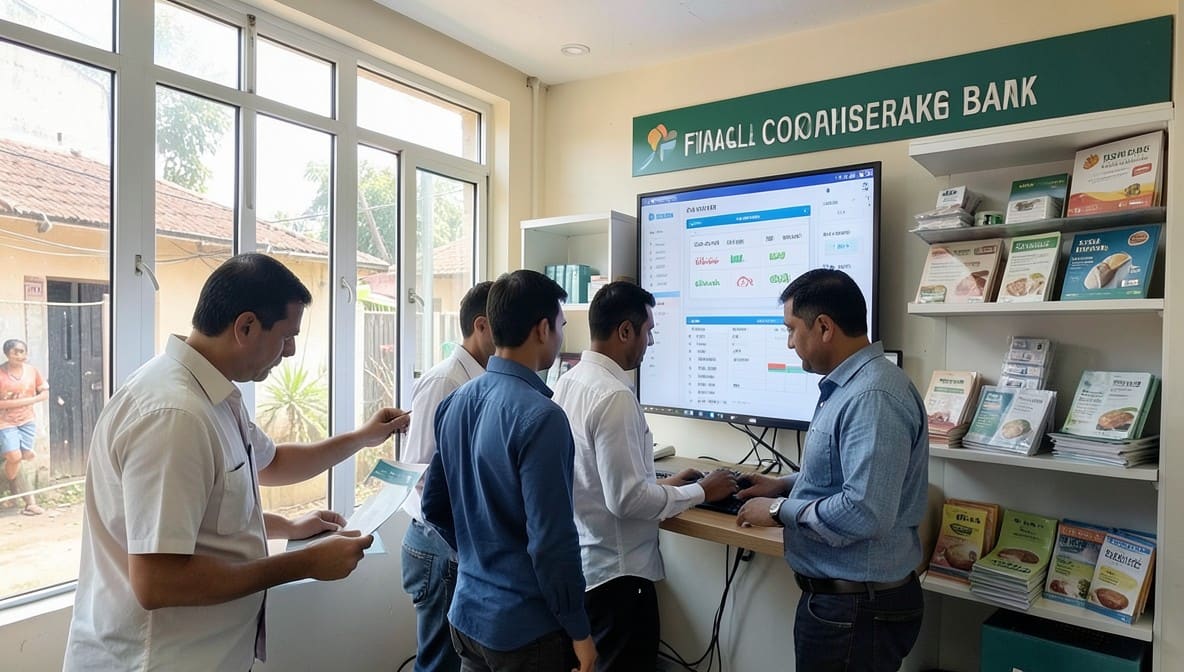
The Competition Commission of India has clarified that restricting the upgrade of Core Banking Solutions to authorized partners of the Original Equipment Manufacturer does not amount to abuse of dominance or an anti-competitive agreement, even when the procuring entity holds a statutory monopoly. This ruling provides critical guidance on the boundaries of regulatory discretion in technology procurement for public financial infrastructure.
Background & Facts
The Dispute
The Informant, M/s Natural Support Consultancy Services Private Limited (NSCSPL), alleged that National Bank for Agriculture and Rural Development (NABARD) and Infosys Limited engaged in anti-competitive conduct by restricting participation in a 2023 Request for Proposal (RFP) for upgrading Core Banking Solutions (CBS) to only those System Integrators (SIs) authorized by Infosys, the OEM of the Finacle software platform. The Informant claimed this exclusionary practice violated Sections 3 and 4 of the Competition Act, 2002.
Key Facts
- NABARD, established under the NABARD Act, 1981, acts as a statutory regulator and facilitator for Rural Cooperative Banks (RCBs) in India.
- In 2011, NABARD issued RFP No. NABARD\Repo Cell\CBS\RFP\2011\001 dated 30.08.2011 to procure CBS for 140 RCBs, empaneling two consortia: (i) Infosys as OEM and Wipro as SI, and (ii) Tata Consultancy Services as both OEM and SI.
- The initial contract with Infosys and Wipro was for five years and was renewed twice, extending until 31.12.2022.
- In late 2022, Wipro withdrew from the contract, leaving 58 RCBs that wished to continue using the Finacle CBS platform.
- On 27.10.2023, NABARD issued RFP No. GEM/2023/B/4140840 titled "Identification of Application Service Provider for Migration/Upgradation of Core Banking Solution from Finacle 7.x to Finacle 10.2.25 and Maintenance for 5 Years" via the Government e-Marketplace (GeM) portal.
- The 2023 RFP restricted eligibility to System Integrators who were authorized partners of Infosys, as only such partners had access to proprietary tools, technical support, and data integrity protocols required for upgrading Finacle 7.x to 10.2.25.
- M/s Dynacons Systems and Solutions Ltd., an authorized Infosys partner, was selected as the new SI on 06.03.2024.
- NSCSPL, not being an authorized Infosys partner, was ineligible to bid.
- NSCSPL had previously filed RTI applications and a complaint with the Central Vigilance Commission, both of which found no procedural irregularities.
- NSCSPL also filed a writ petition before the Delhi High Court (C) No. 9287 of 2025, which was withdrawn on 08.07.2025.
Procedural History
- 30.08.2011: NABARD issues first RFP for CBS implementation across 140 RCBs.
- 2012: 201 RCBs onboarded onto CBS platforms (Finacle via Wipro and Bancs24 via TCS).
- 2017: First renewal of the 2011 contract for another five years.
- 31.12.2022: Initial contract expires; Wipro withdraws.
- 27.10.2023: NABARD issues 2023 RFP for Finacle 7.x to 10.2.25 upgrade via GeM portal.
- 06.03.2024: NABARD notifies Dynacons Systems as selected SI.
- 12.11.2025: CCI issues notice to NABARD seeking response to Information filed by NSCSPL.
- 26.12.2025: NABARD files initial response.
- 12.01.2026: NABARD refiles response with affidavit.
- 29.01.2026: CCI considers matter in its meeting.
- 20.04.2026: CCI passes order under Section 26(2) of the Competition Act.
The Parties' Positions
Informant (NSCSPL): Alleged that NABARD and Infosys engaged in a vertical anti-competitive agreement under Section 3(4)(b) and (d) by creating an exclusive ecosystem. Argued that restricting SIs to Infosys-authorized partners constituted abuse of dominance under Section 4(2)(a)(i), (b)(i), (b)(ii), (c), and (e), by foreclosing market access and stifling innovation.
Respondent (NABARD): Contended that the 2023 RFP was limited to Finacle upgrades only, not new CBS procurement. Stated that only authorized partners had access to proprietary tools, security protocols, and technical support necessary to prevent data corruption, system failure, and financial risk. Emphasized that participating banks voluntarily consented to continue with Finacle and that the selection process was transparent, committee-driven, and non-discriminatory.
Relief Sought
The Informant sought:
- Declaration that an anti-competitive agreement existed between NABARD and Infosys.
- Declaration that NABARD abused its dominant position.
- Imposition of penalty.
- Any other relief deemed just and equitable.
The Legal Issue
The central question was whether restricting participation in a CBS upgrade RFP to only authorized partners of the OEM constitutes abuse of dominant position under Section 4 of the Competition Act, 2002, or an anti-competitive agreement under Section 3(4)(b) and (d), when the restriction is grounded in technical necessity and user consent.
Arguments Presented
For the Appellant/Petitioner
The Informant relied on the principle that dominant entities cannot impose conditions that foreclose market access without objective justification. It argued that the 2023 RFP’s requirement of Infosys authorization created an artificial barrier, excluding technically capable SIs. It cited Coca-Cola India v. Competition Commission of India to assert that even non-mandatory conditions can amount to abuse if they distort competition. The Informant contended that the repeated extensions of the 2011 contract indicated a pattern of collusion, violating Section 3(4)(d) by creating exclusive dealing.
For the Respondent/State
NABARD argued that the restriction was not discriminatory but technologically necessary. It emphasized that Finacle 10.2.25 upgrades required proprietary tools, secure data migration protocols, and vendor-specific support only available to authorized partners. NABARD highlighted that the participating banks had voluntarily opted to continue with Finacle, and the selection process involved a multi-bank evaluation committee. It relied on Cement Manufacturers Association v. CCI to assert that technical compatibility and operational continuity are legitimate grounds for limiting eligibility.
The Court's Analysis
The Commission undertook a structured analysis under Sections 3 and 4 of the Competition Act. First, it delineated the relevant market as the "Market for procurement of CBS services for Rural Co-operative Banks in India," accepting NABARD’s statutory role as a facilitator but not as a commercial player. It found NABARD to be dominant due to its exclusive statutory mandate under the NABARD Act, 1981, with no equivalent public or private entity performing the same function.
The Commission then examined whether the 2023 RFP’s restriction amounted to abuse under Section 4. It noted that the RFP was not for a new CBS platform but for upgrading an existing one - Finacle 7.x to 10.2.25. The Commission accepted NABARD’s technical justification: unauthorized vendors lacked access to proprietary software tools, security patches, and vendor support, posing risks of data loss, system failure, and financial exposure to banks.
"Only authorized partners have access to proprietary tools and support from Infosys and engagement of unauthorized vendors could risk data corruption, system failure, security breaches, financial burden etc."
The Commission held that such a restriction was not discriminatory but a reasonable and necessary condition for ensuring service integrity. It distinguished this from cases where dominant firms impose arbitrary exclusivity, noting that the condition was tied to a specific technical upgrade, not a general market exclusion.
Regarding Section 3, the Commission found no evidence of an agreement or concerted practice between NABARD and Infosys. The renewal of the 2011 contract was a continuation of a pre-existing, transparent arrangement. The 2023 RFP was issued only after banks voluntarily expressed intent to continue with Finacle. The Commission noted that multiple RTI responses, CVC investigations, and the withdrawal of the Delhi High Court petition all corroborated procedural regularity.
The Commission concluded that the Informant failed to establish any appreciable adverse effect on competition. The restriction did not prevent new entrants from competing in the broader CBS market - it merely required technical competence for a specific upgrade task.
The Verdict
The Competition Commission of India dismissed the Informant’s allegations and closed the matter under Section 26(2) of the Competition Act, 2002. The Commission held that neither an anti-competitive agreement under Section 3 nor abuse of dominance under Section 4 was established. No penalty was imposed. The Commission directed the Secretary to communicate the order to the Informant.
What This Means For Similar Cases
Technical Necessity Can Justify Exclusive Eligibility
- Practitioners must now demonstrate that eligibility criteria in public procurement are not merely commercial preferences but grounded in verifiable technical, security, or operational requirements.
- Restricting bids to OEM-authorized partners for software upgrades is lawful if supported by evidence of proprietary dependencies and risk mitigation.
- The burden shifts to the complainant to prove that alternative, non-exclusive solutions were feasible.
Statutory Monopolies Are Not Per Se Abusive
- Entities like NABARD, with exclusive statutory mandates, may act as facilitators without violating competition law if their actions are transparent, non-arbitrary, and serve public interest.
- Regulatory discretion in technology procurement for critical infrastructure is protected if aligned with user consent and technical realities.
- Repeated contract renewals do not automatically imply collusion; continuity of service is a legitimate objective.
Market Definition Must Reflect Functional Specificity
- Relevant markets must be defined by functional use, not broad categories. A CBS for rural cooperative banks is distinct from commercial banking software.
- Courts and regulators will not treat all IT procurement as fungible - context-specific needs override generalized market definitions.
- Claims of dominance must be tied to the precise service rendered, not the entity’s broader regulatory role.