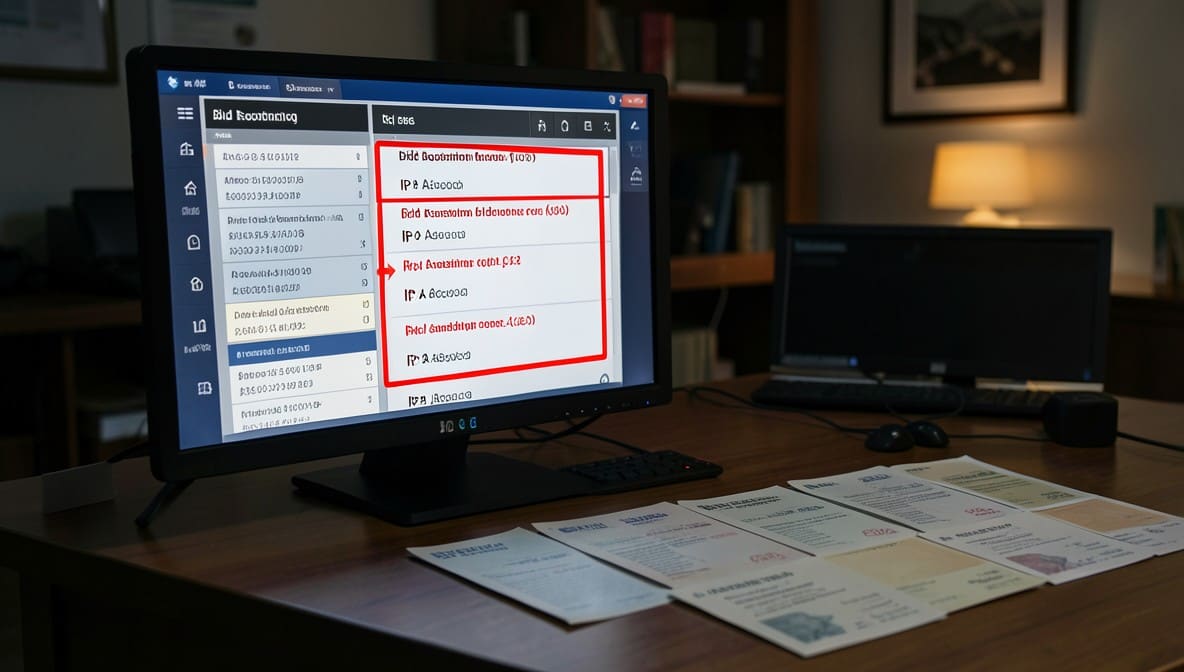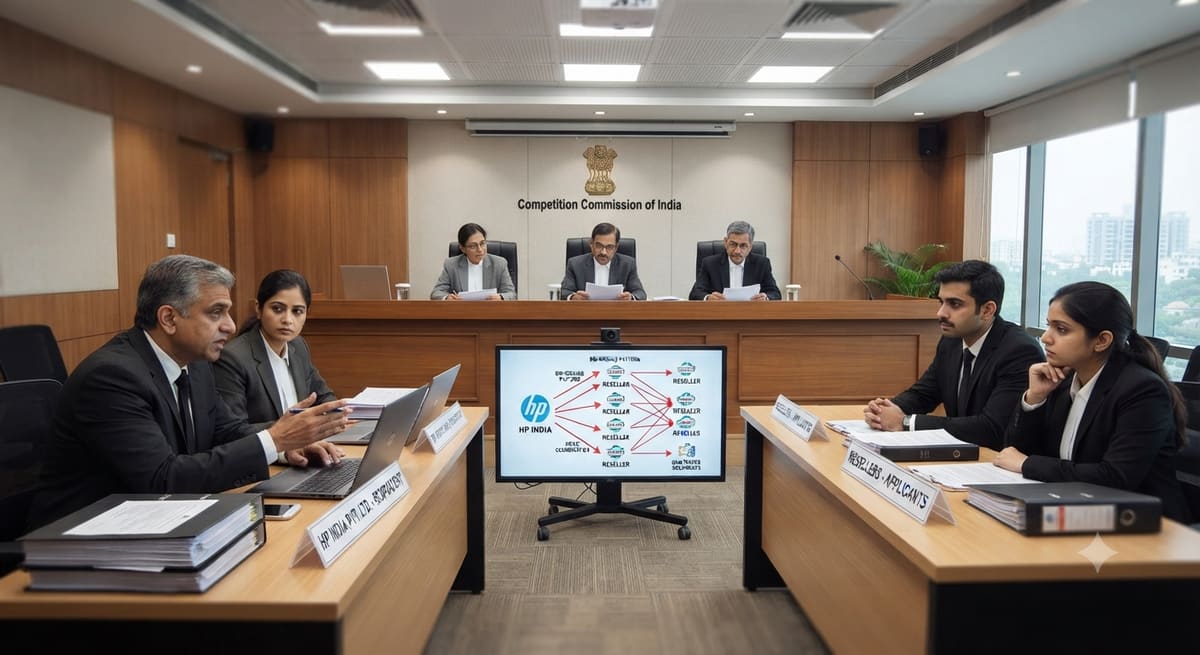
The Competition Commission of India (CCI) has delivered a landmark ruling in Suo Moto Case No. 07 of 2020, penalizing HP India Sales Private Limited and six of its resellers for engaging in bid rigging and collusive bidding in Government e Marketplace (GeM) tenders. The judgment clarifies that OEM-reseller interactions can constitute a horizontal agreement under Section 3(3) of the Competition Act, 2002, if they compete in the same tender. The CCI rejected arguments that such relationships are purely vertical, emphasizing that participation in the same bidding process transforms them into competitors. The order also underscores the deterrent role of penalties, calculated on relevant turnover rather than platform-specific transactions, to curb systemic anti-competitive conduct.
Background & Facts
The Dispute
The case originated from a lesser penalty application filed by HP India under Section 46 of the Competition Act, 2002, alleging cartelization among itself and its Tier-2 resellers in the sale of Personal Systems Products (laptops, desktops, accessories, etc.) on the Government e Marketplace (GeM) platform. The CCI, forming a prima facie opinion of contravention of Section 3 of the Act, directed the Director General (DG) to investigate tenders exceeding ₹1 crore floated by Delhi-based procurers on GeM.
Key Facts
HP India (OP-1), an Original Equipment Manufacturer (OEM), sold products through Tier-1 distributors and Tier-2 resellers.
Resellers (OP-2 to OP-11) included Delphi Infosolutions, Comnet Vision, Digitech Computers, Softlabs Solution, Orbit Techsol, Thoughtsol Infotech, Hind Technocare, Intensity Global, M Integraph, and Krishna Computer.
The GeM portal, introduced in 2016, disrupted legacy commercial relationships, creating competitive pressure among resellers to retain Most Valuable Customer (MVC) accounts.
Manufacturer’s Authorization Form (MAF) and Transfer Price (TP) were critical for resellers to participate in GeM tenders. HP India controlled the issuance of MAFs and TPs, often restricting participation to designated resellers.
Reverse Auction (RA) mechanism on GeM incentivized coordination among HP India and its resellers to ensure HP’s representation in the final bidding rounds.
Procedural History
17.11.2020: CCI passed a prima facie order under Section 26(1) directing DG to investigate GeM tenders exceeding ₹1 crore in Delhi.
24.08.2021: Mr. Manoj Grover, a former HP India official, filed a lesser penalty application under Section 46.
19.05.2022: Delphi Infosolutions (OP-2) filed a lesser penalty application.
26.03.2023: DG submitted its Investigation Report, finding collusion in 7 GeM tenders.
15.11.2023: CCI referred the matter back to DG for supplementary investigation under Section 26(3A).
06.03.2024: DG submitted Supplementary Investigation Report.
03.05.2024: CCI directed parties to file objections/suggestions to the Investigation Report.
25.02.2026, 12.03.2026, 09.04.2026: Oral hearings conducted.
13.07.2026: CCI passed the final order under Section 27 of the Act.
The Parties' Positions
HP India (OP-1)
Admitted to coordinating with resellers to ensure HP’s representation in GeM tenders but denied anti-competitive intent.
Argued that GeM’s RA mechanism incentivized coordination to prevent early exit of resellers.
Claimed no impact on inter-brand competition, as other OEMs (Dell, Acer, Lenovo) participated in tenders.
Cited mitigating factors: first-time offender, compliance programs, cooperation during investigation.
Resellers (OP-2 to OP-11)
Delphi (OP-2): Argued vertical relationship with HP India precludes Section 3(3) applicability; participation in only one tender above ₹1 crore.
Comnet (OP-3): Denied collusion, stating emails sought TP/MAF as standard industry practice; did not participate in impugned tenders.
Digitech (OP-4): Claimed unilateral emails from HP India without response; technical disqualification in one tender.
Softlabs (OP-5): Argued independent bid pricing; technical disqualification in impugned tender.
Orbit (OP-6): Contended no AAEC due to participation of other OEMs; MSME status and cooperation as mitigating factors.
Thoughtsol (OP-7): Denied consensus ad idem; quoted prices independently in tenders.
Hind Technocare (OP-8): Argued no evidence of collusion; technical disqualification in tender.
Intensity Global (OP-9): Claimed no collusion; disqualified in tenders and quoted higher prices than HP’s suggestions.
M Integraph (OP-10): Denied collusion; no evidence of bid price manipulation.
Krishna Computer (OP-11): Admitted to following HP’s directions but argued no knowledge of HP’s participation in tenders.
Relief Sought
HP India: Reduction in penalty based on relevant turnover and mitigating factors.
Resellers: Exoneration from allegations; no penalty due to lack of evidence, MSME status, and cooperation.
The Legal Issue
The central question was whether collusion between an OEM (HP India) and its resellers in GeM tenders constitutes a horizontal agreement under Section 3(3)(d) of the Competition Act, 2002, given their vertical relationship in the supply chain.
Arguments Presented
For HP India and Resellers
Vertical Relationship: Argued that OEM-reseller interactions are vertical, not horizontal, and thus outside Section 3(3).
No AAEC: Contended that inter-brand competition (participation of other OEMs) negated any Appreciable Adverse Effect on Competition (AAEC).
Standard Industry Practices: Claimed that seeking TP/MAF and price guidance are routine business practices.
MSME Status: Resellers emphasized their limited market share and financial vulnerability.
Cooperation: Highlighted cooperation during investigation and first-time contravention as mitigating factors.
For the CCI
Horizontal Agreement: Argued that participation in the same tender transforms OEM and resellers into competitors, satisfying Section 3(3).
Evidence of Collusion: Relied on emails, statements, and bid patterns showing HP India dictating bid prices and restricting MAF issuance.
AAEC Presumption: Invoked the presumption of AAEC under Section 3(3), rebuttable only by demonstrating no competitive harm.
Deterrence: Emphasized that penalties must reflect systemic conduct, not just platform-specific transactions.
The Court's Analysis
The CCI conducted a detailed examination of the evidence, including emails, statements, and bid patterns, to determine collusion:
Horizontal vs. Vertical RelationshipThe CCI rejected the argument that OEM-reseller interactions are purely vertical. It held that participation in the same tender renders them competitors, bringing their conduct under Section 3(3):
"Both HP and these resellers have participated as bidders in the GeM tenders. This demonstrates that while bidding for a particular tender, they have stepped into the shoes of competitors."
Evidence of Collusion
HP India emerged as L-1 in 3 of 7 tenders investigated, often dictating bid prices to resellers.
Emails showed HP India directing resellers to quote specific prices or withholding MAFs to manipulate tender outcomes.
Statements of resellers confirmed reliance on HP India for bid prices and participation as cover bidders.
Bid Patterns: HP India’s direct participation alongside resellers in tenders, with lower quoted prices, indicated strategic manipulation.
Appreciable Adverse Effect on Competition (AAEC)The CCI held that intra-brand competition was significantly distorted due to:
Restriction of Participation: HP India controlled MAF issuance, limiting reseller participation.
Price Dictation: HP India communicated bid prices, eliminating independent pricing by resellers.
Cover Bidding: Resellers participated as cover bidders to ensure HP’s success in tenders.The CCI noted that inter-brand competition (participation of other OEMs) did not rebut the presumption of AAEC, as HP India’s conduct systematically distorted the bidding process.
Role of IndividualsThe CCI examined the liability of individuals under Section 48 of the Act:
Section 48(1): Applies to individuals in charge of and responsible for the company’s affairs.
Section 48(3): Applies to individuals with consent, connivance, or negligence in the contravention.The CCI held 9 individuals of HP India, 2 of Delphi, and 1 of Orbit liable under Section 48.
Penalty CalculationThe CCI rejected arguments to limit penalties to platform-specific turnover, emphasizing deterrence against systemic conduct.
HP India: Penalty imposed at 10% of average relevant turnover (2017-2020), reduced to 5% due to lesser penalty application.
Delphi: Penalty imposed at 8% of average relevant turnover, reduced to 4% for cooperation.
Other Resellers: Penalty imposed at 3% of average relevant turnover, reduced to 2% for mitigating factors.
The Verdict
The CCI held HP India (OP-1), Delphi Infosolutions (OP-2), Digitech Computers (OP-4), Orbit Techsol (OP-6), Hind Technocare (OP-8), and Krishna Computer (OP-11) liable for contravening Section 3(3)(d) read with Section 3(1) of the Competition Act, 2002. The following directions were issued:
Cease and Desist Order: Contravening OPs and their liable individuals were directed to discontinue the impugned practices.
Penalty Imposition:
HP India: ₹12.40 crore (5% of average relevant turnover of ₹248.09 crore).
Delphi Infosolutions: ₹62,666 (4% of average relevant turnover of ₹15.66 lakh).
Digitech Computers: ₹17.96 lakh (2% of average relevant turnover of ₹8.98 crore).
Orbit Techsol: ₹86.31 lakh (2% of average relevant turnover of ₹43.15 crore).
Mr. Sushil Kumar Jain (Orbit): ₹30,067 (2% of average income of ₹15.03 lakh).
Hind Technocare: ₹6.72 lakh (2% of average relevant turnover of ₹3.36 crore).
Krishna Computer: ₹1.91 lakh (2% of average relevant turnover of ₹95.59 lakh).
Compliance Training: Contravening OPs were directed to organize competition compliance programs and submit a report within 60 days.
Confidentiality: Certain documents were granted confidentiality for 3 years under Regulation 36 of the General Regulations, 2024.
What This Means For Similar Cases
OEM-Reseller Collusion Constitutes Horizontal Agreement
Competitors in Tenders: The CCI clarified that OEMs and resellers participating in the same tender are competitors, bringing their conduct under Section 3(3).
Vertical Relationship Irrelevant: The vertical relationship in the supply chain does not preclude horizontal liability if the parties compete in the same bidding process.
Implications for Supply Chains: Businesses must ensure that OEM-reseller interactions do not distort competition, particularly in government procurement.
Evidence of Collusion Must Be Corroborated
Emails and Statements: The CCI relied on emails dictating bid prices and statements of resellers to establish collusion.
Bid Patterns: Direct participation of OEM alongside resellers, with lower quoted prices, was a key indicator of manipulation.
MAF and TP Control: Restriction of MAF issuance and dictation of TP were used to limit participation and control bid outcomes.
Penalties Must Reflect Systemic Conduct
Relevant Turnover Basis: Penalties were calculated on relevant turnover (sale of Personal Systems Products) rather than global turnover.
Deterrence Over Platform-Specific Turnover: The CCI rejected arguments to limit penalties to platform-specific transactions, emphasizing deterrence against systemic conduct.
Mitigating Factors: Cooperation, first-time contravention, and MSME status were considered for penalty reduction.
MSMEs Are Not Exempt from Liability
Limited Market Share: The CCI held that even small players can distort competition if they collude with dominant OEMs.
Financial Vulnerability: While MSME status was considered for penalty reduction, it did not exonerate them from liability.
Compliance Programs: MSMEs must implement competition compliance programs to avoid contraventions.