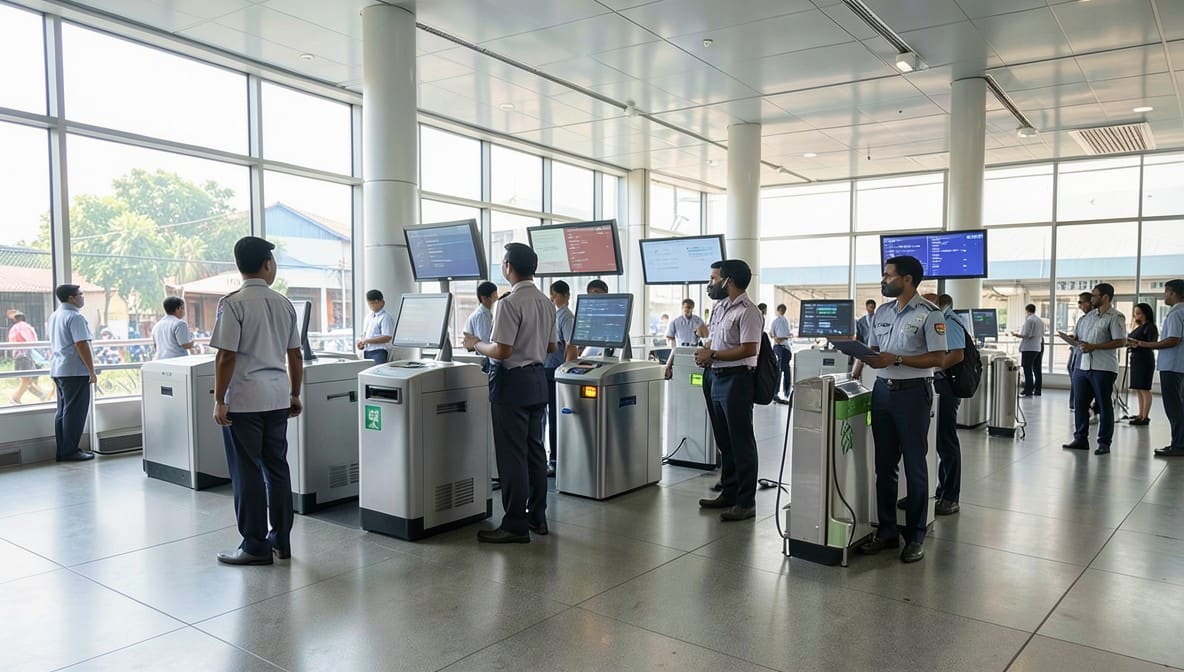
The Competition Commission of India (CCI) has closed an investigation into allegations of anti-competitive practices by Delhi International Airport Limited (DIAL) in awarding security contracts to RAXA Security Services Limited, a subsidiary of GMR Group. The Commission found no evidence of contravention of Sections 3 or 4 of the Competition Act, 2002, emphasizing that commercial decisions must respect arms-length principles and compliance with contractual obligations under the Operation, Management and Development Agreement (OMDA).
Background & Facts
The Dispute
The Informant, Swam Kartik Sharma, Director of M/s Galaxy Security and Allied Services Pvt. Ltd., filed an Information before the CCI alleging that DIAL, Airports Authority of India (AAI), and Ministry of Civil Aviation (MoCA) had contravened Sections 3 and 4 of the Competition Act, 2002. The core allegation centered on DIAL's award of security service contracts to RAXA Security Services Limited (RAXA), a subsidiary of GMR Group, without adhering to a competitive bidding process, thereby allegedly creating a monopolistic environment and excluding other contractors from the market.
Key Facts
- The Informant is the Director of M/s Galaxy Security and Allied Services Pvt. Ltd., a provider of security services in Delhi and other states.
- GMR Group operates Indira Gandhi International Airport (IGIA) under a 30-year OMDA with the Government of India, with DIAL being the concessionaire entity.
- RAXA has provided security services at IGIA for the past twenty years, with GMR Airports Infrastructure Limited holding nearly 100% shares of RAXA.
- On 19.02.2025, the Informant emailed DIAL alleging that the award of security contracts to RAXA violated General Financial Rules (GFR) due to the absence of a public tender process.
- DIAL responded on 24.02.2025, stating that RAXA was awarded the contract through a competitive bidding process in April 2022, and that GFR does not apply to DIAL as a private entity.
Procedural History
- 10.12.2025: CCI directed DIAL to file its response to the Information and furnish specific details regarding the award of the contract to RAXA.
- 18.02.2026: CCI granted DIAL an extension of four weeks to file its response.
- 27.03.2026: DIAL filed its response, raising preliminary objections, including allegations of misleading information, lack of standing by the Informant, and bar by limitation.
- 16.07.2026: CCI passed the final order under Section 26(2) of the Competition Act, 2002, closing the matter.
Relief Sought
The Informant sought an investigation into DIAL's alleged anti-competitive practices and interim relief under Section 33 of the Act to restrain DIAL from taking adverse action against the Informant. The Informant also prayed for measures to curb the monopolistic environment in the airport security business.
The Legal Issue
The central question was whether DIAL's award of security service contracts to RAXA, a related entity, constituted an abuse of dominant position under Section 4 of the Competition Act, 2002, or engaged in anti-competitive agreements under Section 3, by failing to adhere to competitive bidding processes or by leveraging its dominant position to exclude competitors.
Arguments Presented
For the Informant
The Informant contended that DIAL's failure to follow a competitive bidding process for awarding contracts to RAXA violated the principles of transparency and fairness, thereby contravening Sections 4(2)(a)(i), 4(2)(b)(i), 4(2)(c), and 4(2)(e) of the Act. The Informant argued that the continuous award of contracts to RAXA, a subsidiary of GMR, for twenty years without a transparent process created a monopolistic environment and restricted market access for other contractors.
For the Opposite Parties (DIAL, AAI, MoCA)
DIAL submitted that the contract was awarded to RAXA through a competitive bidding process in April 2022, in compliance with the OMDA and applicable laws. DIAL emphasized that the value of the tender (approx. INR 42.80 crores) was below the threshold requiring competitive bidding under Article 8.5.7 of the OMDA, yet it followed the process voluntarily. DIAL also highlighted that the Informant lacked standing, as Galaxy Security did not possess a valid Private Security Agency (PSA) license until 23.10.2024 and had been debarred by a PSU for collusive bidding.
DIAL further argued that the Informant was not an aggrieved party but part of a pattern of vexatious litigation by entities associated with Mr. Ajit Swami, a chronic litigant. DIAL also contended that the Information was barred by limitation, as the contract was awarded on 30.06.2022, beyond the three-year look-back period under the proviso to Section 19(1) of the Act.
DIAL furnished evidence of five tenders issued for security services at IGIA in 2007, 2014, 2020, 2022, and 2025, all of which followed competitive bidding processes and were awarded to RAXA on an arms-length basis. The Commission noted that DIAL had complied with the requirements of Schedule 12 of the OMDA, including the appointment of an independent probity auditor and approval by the Board of Directors, which includes AAI representation.
The Court's Analysis
The Commission examined the allegations under Sections 3 and 4 of the Competition Act, 2002. It noted that the Informant had not furnished substantive material to demonstrate how DIAL's conduct amounted to imposition of unfair conditions under Section 4(2)(a)(i) or how the tendering process was not competitive.
The Commission observed that DIAL had followed a competitive bidding process for all tenders issued for security services at IGIA, including the tender for non-core security functions in 2025. The process included publication of tender notices, invitation of sealed bids, technical and financial evaluation, and approval by the Board of Directors, in compliance with the OMDA and applicable laws. The Commission also noted that DIAL had appointed an independent probity auditor and obtained AAI's approval for related party transactions, as required under Schedule 12 of the OMDA.
"The Commission deems it appropriate not to interfere with the commercial decisions made by the entities in the normal course of business unless the same raise any anti-competitive concern."
The Commission further held that the Informant had not placed any material on record to indicate bid-rigging or collusive bidding under Section 3 of the Act. It also noted that the Informant had not demonstrated any contravention of Section 4(2)(b)(i), 4(2)(c), or 4(2)(e), as the tendering process was transparent and competitive.
The Commission emphasized that the procurer must have the freedom to exercise its choice in procurement, subject to compliance with the law and contractual obligations. It reiterated that related party transactions must be conducted on an arms-length basis and in compliance with the OMDA, which DIAL had done.
The Verdict
The Commission closed the matter under Section 26(2) of the Competition Act, 2002, finding no contravention of Sections 3 or 4 of the Act. The Information was held to be unsubstantiated, and no case for interim relief under Section 33 of the Act arose. The Commission directed the Secretary to communicate the decision to the Informant.
What This Means For Similar Cases
Compliance with OMDA Is Non-Negotiable
- Entities operating under OMDA must strictly adhere to the provisions governing related party transactions, including the appointment of an independent probity auditor and approval by the Board of Directors.
- The Commission will not interfere with commercial decisions unless they raise anti-competitive concerns or violate the law.
Transparency in Procurement Is Key
- Competitive bidding processes must be followed for all tenders, regardless of the tender value, to ensure transparency and fairness.
- The Commission will scrutinize the tendering process to ensure compliance with the principles of arms-length transactions and non-discrimination.
Standing and Limitation Are Critical
- The Informant must demonstrate standing and provide substantive evidence to support allegations of anti-competitive practices.
- The Commission will not condone delays beyond the statutory limitation period without sufficient cause.