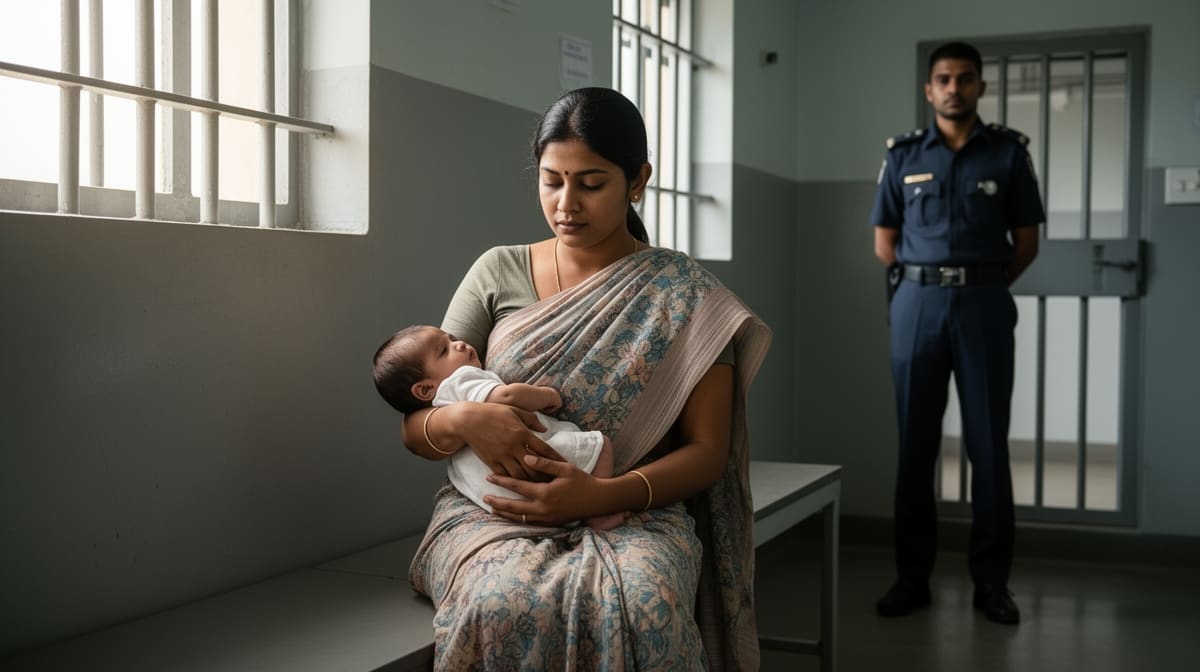
The Bombay High Court has suspended the life sentence of a woman convicted under Section 302 IPC, emphasizing that the case rests entirely on circumstantial evidence and that her personal circumstances - including being a victim of sexual assault as a minor and now being a mother of two - warrant interim relief pending appeal. This order underscores the court’s discretion to grant bail in cases where conviction is not beyond reasonable doubt and humanitarian considerations are compelling.
Background & Facts
The Dispute
The applicant, Nilam Kashinath Kadam, was convicted by the Additional Sessions Judge, Vaduj, in Sessions Case No.13 of 2017 arising out of CR No.56 of 2015 registered at Aundh Police Station, District Satara, for the offence under Section 302 of the Indian Penal Code, 1860. She was sentenced to life imprisonment on 20th April 2026. The conviction was based solely on circumstantial evidence.
Key Facts
- The applicant is a 24-year-old woman who was sexually assaulted while a minor, resulting in pregnancy and the birth of a child.
- She is currently married and is the mother of two children, aged 7 and 9 years.
- She was on bail throughout the trial proceedings.
- She was taken into custody only on 23rd April 2026, immediately after the conviction and sentencing.
- The prosecution’s case relies entirely on circumstantial evidence, with no direct eyewitness or forensic link establishing her guilt beyond reasonable doubt.
- The applicant’s counsel highlighted Paragraph 15 of the trial court’s judgment, which acknowledges the absence of conclusive proof and the reliance on inferences.
Procedural History
- CR No.56 of 2015: Registered at Aundh Police Station, District Satara, on the alleged incident.
- Sessions Case No.13 of 2017: Trial commenced before the Additional Sessions Judge, Vaduj.
- 20th April 2026: Conviction and life sentence imposed.
- 23rd April 2026: Applicant taken into custody after being on bail during trial.
- 08th May 2026: Interim Application No.295 of 2026 filed before the Bombay High Court, Circuit Bench at Kolhapur, seeking suspension of sentence and grant of bail pending appeal.
Relief Sought
The applicant sought suspension of the life sentence and grant of bail during the pendency of Criminal Appeal No.110 of 2026, citing her status as a victim of sexual assault, her maternal responsibilities, and the weak, circumstantial nature of the prosecution’s case.
The Legal Issue
The central question was whether, in a case founded entirely on circumstantial evidence and where the accused is a woman with compelling personal circumstances - including prior victimization and current motherhood - the High Court may suspend the sentence and grant bail pending appeal, even in a grave offence like murder under Section 302 IPC.
Arguments Presented
For the Appellant/Petitioner
Mr. Dhananjayrao D. Rananaware, learned counsel for the applicant, submitted that the conviction was based on speculative inferences and that not all circumstances necessary to establish guilt were proven. He relied on Paragraph 15 of the trial judgment, which itself acknowledges the absence of direct evidence and the reliance on a chain of circumstances. He emphasized the applicant’s status as a victim of sexual assault as a minor, her current role as a mother of two minor children, and the fact that she had been on bail throughout the trial without any flight risk or interference with witnesses. He argued that the gravity of the offence must be balanced against the humanitarian and procedural concerns, particularly where the evidence is not conclusive.
For the Respondent/State
Mr. A. A. Naik, Additional Public Prosecutor, supported the conviction and opposed bail, arguing that Section 302 IPC is a grave offence and that the trial court’s findings should not be disturbed at the interim stage. He contended that suspension of sentence and grant of bail in murder cases are exceptional and should not be granted merely on humanitarian grounds without a clear legal basis.
The Court's Analysis
The Court examined the nature of the evidence and the procedural posture of the case. It noted that the conviction was based entirely on circumstantial evidence and that the trial court itself had acknowledged the absence of direct proof. The Court observed that the chain of circumstances relied upon by the prosecution was not complete or unbroken, and that the possibility of an alternative explanation had not been conclusively ruled out.
"The case is of circumstantial evidence and all the circumstances are not established that the Applicant has been convicted merely on surmises."
The Court further considered the applicant’s personal circumstances: her history as a victim of sexual assault as a minor, her current status as a mother of two young children, and the fact that she had remained on bail throughout the trial without any adverse incident. The Court held that these factors, taken together with the weak evidentiary foundation, justified the grant of interim relief.
The Court distinguished this case from those involving heinous crimes with clear, direct evidence, noting that where the conviction is tenuous and the accused is not a flight risk, the balance of convenience and equity tilts in favour of granting bail pending appeal.
The Verdict
The applicant succeeded. The Court suspended the sentence of life imprisonment imposed on 20th April 2026 and granted bail pending the disposal of Criminal Appeal No.110 of 2026. The applicant shall be released on furnishing a personal bond of Rs.25,000 with one or two solvent local sureties in the same amount. The bail bond must be submitted before the trial court. The applicant is directed to appear before the High Court whenever the appeal is listed for final hearing.
What This Means For Similar Cases
Circumstantial Evidence Demands Stricter Scrutiny
- Practitioners must challenge convictions based solely on circumstantial evidence by highlighting gaps in the chain of circumstances, especially where the trial court’s own judgment acknowledges uncertainty.
- The burden on the prosecution to establish a complete, unbroken, and conclusive chain remains absolute under Shivaji v. State of Maharashtra and State of U.P. v. Krishna.
Humanitarian Grounds Can Override Gravity of Offence in Interim Relief
- In cases involving female accused who are victims of sexual violence and are primary caregivers, courts may grant bail pending appeal even in Section 302 IPC cases, provided the evidence is weak.
- The court’s discretion under Section 389 CrPC permits suspension of sentence where the appeal is likely to succeed or where continued incarceration would cause undue hardship.
Bail Is Not a Merit Determination at Interim Stage
- The grant of bail at the interim stage does not imply acquittal or a finding of innocence.
- It is a procedural safeguard to preserve the right to appeal, particularly where the conviction is not beyond reasonable doubt and the accused has no history of non-compliance.