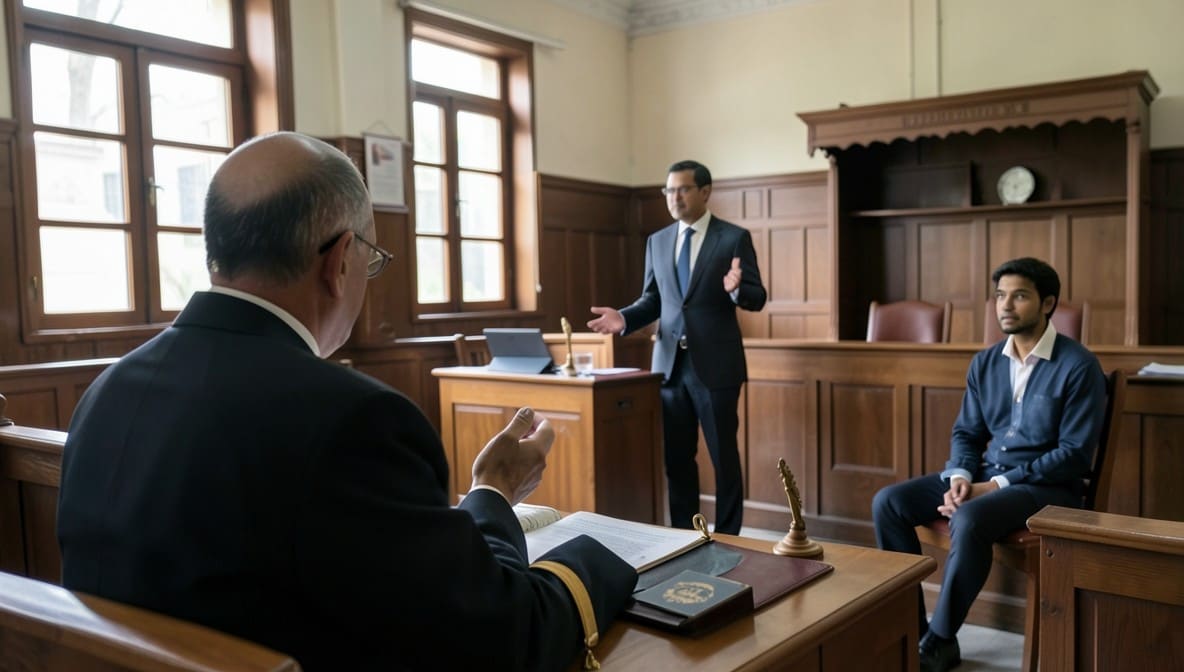
In a significant order addressing the rights of convicts awaiting appeal hearings, the Bombay High Court has suspended the life imprisonment sentence of an appellant convicted under Section 302 of the Indian Penal Code, citing a 14-year incarceration without resolution of his appeal. The judgment underscores the principle that prolonged detention without appellate review may warrant suspension of sentence, even in grave offences, when the delay is attributable to systemic inefficiencies rather than the convict’s conduct.
Background & Facts
The Dispute
The applicant, Daulat Pandurang Kadalag, was convicted by the Additional Sessions Judge, Khed-Rajgurunagar, District Pune, on 02.04.2016 for the murder of his wife, Surekha Daulat Kadalag. The prosecution’s case relied entirely on circumstantial evidence, alleging that the applicant poured kerosene on his wife and set her ablaze. The trial court imposed a sentence of life imprisonment along with a fine of Rs. 3,000.
Key Facts
- The applicant was arrested on 12.03.2012 and has remained incarcerated since.
- The conviction was based on circumstantial evidence, with no direct witnesses to the alleged offence.
- The appeal against the conviction (Criminal Appeal No. 19 of 2017) remained pending for over ten years without hearing.
- The applicant sought suspension of sentence and bail on the ground that his prolonged detention was unjustified given the delay in appellate review.
Procedural History
- 12.03.2012: Applicant arrested and taken into custody.
- 02.04.2016: Convicted by the Additional Sessions Judge, Khed-Rajgurunagar, in Session Case No. 137 of 2014.
- Post-2016: Criminal Appeal No. 19 of 2017 filed before the Bombay High Court, remaining pending.
- 2023: Interim Application No. 3551 of 2023 filed for suspension of sentence.
- 10.07.2026: Bombay High Court allows the application and suspends the sentence.
Relief Sought
The applicant sought suspension of his life imprisonment sentence and bail, arguing that:
- He had been incarcerated for over fourteen years without his appeal being heard.
- The delay in appellate review was not attributable to his conduct.
- The case relied on circumstantial evidence, warranting a re-examination of the conviction.
The Legal Issue
The central question before the Court was whether suspension of sentence under Section 389 of the Code of Criminal Procedure (CrPC) could be granted to a convict serving life imprisonment for murder, where the appeal had remained pending for an inordinate period without hearing, and the case rested on circumstantial evidence.
Arguments Presented
For the Applicant
- Cited the precedent of Saudan Singh v. State of Uttar Pradesh to argue that prolonged incarceration without appellate review justifies suspension of sentence.
- Emphasized that the applicant had been behind bars for fourteen years without any progress in his appeal.
- Highlighted that the case was based on circumstantial evidence, which necessitated a thorough appellate review.
For the Respondent-State
- The State, represented by the Additional Public Prosecutor, did not oppose the application, implicitly acknowledging the delay in the appellate process.
The Court's Analysis
The Court relied on the principles established in Saudan Singh v. State of Uttar Pradesh, where the Supreme Court held that prolonged detention without appellate review may warrant suspension of sentence, even in cases involving grave offences. The Court observed:
"The charge against him was that he had committed the murder of his wife... The case is based on circumstantial evidence. Even though it may be found that the nominal roll is not on record, from the judgment we can gather that he is behind bar since 12/03/2012. Thus, more than fourteen years have elapsed. The observations in the case of Saudan Singh are applicable to the present case."
The Court noted that the applicant’s prolonged incarceration was not due to any fault of his own but rather the systemic delay in hearing his appeal. While the offence was grave, the Court balanced the right to a speedy appellate review against the interests of justice, concluding that suspension of sentence was warranted under the circumstances.
The Verdict
The Bombay High Court allowed Interim Application No. 3551 of 2023 and suspended the applicant’s life imprisonment sentence imposed by the Additional Sessions Judge, Khed-Rajgurunagar, in Session Case No. 137 of 2014. The Court directed:
- The applicant shall furnish a personal bond and surety bond of Rs. 25,000 each to the satisfaction of the Trial Court.
- The applicant shall report to the Chakan Police Station on the first Monday of September, January, and May between 10:00 a.m. and 12:00 noon until the disposal of the appeal.
- The applicant shall furnish his contact details and residential address to the Trial Court.
- The applicant shall cooperate during the hearing of the appeal.
- The applicant shall be released from jail if not required in any other case.
What This Means For Similar Cases
Suspension of Sentence Not Automatic, But Delay Justifies Relief
- The judgment reaffirms that suspension of sentence under Section 389 CrPC is not automatic, even in cases involving grave offences like murder. However, prolonged incarceration without appellate review may tilt the balance in favour of the convict.
- Practitioners should argue that systemic delays in hearing appeals, particularly when the convict has been incarcerated for over a decade, warrant suspension of sentence, especially when the case relies on circumstantial evidence.
Circumstantial Evidence Cases Require Scrutiny
- Courts may be more inclined to suspend sentences in cases based on circumstantial evidence, as the absence of direct proof leaves room for appellate review to re-examine the conviction.
- Defence counsel should emphasize the weaknesses in the prosecution’s case, such as reliance on circumstantial evidence, to strengthen arguments for suspension of sentence.
Compliance with Bail Conditions Is Critical
- The Court imposed strict reporting conditions (first Monday of every four months) and required the applicant to furnish personal and surety bonds of Rs. 25,000 each. Non-compliance with these conditions could lead to revocation of the suspension order.
- Practitioners must ensure that clients strictly adhere to bail conditions, as failure to do so may result in re-incarceration.
Precedent Applicability
- The reliance on Saudan Singh v. State of Uttar Pradesh establishes that delayed appellate review is a valid ground for suspension of sentence, even in Section 302 IPC cases. This precedent can be cited in similar matters where convicts have been incarcerated for extended periods without their appeals being heard.