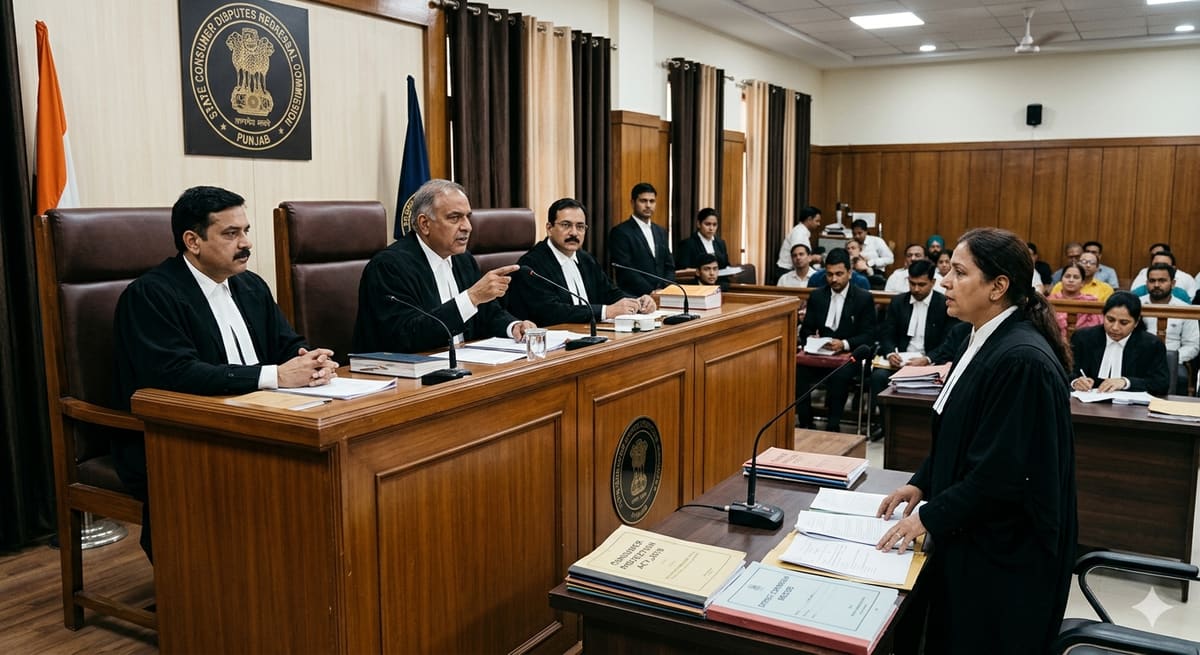
The Kerala State Consumer Disputes Redressal Commission has clarified a critical procedural shift under the Consumer Protection Act, 2019: even complaints filed under the old 1986 Act cannot be dismissed for default. This ruling reinforces the legislature’s intent to prioritize substantive justice over technical non-appearance, offering renewed recourse to consumers whose cases were prematurely closed.
Background & Facts
The Dispute
The appellants, M.K. Balan and M.K. Santha, filed a consumer complaint (C.C. No. 255/2015) before the District Consumer Disputes Redressal Commission, Kozhikode, against the Vatakara Co-operative Housing Society. The complaint alleged deficiency in service related to delayed possession of an apartment, failure to provide amenities, and non-compliance with agreed timelines under the sale agreement.
Key Facts
- The complaint was filed on 15.06.2015 under the Consumer Protection Act, 1986.
- The matter was listed for hearing on multiple occasions between 2015 and 2019.
- The complainants failed to appear on the hearing date of 29.07.2019.
- On that date, the District Commission dismissed the complaint for default under Section 13(2)(c) of the Consumer Protection Act, 1986.
- The appellants were not represented by counsel at the time of dismissal.
- No application for restoration or explanation for non-appearance was filed before the District Commission.
Procedural History
- 15.06.2015: Complaint filed before District Consumer Disputes Redressal Commission, Kozhikode (C.C. No. 255/2015)
- 29.07.2019: District Commission dismissed complaint for default under Section 13(2)(c) of the Consumer Protection Act, 1986
- 28.08.2019: First Appeal No. SC/32/A/353/2019 filed before Kerala State Consumer Disputes Redressal Commission
- 23.03.2026: Judgment delivered by the State Commission
Relief Sought
The appellants sought setting aside of the order dated 29.07.2019 dismissing the complaint for default, and restoration of the complaint to its pre-dismissal stage for adjudication on merits.
The Legal Issue
The central question was whether the Consumer Protection Act, 2019, specifically Section 38(3)(c), which mandates adjudication on merits even if the complainant fails to appear, applies to complaints filed under the Consumer Protection Act, 1986, and overrides the earlier provision permitting dismissal for default under Section 13(2)(c).
Arguments Presented
For the Appellant
The first appellant appeared in person and argued that the dismissal was unjust, as no notice of the hearing date was properly served, and the complainants were unaware of the date. He contended that the 2019 Act, being more protective of consumer rights, should apply retrospectively to pending complaints. He relied on the principle that procedural laws are generally retrospective unless expressly stated otherwise.
For the Respondent
The respondent did not appear or file any representation before the State Commission. No counter-arguments were presented.
The Court's Analysis
The State Commission undertook a detailed statutory interpretation of the transition provisions under the Consumer Protection Act, 2019. It noted that while the complaint was filed under the 1986 Act, the dismissal occurred after the 2019 Act came into force on 20.07.2020. The Court emphasized that Section 107(2) of the 2019 Act explicitly provides that any provision of the 1986 Act that is inconsistent with the 2019 Act shall stand repealed to the extent of the inconsistency.
"Section 38(3)(c) of the Consumer Protection Act, 2019 mandates that even if the complainant fails to appear, the complaint shall be decided on merits. This provision is clearly inconsistent with Section 13(2)(c) of the 1986 Act, which permits dismissal for default."
The Court held that Section 107(2) operates as a legislative directive to apply the more consumer-friendly procedural safeguard of the 2019 Act to all pending proceedings, regardless of when the complaint was filed. The Court further observed that the 2019 Act was enacted to strengthen consumer rights and eliminate technical dismissals that deprive consumers of substantive justice.
Additionally, the Court noted that the dismissal on 29.07.2019 occurred after the 2019 Act was notified, and therefore, the new procedural norm must govern. The Court also found that even on equitable grounds, granting another opportunity to the complainants was just and necessary, particularly in the absence of any representation from the respondent.
The Verdict
The appeal was allowed. The order dated 29.07.2019 dismissing the complaint for default is set aside. The District Consumer Disputes Redressal Commission, Kozhikode, is directed to proceed with the complaint afresh, restoring it to the stage immediately prior to dismissal. The complainants shall appear before the District Commission on 18.05.2026 without further notice. The District Commission shall issue notice to the respondent and afford both parties a full opportunity to present evidence and arguments. The proceedings shall be concluded within six months from the date of resumption.
What This Means For Similar Cases
Procedural Fairness Overrides Technical Defaults
- Practitioners must now argue that any complaint pending on or after 20.07.2020, regardless of filing date, is governed by Section 38(3)(c) of the 2019 Act
- Dismissals for non-appearance after the 2019 Act’s enforcement are legally invalid and subject to immediate reversal
- Courts and commissions must treat non-appearance as a procedural irregularity to be addressed by adjournment, not termination
Retroactive Application of Procedural Safeguards
- The judgment establishes that procedural amendments enhancing consumer rights apply retrospectively to pending cases
- This principle extends beyond consumer law to other statutes with similar transition clauses
- Legal teams should routinely invoke Section 107(2) of the 2019 Act to challenge dismissals in any pending consumer matter
Duty to Notify and Record Non-Appearance
- Commissions must now record the reasons for non-appearance and consider whether the complainant was properly served
- Failure to issue notice or record service attempts may render any dismissal void ab initio
- Advocates should file applications for restoration even if the complaint was dismissed under the 1986 Act, citing this judgment as binding precedent