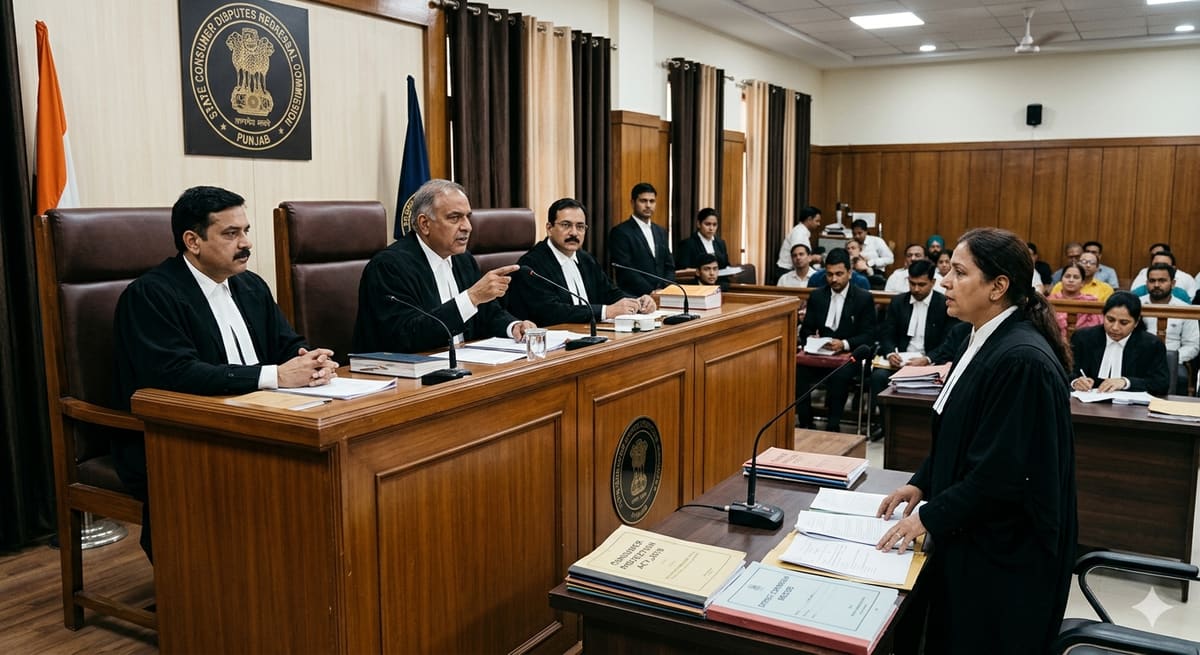
The Punjab State Consumer Disputes Redressal Commission has clarified that District Consumer Commissions cannot issue evidence-related directions at the preliminary stage of a complaint, as it violates the principles of natural justice and the procedural framework under Section 38 of the Consumer Protection Act, 2019. The ruling underscores that premature directions, especially those requiring parties to produce documents like registration certificates, completion certificates, or bank account details before filing a reply, amount to an abuse of process and exceed the Commission's jurisdiction.
Background & Facts
The Dispute
The case arose from a consumer complaint filed by Raj Davinder Athwal, a non-resident Indian residing in Canada, against M/s Mona Townships Private Limited and its directors (Respondents No.2-5) for failure to deliver possession of a flat in Mona Greens, Zirakpur, despite receiving full payment of Rs.35,00,000. The complainant alleged that the opposite parties (OPs) sold her flat to Raman Kumar Garg (Appellant/OP No.5) in an illegal manner, causing mental harassment and financial loss. The complainant sought refund of Rs.35,00,000 with 12% interest from 31.08.2016, compensation of Rs.5,00,000 for harassment, Rs.10,00,000 as special compensation for illegal sale, and Rs.1,50,000 as litigation costs.
Key Facts
The complainant booked a flat in Mona Greens and paid Rs.35,00,000 in full
The opposite parties failed to deliver possession within the agreed timeline
The complainant alleged illegal sale of her flat to the appellant (OP No.5)
The complaint was filed before the District Consumer Disputes Redressal Commission, SAS Nagar (Mohali) on Consumer Complaint No.549 of 2024
The complainant sought refund, interest, compensation, and costs as detailed in the prayer clause
Procedural History
29.11.2024: District Commission admitted the complaint and issued notices to OPs
The District Commission also issued directions to OPs to produce the following documents at the preliminary stage:
Registration Certificate of the project
Copy of license under Punjab Apartment and Property Regulation Act, 1995
Change of Land Use (CLU) documents
Letter of Intent (LOI)
Approved site plan
Completion Certificate
Photographs of the site/unit
List of directors and bank accounts of the company
Details of moveable/immovable properties for attachment
Encumbrance details, if any
The District Commission further directed Greater Mohali Area Development Authority (GMADA) to furnish project-related documents, despite GMADA not being a party to the complaint
17.02.2025: Appellant (OP No.5) filed First Appeal No.142 of 2025 before the State Consumer Disputes Redressal Commission, Punjab, challenging the preliminary directions
06.11.2025: Service upon Respondent No.2 was dispensed with
27.04.2026: Appeal reserved for decision
07.05.2026: Appeal decided
Positions Before This Court
For the Appellant
The District Commission’s order was premature and contrary to the Consumer Protection Act, 2019
The Commission exceeded its jurisdiction by issuing evidence-related directions at the preliminary stage, before the OPs filed their reply
The directions violated natural justice as the OPs were not given an opportunity to present their case
The District Commission attempted to prove the complainant’s case without waiting for the OPs’ reply
The directions to produce moveable/immovable property details were execution-stage requirements, not preliminary-stage
The District Commission ignored Section 38 of the Act, which mandates that evidence be considered only after the OPs file their reply
The appellant was not even a party against whom relief was sought in the complaint
For the Respondent/Complainant
The District Commission rightly issued directions to all OPs, including the appellant
The directions were necessary to expedite the proceedings and gather relevant evidence
The appellant’s challenge was misplaced, as the District Commission acted within its jurisdiction
The Legal Issue
The central question before the State Commission was:Whether the District Consumer Disputes Redressal Commission can issue evidence-related directions at the preliminary stage of a complaint, before the opposite parties file their reply, and without affording them an opportunity to be heard?
Arguments Presented
For the Appellant
Violation of Natural Justice: The District Commission’s directions denied the OPs an opportunity to file a reply, violating the principles of natural justice
Excess of Jurisdiction: The Commission exceeded its statutory powers under Section 38 of the Consumer Protection Act, 2019, which requires evidence to be considered only after the OPs’ reply
Premature Directions: The directions to produce registration certificates, completion certificates, and property details were execution-stage requirements, not preliminary-stage
Third-Party Directions: The Commission erred in directing GMADA, a non-party, to furnish documents at the preliminary stage
No Relief Against Appellant: The complainant did not seek any relief against the appellant (OP No.5), making the directions irrelevant and unjustified
For the Respondent/Complainant
Procedural Fairness: The District Commission acted within its jurisdiction by issuing directions to all OPs
Expediency: The directions were necessary to gather evidence and expedite the proceedings
No Prejudice: The appellant failed to demonstrate prejudice caused by the directions
The Court's Analysis
The State Commission critically examined Section 38 of the Consumer Protection Act, 2019, which governs the procedure for admitting and disposing of consumer complaints. The Court observed:
"From perusal of record and order of the District Commission, it is apparent that in the case in hand the District Commission had issued directions to the OPs even without waiting for the written version which appears to be an abuse of process of law. Moreover, while issuing a number of directions as mentioned in the impugned order, asking the OPs to place on record the Registration Certificate of the project, CLU, LOI, etc. which shows that the District Commission is trying to prove the case of the Complainant without giving any opportunity to the OPs to place on record the reply with supporting documents."
The Court further held that the District Commission exceeded its jurisdiction by:
Issuing evidence-related directions at the preliminary stage, before the OPs filed their reply
Directing the OPs to produce documents that are typically required at the execution stage, not the preliminary stage
Attempting to prove the complainant’s case without affording the OPs an opportunity to present their defense
Directing a third party (GMADA) to furnish documents, despite GMADA not being a party to the complaint
The Court relied on Section 38(3)(a) and (b) of the Act, which stipulates that the District Commission shall:
Refer a copy of the complaint to the opposite party directing him to give his version of the case within 30 days (extendable by 15 days)
Proceed to settle the dispute on the basis of evidence brought by the complainant and the opposite party only after the opposite party denies or disputes the allegations
The Court emphasized that no proceedings complying with the procedure under Section 38(1) and (2) can be called into question on the ground of non-compliance with natural justice. However, the impugned order clearly violated this statutory framework by issuing premature directions.
The Verdict
The State Consumer Disputes Redressal Commission, Punjab allowed the appeal and set aside the directions issued in paras 4 and 5 of the District Commission’s order dated 29.11.2024. The Court directed the District Commission to proceed with the complaint as per the provisions of the Consumer Protection Act, 2019, ensuring that the OPs are afforded a fair opportunity to file their reply and present evidence.
What This Means For Similar Cases
District Commissions Cannot Pre-empt Evidence Collection
Preliminary Stage ≠ Evidence Stage: District Commissions cannot issue evidence-related directions at the preliminary stage, as this amounts to proving the complainant’s case prematurely
Opportunity to Reply Mandatory: Opposite parties must be given a fair chance to file their reply before any evidence-related directions are issued
Third-Party Directions Invalid: Directions to non-parties (e.g., GMADA) at the preliminary stage are ultra vires and liable to be set aside
Natural Justice Must Guide Procedural Directions
No Shortcuts in Consumer Disputes: While expediency is important, District Commissions cannot bypass procedural safeguards under the guise of efficiency
Execution-Stage Directions Only: Directions requiring property details, bank accounts, or completion certificates are execution-stage requirements and cannot be issued at the preliminary stage
Section 38(5) Protection: While Section 38(5) protects proceedings complying with the Act from challenge on natural justice grounds, premature directions violate this protection
Practical Takeaways for Practitioners
Challenge Premature Directions: If a District Commission issues evidence-related directions before the OPs file their reply, practitioners should immediately challenge such orders as ultra vires
Focus on Section 38 Compliance: Ensure that the District Commission follows the statutory procedure under Section 38(3)(a) and (b) before issuing any directions
Avoid Third-Party Overreach: Directions to non-parties at the preliminary stage are invalid and should be vigorously opposed
Documentary Evidence Timing: Evidence like registration certificates, completion certificates, and property details should only be required after the OPs file their reply