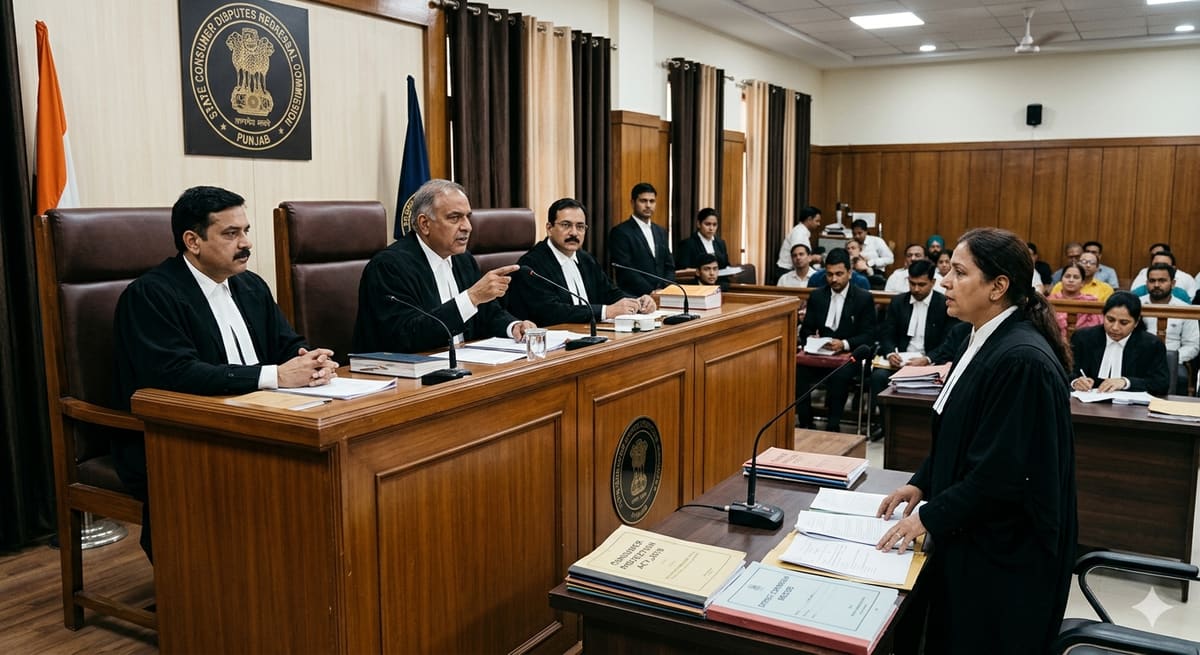
The West Bengal State Consumer Disputes Redressal Commission has reaffirmed a foundational principle of procedural fairness: allegations of document spoliation and fabrication cannot be adjudicated through interlocutory applications. The Commission emphasized that such grave claims must be resolved only after full opportunity for evidence and cross-examination, ensuring the right to be heard is not circumvented.
Background & Facts
The Dispute
The complainant, Dr. Dipankar Chakrabarti, filed a consumer complaint (CC/649/2022) against multiple respondents including Charnock Hospital, Poddar Ambulance Service, Spandan Hospital, and several doctors, alleging deficiencies in medical services rendered during the treatment of a patient. The complainant alleged that key medical records, diagnostic reports, and treatment logs were tampered with, concealed, or fabricated by the opposite parties to evade liability.
Key Facts
- The complaint was originally filed before the District Consumer Disputes Redressal Commission, Rajarhat.
- The opposite parties (except OP Nos. 3 and 4) filed written versions and detailed questionnaires challenging the complainant’s evidence on affidavit.
- On an unspecified date prior to 01.07.2025, the complainant filed an interlocutory application seeking drastic remedies based on alleged spoliation of evidence.
- OP Nos. 3 and 4 failed to file written versions within the statutory period and were proceeded against ex parte.
- The complainant’s interlocutory application sought: (a) declaration of document spoliation; (b) dismissal of opposite parties’ claims; (c) ex parte judgment; and (d) adverse inference against the respondents.
Procedural History
- Date of Complaint Filing: CC/649/2022 filed before District Consumer Disputes Redressal Commission, Rajarhat (exact date not specified in judgment).
- Date of Filing of Written Versions and Questionnaires: Prior to 01.07.2025 by OP Nos. 1, 2, 5, 6, 7, and 9.
- 01.07.2025: District Commission dismissed the interlocutory application, holding that allegations of spoliation must be addressed at final hearing.
- 08.06.2026: Revision petition filed before the State Commission under Revision Petition No. SC/19/RP/102/2025.
- 08.06.2026: State Commission heard arguments and delivered judgment.
The Parties' Positions
Complainant’s Position: Alleged that the opposite parties deliberately destroyed, concealed, or fabricated medical documents to mislead the forum. Argued that this warranted immediate adverse inference and ex parte judgment under Section 114 of the Indian Evidence Act and principles of natural justice.
Respondents’ Position: Contended that they had already filed written versions and questionnaires, thereby affirming their intent to contest the case on merits. Argued that the complainant’s application was an abuse of process, seeking premature adjudication without affording them opportunity to rebut.
Relief Sought
The complainant sought: (a) a declaration that the opposite parties had spoliated documents; (b) dismissal of the opposite parties’ defense; (c) ex parte judgment against them; and (d) adverse inference to be drawn against them.
The Legal Issue
Can a consumer forum grant an ex parte judgment or draw adverse inference against opposite parties based solely on allegations of document spoliation, raised via an interlocutory application, before the final hearing and without affording them an opportunity to present evidence?
Arguments Presented
For the Petitioner
The petitioner argued that the deliberate concealment and fabrication of medical records by the opposite parties constituted a serious breach of consumer rights and procedural integrity. Citing State of U.P. v. Ved Prakash and K. S. Puttaswamy v. Union of India, the petitioner contended that spoliation of evidence warrants immediate adverse inference under Section 114 of the Indian Evidence Act, and that the forum has inherent power to prevent abuse of process. The petitioner asserted that allowing the opposite parties to continue defending the case would perpetuate injustice.
For the Respondent
The respondents countered that they had already filed written versions and questionnaires, demonstrating active participation in the proceedings. They emphasized that the complainant’s application was an attempt to bypass the evidentiary process and obtain a summary judgment without proof. Relying on Arnesh Kumar v. State of Bihar and State of Haryana v. Bhajan Lal, they argued that allegations of tampering must be tested through cross-examination and not decided on pleadings alone. The right to be heard (audi alteram partem) is non-negotiable, even in consumer disputes.
The Court's Analysis
The State Commission undertook a rigorous analysis of the procedural posture of the case. It noted that the opposite parties, except two, had already filed written versions and questionnaires challenging the complainant’s evidence. This demonstrated their intent to contest the matter on its merits. The Commission held that allegations of spoliation are not mere procedural irregularities but serious factual assertions that go to the root of the case.
"Grievances concerning the spoliation and fabrication of documents reside squarely within the realm of final adjudication. Such grave assertions must be weighed solely against the crucible of evidence on record, while steadfastly honoring the sacred tenet of audi alteram partem."
The Court observed that the District Commission’s decision to defer the issue to final hearing was not only legally sound but constitutionally imperative. The Commission emphasized that the forum’s role is not to act as a summary court but to ensure a fair trial. Drawing adverse inference or granting ex parte judgment at the interlocutory stage would effectively deprive the respondents of their right to present evidence, rebut allegations, and cross-examine witnesses.
The Court further clarified that while Section 114 of the Indian Evidence Act permits adverse inference, its application requires a foundation of credible evidence - not mere allegations. The mere assertion of spoliation, without corroboration or opportunity for rebuttal, cannot trigger such an inference.
The Commission also rejected the notion that consumer forums have broader powers to bypass procedural norms. It held that even under the Consumer Protection Act, 2019, the principles of natural justice remain inviolable.
The Verdict
The revision petition was dismissed. The Order dated 01.07.2025 of the District Consumer Disputes Redressal Commission, Rajarhat, was affirmed. The complainant’s interlocutory application seeking adverse inference, ex parte judgment, and dismissal of the opposite parties’ claims was rightly rejected. The case was directed to proceed to final hearing, with the complainant expressly permitted to raise all issues relating to document spoliation at that stage. The State Commission ordered that the matter be resolved expeditiously, with no further delay.
What This Means For Similar Cases
Adverse Inference Requires Full Opportunity to Rebut
- Practitioners must not file interlocutory applications seeking adverse inference based on allegations of document tampering without supporting evidence.
- Courts will not grant summary relief on untested claims, even in consumer cases.
- The burden to prove spoliation lies on the party alleging it, and must be discharged through evidence, not pleadings.
Procedural Compliance Is Non-Negotiable
- Filing written versions and questionnaires constitutes active contestation and precludes ex parte proceedings.
- Opposite parties who participate in proceedings cannot be deemed to have abandoned their defense.
- Any attempt to shortcut the evidentiary process will be summarily rejected.
Final Hearing Is the Only Forum for Grave Allegations
- Allegations of forgery, fabrication, or destruction of documents must be raised and adjudicated at final hearing.
- Consumer forums must not be used as venues for summary punishment.
- The right to be heard is absolute and cannot be waived by procedural convenience.