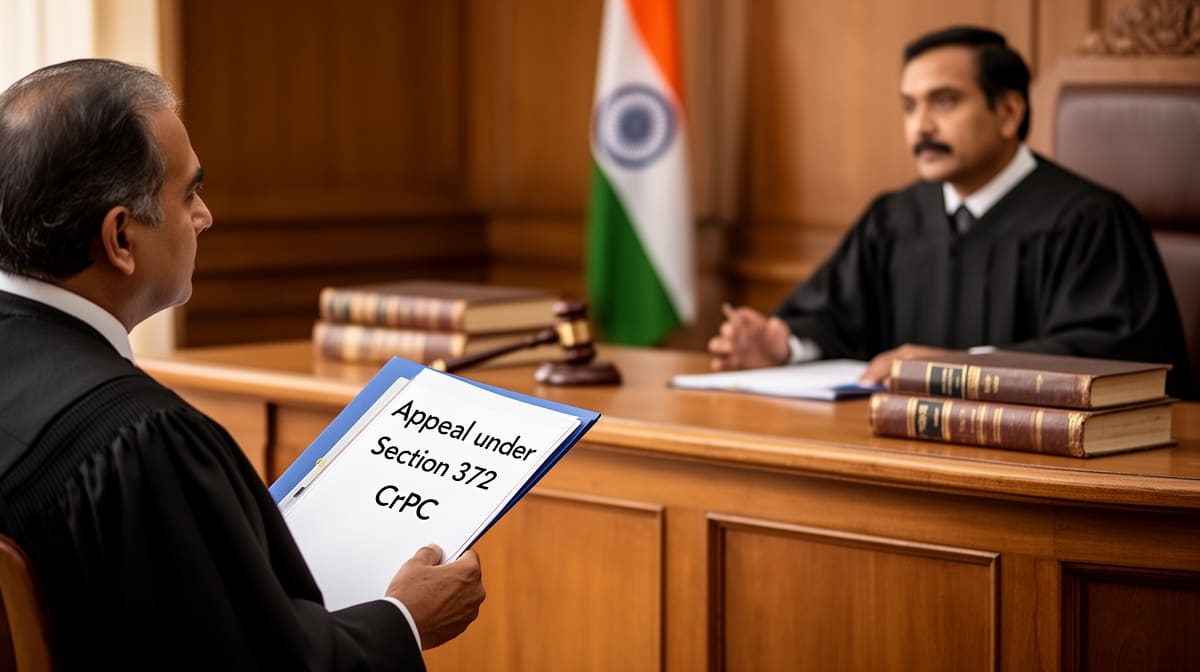
The Madhya Pradesh High Court has clarified that leave to appeal against an acquittal under Section 378 CrPC must be granted when a prima facie case is made out, particularly in cases involving sexual offences against children under the POCSO Act. The judgment reinforces that appellate courts must not dismiss applications for leave on superficial grounds but must examine whether arguable points arise from the prosecution’s evidence.
Background & Facts
The Dispute
The case arises from an alleged sexual assault on a minor girl, the prosecutrix, on 30.12.2021 near Ram Mandir, village Piplya, District Rajgarh. The accused, Sarvan @ Rajesh Chourasiya, was charged under Section 8 read with Section 12 of the Protection of Children from Sexual Offences Act, 2012, and Sections 294, 323, 506, and 34 of the Indian Penal Code. The trial court acquitted the accused on 11.05.2023 in Sessions Trial Case No. 39/2022.
Key Facts
- The prosecutrix (PW-1), a minor girl, reported that on 30.12.2021 at approximately 7:00 PM, while returning home from tuition, she encountered the accused near his house.
- She stated that the accused grabbed her hand in an indecent manner and pressed her chest.
- When she screamed, he snatched her torch and threatened her life.
- She escaped and informed her mother and brother upon reaching home.
- The brother confronted the accused, who assaulted him with shoes and used abusive language, threatening retaliation if a complaint was filed.
- A written application (Exhibit-2) was submitted by the prosecutrix to Police Station Boda on 31.12.2021.
- First Information Report (Exhibit-3) was registered as Crime No. 300/2021 on the same day.
- The prosecution relied on the testimony of the prosecutrix (PW-1) and the FIR (Exhibit-3), supported by the statement of Seeta Yadav (PW-8), who registered the FIR.
Procedural History
- 30.12.2021: Alleged incident occurred near Ram Mandir, village Piplya.
- 31.12.2021: Written complaint (Exhibit-2) submitted to Police Station Boda; FIR (Exhibit-3) registered.
- 11.05.2023: Trial Court (Second Additional Session Judge, Narsingarh) acquitted the accused in Sessions Trial Case No. 39/2022.
- 26.03.2026: Appeal filed under proviso to Section 378 CrPC seeking leave to appeal against acquittal.
- I.A. No. 10364/2023: Filed seeking leave to appeal before the Madhya Pradesh High Court.
Relief Sought
The State sought leave to appeal against the acquittal order dated 11.05.2023, arguing that the trial court erred in disregarding the prosecutrix’s testimony and the statutory presumption under Section 29 of the POCSO Act.
The Legal Issue
The central question was whether the High Court, in an application under Section 378(3) CrPC, must grant leave to appeal against an acquittal when the prosecution’s evidence, including the testimony of the victim and the presumption under Section 29 of the POCSO Act, raises a prima facie case or arguable points requiring re-appreciation.
Arguments Presented
For the Appellant
The State contended that the trial court failed to appreciate the prosecutrix’s testimony, which was consistent and detailed. It emphasized that under Section 29 of the POCSO Act, the court is required to presume that the accused had the requisite intent and knowledge unless disproved. The State argued that the acquittal was based on an erroneous evaluation of evidence and that the trial court ignored the presumption, thereby violating the legislative intent behind the POCSO Act. Reliance was placed on Manoj Rameshlal Chhabriya v. Mahesh Prakash Ahuja and Sita Ram v. State of U.P. to argue that leave must be granted where arguable points exist.
For the Respondent
The accused’s counsel supported the acquittal, arguing that the prosecutrix’s testimony was inconsistent and lacked corroboration. He contended that the delay in reporting, absence of medical evidence, and lack of independent witnesses rendered the prosecution case weak. He submitted that the trial court’s acquittal was well-reasoned and that no substantial question of law or fact warranted appellate intervention.
The Court's Analysis
The Court examined the principles laid down in Manoj Rameshlal Chhabriya v. Mahesh Prakash Ahuja (2025 INSC 282), particularly paragraphs 20 and 24, which hold that the High Court must not decide whether the acquittal is perverse at the leave stage, but must determine whether arguable points have been raised requiring re-examination of evidence.
"Where there is application of mind by the appellate court and reasons (may be in brief) in support of such view are recorded, the order of the court may not be said to be illegal or objectionable. At the same time, however, if arguable points have been raised, if the material on record discloses deeper scrutiny and reappreciation, review or reconsideration of evidence, the appellate court must grant leave as sought and decide the appeal on merits."
The Court noted that the prosecutrix’s testimony was detailed, consistent, and made shortly after the incident. The Court further emphasized that Section 29 of the POCSO Act creates a statutory presumption that the accused had the requisite intent and knowledge, which the trial court failed to apply. The Court held that the acquittal, by disregarding this presumption and the victim’s testimony without adequate reasoning, raises an arguable point requiring appellate scrutiny.
The Court also referenced Sita Ram v. State of U.P., affirming that the right to appeal is a fundamental component of fair procedure, especially in cases involving grave offences against children. The Court concluded that the State had made out a prima facie case warranting leave to appeal.
The Verdict
The application for leave to appeal under Section 378(3) CrPC was allowed. The High Court granted leave and admitted the appeal for final hearing. The respondent was directed to furnish a bail bond of Rs. 5,000/- before the concerned trial court on or before 29.04.2026. The trial court was directed to intimate the High Court regarding compliance. The case was listed for final hearing in due course.
What This Means For Similar Cases
Leave to Appeal Cannot Be Denied Without Reasoning
- Practitioners must insist that High Courts record brief but meaningful reasons when refusing leave under Section 378 CrPC.
- A mechanical refusal without reference to the prosecution’s evidence or statutory presumptions is legally unsustainable.
POCSO Presumption Is a Critical Factor at Leave Stage
- The presumption under Section 29 of the POCSO Act must be factored into the leave determination, even before full trial evaluation.
- Failure to apply this presumption by the trial court creates an arguable point that justifies appellate intervention.
Victim Testimony Alone Can Sustain Leave
- In POCSO cases, the testimony of the victim, if credible and consistent, is sufficient to raise arguable points - even without medical or corroboration evidence - at the leave stage.
- Courts must not demand perfection from child victims when assessing whether leave should be granted.