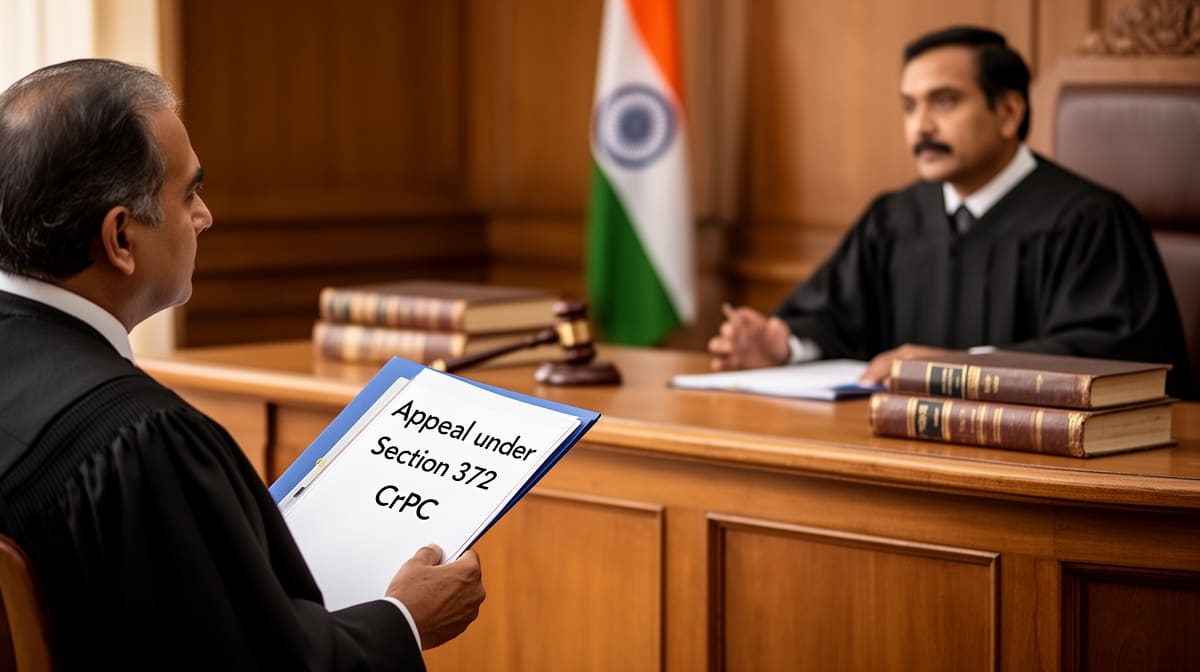
The Madhya Pradesh High Court has clarified that leave to appeal against an order of acquittal under Section 378(3) of the CrPC does not require the State to prove the acquittal is perverse at the threshold. Instead, the presence of a prima facie case or arguable points warrants grant of leave, reinforcing procedural fairness in criminal appeals.
Background & Facts
The Dispute
The appellant, Smt. Rekha, filed an appeal under Section 378(4) of the CrPC against the acquittal of the respondent, Nandlal, in a case under Section 138 of the Negotiable Instruments Act, 1881. The respondent had been convicted by the Judicial Magistrate First Class (JMFC), Ambedkar Nagar (Mhow), on 07.12.2023 for issuing a dishonoured cheque. However, the learned Additional Sessions Judge (ASJ), Ambedkar Nagar, reversed this conviction in Criminal Appeal No. 102/2023 on 11.06.2024, acquitting the respondent.
Key Facts
- The complaint was filed under Section 138 NI Act in SC NIA No. 369/2019, alleging issuance of a cheque for Rs. 2,50,000 dated 15.01.2019 which was dishonoured on 20.01.2019
- Legal notice under Section 138 was issued on 25.01.2019 and received by the accused on 05.02.2019
- The accused failed to make payment within 15 days of notice, triggering criminal liability
- The JMFC, on 07.12.2023, convicted the accused after finding the prosecution evidence credible and the defence rebutted
- The ASJ, on 11.06.2024, acquitted the accused, holding that the prosecution failed to establish mens rea and that the cheque was issued as security, not for discharge of debt
- The appellant challenged this acquittal by filing IA No. 12538/2024 seeking leave to appeal
Procedural History
- 15.01.2019: Cheque issued by respondent for Rs. 2,50,000
- 20.01.2019: Cheque dishonoured by bank
- 25.01.2019: Legal notice sent under Section 138 NI Act
- 05.02.2019: Notice received by accused
- 07.12.2023: JMFC convicts accused under Section 138 NI Act
- 11.06.2024: ASJ reverses conviction and acquits accused
- 12.06.2024: Appellant files IA No. 12538/2024 seeking leave to appeal under Section 378(3) CrPC
- 05.05.2026: High Court hears application and grants leave
Relief Sought
The appellant seeks leave to appeal against the acquittal order dated 11.06.2024, with a view to having the conviction under Section 138 NI Act restored, and to secure appropriate punishment and compensation.
The Legal Issue
The central question was whether the High Court must grant leave to appeal under Section 378(3) of the CrPC merely upon demonstration of a prima facie case or arguable points, or whether it must first be satisfied that the acquittal is perverse or clearly erroneous.
Arguments Presented
For the Appellant
The appellant relied on Manoj Rameshlal Chhabriya v. Mahesh Prakash Ahuja & Anr. (2025 INSC 282) to argue that the High Court’s duty at the leave stage is not to reappreciate evidence or determine final guilt, but to assess whether arguable points exist that warrant deeper scrutiny. It was submitted that the ASJ’s conclusion that the cheque was issued as security, without examining the surrounding circumstances or the accused’s conduct after dishonour, raised a substantial legal question under Section 138 NI Act. The appellant also cited Sita Ram v. State of U.P. to emphasize the constitutional imperative of a second review in criminal matters.
For the Respondent
The respondent did not file a written reply. No oral submissions were recorded opposing the application for leave.
The Court's Analysis
The Court examined the settled principles laid down in Manoj Rameshlal Chhabriya v. Mahesh Prakash Ahuja & Anr. and Sita Ram v. State of U.P., emphasizing that the grant of leave under Section 378(3) CrPC is not a mere formality, nor is it a pre-judgment on the merits. The Court held that the High Court must apply its mind to determine whether the order of acquittal raises arguable points requiring re-examination.
"In such cases, the appellate court must consider the relevant material, sworn testimonies of prosecution witnesses and record reasons why leave sought by the State should not be granted... Where there is application of mind by the appellate court and reasons (may be in brief) in support of such view are recorded, the order of the court may not be said to be illegal or objectionable."
The Court found that the ASJ’s acquittal rested on the assertion that the cheque was issued as security, a conclusion not supported by the evidence on record. The JMFC had found the cheque was issued in discharge of a legally enforceable debt, and the accused had failed to rebut the presumption under Section 139 NI Act. The ASJ’s reasoning lacked analysis of the accused’s conduct post-dishonour and ignored the statutory presumption.
The Court further noted that the ASJ’s judgment did not engage with the prosecution’s evidence in detail, and the reversal appeared to be based on a speculative inference rather than a reasoned evaluation. This, the Court held, constituted an arguable point warranting appellate scrutiny.
The Verdict
The application for leave to appeal is allowed. Leave under Section 378(3) of the CrPC is granted. The appeal is admitted for final hearing. The respondent is directed to furnish a bail bond of Rs. 5,000 before the concerned court on or before 17.05.2026. The Trial Court shall intimate this Court regarding compliance. The case is listed for final hearing in due course.
What This Means For Similar Cases
Leave to Appeal Is Not a Merits Hearing
- Practitioners must now argue that at the leave stage, the High Court need not find the acquittal "perverse" - only that the record raises arguable points
- A mere difference of opinion between trial and appellate courts, if grounded in evidence, suffices to warrant leave
- Failure to record reasons for refusal of leave renders the order liable to be set aside, as per Manoj Rameshlal Chhabriya
Section 138 NI Act: Security Cheques Require Clear Evidence
- The burden under Section 139 NI Act shifts to the accused to rebut the presumption of liability
- Claiming a cheque was issued as security without documentary or testimonial corroboration is insufficient
- Courts must examine the transactional context, not just the accused’s assertion
Procedural Compliance in Appeals Is Non-Negotiable
- High Courts must record at least brief reasons for granting or refusing leave under Section 378(3)
- Blanket refusals without reasoning violate the principles of natural justice and constitutional safeguards
- Prosecution must be given a meaningful opportunity to challenge acquittals where legal errors are apparent