The Karnataka High Court has reaffirmed the principle that loss of profits in arbitration cannot be awarded on a presumptive basis without substantive evidence. In dismissing an appeal under Section 37 of the Arbitration and Conciliation Act, 1996, the Court upheld an arbitral award rejecting claims aggregating Rs. 4.38 crore, including Rs. 1.91 crore for loss of profits, due to the appellant’s failure to prove damages despite alleged unlawful foreclosure of a construction contract by the Railways.
Background & Facts
The Dispute
The appellant, M/s. N.N. Constructions, a proprietary concern, entered into an Agreement dated 27.04.2017 with the South Western Railway for widening the Fountain Circle Road Under Bridge (RUB) No. 867 in Bengaluru. The contract value was Rs. 12,77,28,104/-, with a completion period of eight months (until 30.11.2017). The appellant furnished a Performance Guarantee of Rs. 63,86,405/- and an Earnest Money Deposit (EMD) of Rs. 9,58,840/-, which was adjusted towards the Security Deposit.
Key Facts
- Tender Invitation: Respondent No. 1 (Railways) invited tenders on 12.10.2016 for the project.
- Letter of Acceptance (LOA): Issued on 30.03.2017, accepting the appellant’s tender.
- Contract Execution: Agreement No. 61/SBC/17 executed on 27.04.2017, governed by the General Conditions of Contract (GCC).
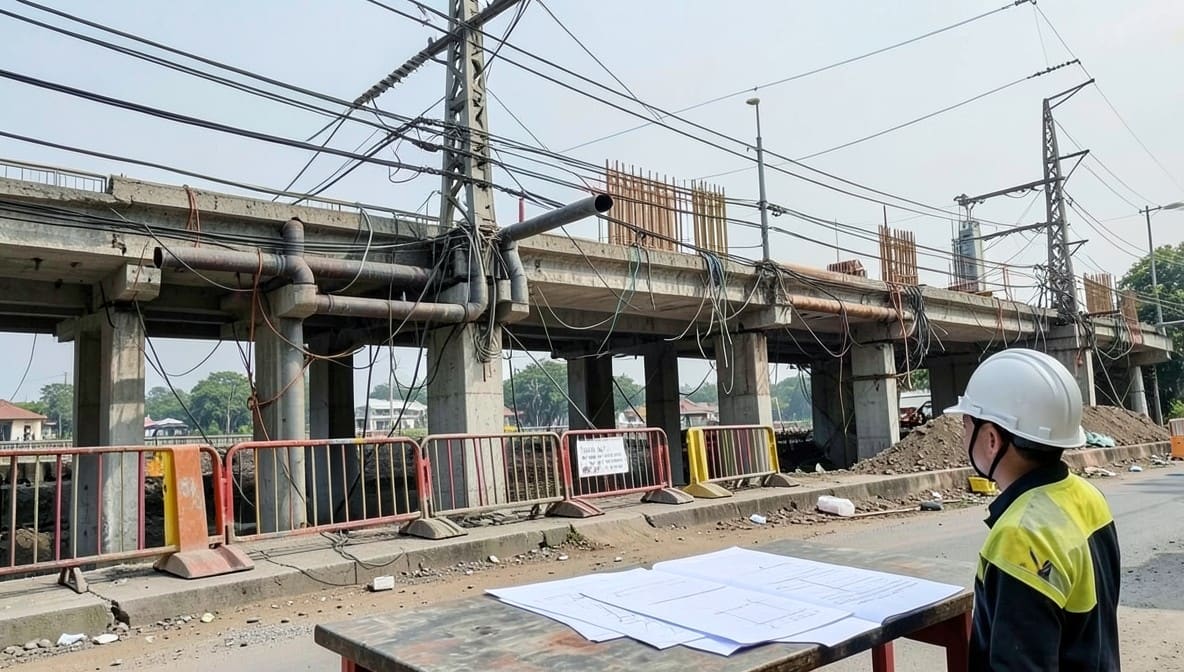
- Site Obstructions: The appellant complained of hindrances, including a BESCOM high-tension line, BWSSB sewage line, OFC cables, and pending BBMP approach roads.
- Contract Extensions: The Railways granted four extensions:
- (a) Up to 30.06.2018;
- (b) Up to 31.05.2019 (pursuant to appellant’s letter dated 24.07.2018);
- (c) Up to 31.05.2020 (under Clause 17-A(ii) of the GCC, citing delays due to traffic diversion);
- (d) Up to 31.01.2021 (under Clause 17-A(ii)).
- Railways’ Communication: By letter dated 04.11.2019, the Railways informed the appellant that approach work for Boxes 1 and 2 was completed and called for work on Boxes 3 and 4.
- Appellant’s Response: The appellant, through letters dated 03.12.2019, 06.03.2020, and 22.05.2020, maintained that diversion of cables, pipelines, and drainage remained incomplete.
- Further Extension Request: On 23.02.2021, the appellant sought an extension until 31.01.2022 under Clause 17-A(iii) of the GCC.
- No Claim Certificate (NCC): The appellant furnished an NCC on 05.03.2021, reserving rights to claims, followed by a revised NCC on 07.04.2021 in the Railways’ format.
- Foreclosure of Agreement: By letter dated 09.06.2021, the Railways informed the appellant that the Agreement was foreclosed pursuant to joint discussions and receipt of the NCC. The final bill of Rs. 1,21,913/- was passed on 09.04.2022.
- Claim Notice: On 07.07.2021, the appellant raised claims under seven heads, aggregating Rs. 4,38,30,224/-, including:
- Expenditure towards PBG: Rs. 6,06,708/-
- Idling of Establishment: Rs. 1,60,00,000/-
- Reimbursement of GST: Rs. 2,52,000/-
- Loss of Profits: Rs. 1,91,59,215/-
- Loss of Credential: Rs. 60,00,000/-
- Interest on EMD/SD: Rs. 8,12,301/-
- Costs: Rs. 10,00,000/-
- Railways’ Rejection: By reply dated 30.07.2021, the Railways denied the claims, asserting mutual foreclosure and voluntary issuance of the NCC.
Procedural History
- 23.02.2024: The appellant filed C.M.P. No. 563/2021 under Section 11 of the A&C Act for constitution of an Arbitral Tribunal, which was allowed.
- 06.06.2024: The appellant filed its Claim Petition (A.C. No. 300/2024) before the Arbitral Tribunal, seeking Rs. 4,38,30,224/- with interest.
- 08.01.2025: The Railways filed its Statement of Objections, contending disentitlement to compensation under Clause 17-A(ii), 43(2), and 61(3) of the GCC.
- 05.05.2025: The Arbitral Tribunal dismissed the claims in their entirety via the impugned award.
- Com.A.P. No. 113/2025: The appellant filed a petition under Section 34 of the A&C Act to set aside the award, which was dismissed by the Commercial Court on 30.01.2026.
- Present Appeal: The appellant filed Commercial Appeal No. 177 of 2026 under Section 37(1)(c) of the A&C Act impugning the Commercial Court’s judgment.
Relief Sought
The appellant sought:
- Setting aside of the impugned award dated 05.05.2025 and the impugned judgment dated 30.01.2026;
- Award of Rs. 4,38,30,224/- with interest as claimed;
- Costs of the proceedings.
The Legal Issue
The central question was whether the Arbitral Tribunal and the Commercial Court erred in rejecting the appellant’s claims for damages, particularly loss of profits, on the grounds that:
- The appellant had failed to substantiate its claims with evidence;
- The No Claim Certificate (NCC) barred further claims under Clause 43(2) of the GCC;
- The appellant’s reliance on M/s. AT Brij Paul Singh v. State of Gujarat was misplaced, as loss of profits cannot be awarded presumptively without evidence.
Arguments Presented
For the Appellant
- Coercion in Issuing NCC: The appellant contended that the NCC was furnished under coercion and thus did not preclude claims under Clauses 63 and 64 of the GCC.
- Loss of Profits: The appellant claimed 15% of the contract value (Rs. 1,91,59,215/-) as loss of profits for unexecuted works, relying on M/s. AT Brij Paul Singh v. State of Gujarat to argue that damages could be awarded on a presumptive basis.
- Breach of Contract: The appellant alleged that the Railways failed to provide a hindrance-free site, leading to delays and eventual foreclosure.
For the Respondent (Railways)
- Voluntary NCC: The Railways contended that the NCC was voluntarily furnished, barring further claims under Clause 43(2) of the GCC.
- No Evidence of Loss: The Railways argued that the appellant failed to produce evidence to substantiate its claims, including loss of profits.
- Mutual Foreclosure: The Railways asserted that the Agreement was foreclosed by mutual consent after joint discussions, as evidenced by the appellant’s communications.
- No Sole Responsibility for Delay: The Railways denied sole responsibility for delays, citing BBMP’s pending approach roads and the appellant’s failure to mobilize resources despite extensions.
The Court's Analysis
The High Court examined the Arbitral Tribunal’s findings and the evidence on record, concluding that the impugned award was not vitiated by patent illegality. Key observations included:
1. Findings of Fact Are Binding
"The aforesaid findings of the Arbitral Tribunal - that Railways was not solely responsible for the delay; that the parties had decided to foreclose the contract by mutual discussion; and that the appellant had voluntarily issued the NCC - are findings of fact. As noted above, the said conclusions are based on materials on record. The said findings hence will not to be held to be perverse or unreasonable in the sense of the Wednesbury principle of unreasonableness."
The Court emphasized that findings of fact by the Arbitral Tribunal, based on evidence, cannot be interfered with unless perverse or unreasonable (Associated Provincial Picture Houses Ltd. v. Wednesbury Corporation).
2. Clause 17-A(iii) of the GCC Bars Damages
The Court referred to Clause 17-A(iii) of the GCC, which expressly provides that extensions granted under this clause do not entitle the contractor to damages or compensation.
"17-A Extension of Time in Contracts : (iii) Extension for Delay due to Railways : In the event of any failure or delay by the Railway to hand over the Contractor possession of the lands necessary for the execution of the works or to give the necessary notice to commence the works or to provide the necessary drawings or instructions or any other delay caused by the Railway due to any other cause whatsoever, then such failure or delay shall in no way affect or vitiate the contract or alter the character thereof or entitle the Contractor to damages or compensation therefor, but in any such case, the Railway may grant such extension or extensions of the completion date as may be considered reasonable."
3. No Interest on Security Deposit Under Clause 16(3) of the GCC
The Court noted that Clause 16(3) of the GCC expressly proscribes payment of interest on the Security Deposit or EMD.
"16.(3) No interest shall be payable upon the Earnest Money and Security Deposit or amounts payable to the Contractor under the Contract, but Government Securities deposited in terms of Sub-Clause 16.(4)(b) of this clause will be payable with interest accrued thereon."
4. Loss of Profits Requires Substantive Evidence
The Court critically analyzed the appellant’s reliance on M/s. AT Brij Paul Singh v. State of Gujarat, distinguishing it on the grounds that loss of profits cannot be awarded presumptively without evidence.
"The decision of the Supreme Court in M/s AT Brij Paul Singh is not an authority for the proposition that no evidence is required to be led to prove the measure of damages on account of loss of profits. It would be erroneous to proceed on the basis that in all cases where the arbitral tribunal or court finds that the contracts have been terminated illegally, a loss of profits quantified at 15% of the balance works would be payable as damages."
The Court relied on Edifice Developers and Projects Engineers Limited v. Essar Projects (India) Limited, where the Bombay High Court set aside an arbitral award for awarding loss of profits without evidence. The Court observed:
"The Arbitral Tribunal proceeded on the basis that it was only Hudson's Formula which was to be applied and that even though no direct evidence had been adduced on behalf of the Appellant, nonetheless the Appellant would be entitled to damages measured with reference to the aforesaid formula. This approach of the Arbitrator is manifestly in the teeth of the law laid down by the Supreme Court in McDermott International."
The Court further cited Nandi Infratech Pvt. Ltd. v. R.K. Bararia, where the Delhi High Court rejected a claim for loss of profits based on an all-inclusive allowance of 15% in item rates, as it did not reflect actual profit margins.
5. Appellant’s Failure to Substantiate Claims
The Court noted that the Arbitral Tribunal had found no evidence to support the appellant’s claims, including:
- Investment in the project;
- Men and materials deployed;
- Loss suffered due to other contracts being deprived;
- Contemporaneous evidence of potential projects.
"No evidence is placed on record much less the acceptable evidence with regard to the investment made by the claimant for this project, men and materials deployed and the loss that he suffered because of other contracts being deprived. There is no independent contemporaneous evidence with regard to the potential projects that the contractor had in the pipeline that could have been undertaken if not for the delays."
The Verdict
The Karnataka High Court dismissed the appeal, upholding the impugned award dated 05.05.2025 and the impugned judgment dated 30.01.2026. The Court held:
- The Arbitral Tribunal’s findings of fact were not perverse or unreasonable;
- The appellant failed to substantiate its claims with evidence;
- The No Claim Certificate (NCC) barred further claims under Clause 43(2) of the GCC;
- Loss of profits cannot be awarded presumptively without evidence, even if the contract was unlawfully foreclosed.
What This Means For Similar Cases
Loss of Profits Requires Concrete Evidence, Not Presumptions
- Contractors must lead substantive evidence to prove loss of profits, including:
- Financial statements showing investments and deployments;
- Contemporaneous records of men, materials, and machinery;
- Evidence of lost opportunities due to delays or foreclosure;
- Trade practices or industry standards supporting claimed profit margins.
- Reliance on Brij Paul Singh is insufficient: Courts will not award damages presumptively based on a fixed percentage of unexecuted works without evidence.
No Claim Certificate (NCC) Can Bar Future Claims
- Voluntary issuance of an NCC may preclude future claims, even if the contractor reserves rights.
- Contractors should carefully review NCC formats and negotiate terms before signing, as Clause 43(2) of the GCC may bar claims post-NCC.
- Coercion claims must be substantiated: Mere allegations of coercion without evidence are unlikely to succeed.
Arbitral Tribunals Cannot Rely on Assumptions or Trade Practices Alone
- Arbitrators must apply the law, not assumptions:
- Section 28(1)(a) of the A&C Act requires disputes to be decided in accordance with substantive law;
- Section 28(3) mandates consideration of contract terms and trade usages;
- Amiable compositeur (equity-based decisions) requires express authorization.
- Hudson’s Formula or other presumptive methods cannot substitute evidence of actual loss.
- Arbitrators drawn from non-technical backgrounds must avoid conjectural awards without record-based justification.