The Bombay High Court has clarified that replacement of a roof with different material under Section 354A of the Mumbai Municipal Corporation Act, 1888 requires prior permission from the Municipal Corporation. The Court dismissed an appeal challenging a demolition order, holding that the appellant’s failure to obtain permission rendered the construction unauthorised, regardless of claims that the structure was pre-existing or tolerated.
Background & Facts
The Dispute
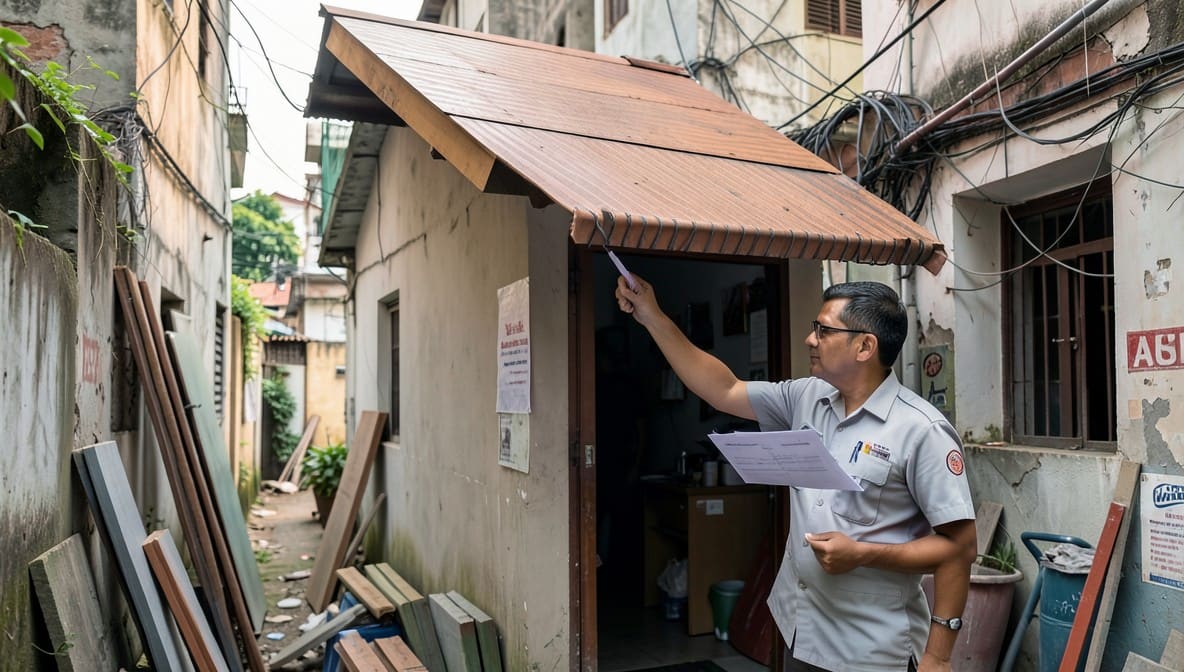
The appellant, Razak Hasan Dokadia, a businessman occupying Shop/Gala No. 28 in Akbar Ali/Munaf Compound, Jogeshwari (West), Mumbai, was issued a notice under Section 354A of the Mumbai Municipal Corporation Act, 1888 (MMC Act) by the Municipal Corporation of Greater Mumbai (MCGM). The notice alleged unauthorised replacement of the roof with ladi coba (a traditional roofing material) using MS Angle and I-Beam, replacing the original A.C. sheet roof. The appellant contested the notice, claiming no unauthorised work was carried out and that the structure existed since 2013 without alterations.
Key Facts
- The appellant has been in occupation of the suit property since 2013
- The MCGM issued a notice under Section 354A MMC Act on 2nd February, 2023, alleging unauthorised replacement of the roof
- The appellant replied on 3rd February, 2023, denying unauthorised work and attributing the notice to complaints from disgruntled neighbours
- The MCGM conducted an inspection on 31st January, 2023, and found evidence of ongoing construction, including materials for roof replacement
- The appellant did not produce any permission or sanction for the roof replacement
- A speaking order was passed on 28th February, 2023, directing removal of the unauthorised structure
Procedural History
- 15.03.2023: The appellant filed L.C. Suit No. 664 of 2023 before the Trial Court, seeking a restraint order against the MCGM notice
- 05.04.2023: The Trial Court dismissed the notice of motion, holding that the construction was unauthorised and ongoing
- June 2023: The appellant filed Appeal from Order No. 302 of 2023 before the Bombay High Court
- 19.06.2026: The High Court dismissed the appeal and rejected the request for stay of the demolition order
The Parties' Positions
For the Appellant
- Argued that the replacement of the roof did not require permission from the MCGM
- Relied on a circular dated 6th January, 1987, which permitted raising the height of existing structures in Gaothans and Koliwadas
- Contended that the suit property was a tolerated structure and no unauthorised work was carried out
For the Respondent (MCGM)
- Relied on Section 342 of the MMC Act, which mandates permission for additions, alterations, or changes in user of a building
- Highlighted the inspection report and photographs showing evidence of ongoing unauthorised construction
- Argued that the appellant failed to produce any permission or sanction for the roof replacement
Relief Sought
The appellant sought a temporary injunction restraining the MCGM from taking any action pursuant to the notice dated 2nd February, 2023, and a declaration that the structure was authorised or tolerated.
The Legal Issue
The central question was whether replacement of a roof with different material under Section 354A of the MMC Act requires prior permission from the Municipal Corporation, and whether the appellant’s failure to obtain such permission rendered the construction unauthorised.
Arguments Presented
For the Appellant
- The appellant’s counsel argued that the replacement of the roof with different material did not require permission under the MMC Act
- Relied on a circular dated 6th January, 1987, which permitted certain modifications in Gaothans and Koliwadas without explicit permission
- Contended that the suit property was a tolerated structure, implying no unauthorised work was carried out
For the Respondent
- The MCGM’s counsel supported the impugned order, relying on Section 342 of the MMC Act, which requires permission for additions, alterations, or changes in user of a building
- Highlighted the inspection report and photographs as evidence of ongoing unauthorised construction
- Argued that the appellant failed to produce any document proving permission or sanction for the roof replacement
The Court's Analysis
The Court examined the provisions of Section 342 and Section 354A of the MMC Act and held that the replacement of a roof with different material constitutes an alteration requiring prior permission. The Court noted:
"The explanation under Section 342 defines 'Tenantable repairs' and explicitly states that replacement of roof with the same material is permissible, but replacement with different material is not included. Thus, the statutory provisions negate the contention that no permission is required for roof replacement."
The Court further observed that the notice under Section 354A described the unauthorised work as the replacement of the A.C. sheet roof with ladi coba using MS Angle and I-Beam. The appellant’s reply to the notice did not dispute the nature of the work but merely denied unauthorised construction. The Court emphasised that the inspection report and photographs provided sufficient evidence of ongoing unauthorised work, and the appellant failed to produce any document proving the structure was tolerated or authorised.
Regarding the circular dated 6th January, 1987, the Court held that it was misplaced reliance, as the circular pertained to raising the height of existing structures in Gaothans and Koliwadas and did not apply to the appellant’s case. The Court also noted that the appellant’s plea in the plaint - that no unauthorised work was carried out - contradicted the argument that the circular permitted the roof replacement.
The Court concluded that the Trial Court’s discretion was exercised based on the material on record, and no perversity was demonstrated to warrant interference.
The Verdict
The appeal was dismissed. The Court held that:
- The replacement of the roof with different material required prior permission under Section 342 of the MMC Act
- The appellant’s failure to obtain permission rendered the construction unauthorised
- The circular dated 6th January, 1987 did not apply to the appellant’s case
- The request for stay of the demolition order was rejected, as no permission was obtained by the appellant
What This Means For Similar Cases
Permission Is Mandatory for Roof Replacement with Different Material
- Practitioners must note that replacement of a roof with different material under Section 342 of the MMC Act requires prior permission from the Municipal Corporation
- The Court’s interpretation of 'Tenantable repairs' under Section 342 clarifies that replacement with the same material is permissible, but replacement with different material is not
- Property owners and developers should ensure compliance with the MMC Act before undertaking any structural modifications
Documentary Evidence Is Crucial to Prove Authorisation
- The appellant’s failure to produce any document proving permission or sanction for the roof replacement was a key factor in the Court’s decision
- In cases involving unauthorised construction, inspection reports, photographs, and official records held by the Municipal Corporation can be decisive
- Property owners should maintain records of permissions, sanctions, and correspondence with the Municipal Corporation to avoid adverse orders
Circulars Must Be Applied in the Correct Context
- The reliance on the circular dated 6th January, 1987 was rejected as it pertained to raising the height of structures in Gaothans and Koliwadas, not roof replacement
- Practitioners must ensure that circulars or notifications relied upon are directly applicable to the facts of the case
- Arguments based on circulars should align with the pleadings and evidence on record to avoid contradictions
Appellate Courts Will Not Interfere Without Perversity
- The High Court emphasised that appellate interference is warranted only if the Trial Court’s discretion is exercised perversely
- Practitioners must demonstrate clear errors in fact or law to succeed in appeals against orders passed under the MMC Act
- Mere dissatisfaction with the Trial Court’s order is insufficient to warrant appellate intervention