The Telangana High Court has clarified that possession of black jaggery cannot form the basis of prosecution under the Telangana Prohibition and Excise Acts, as it does not qualify as a prohibited 'material' under statutory definitions. This ruling provides critical relief to small traders and farmers caught in overbroad enforcement of excise laws.
Background & Facts
The Dispute
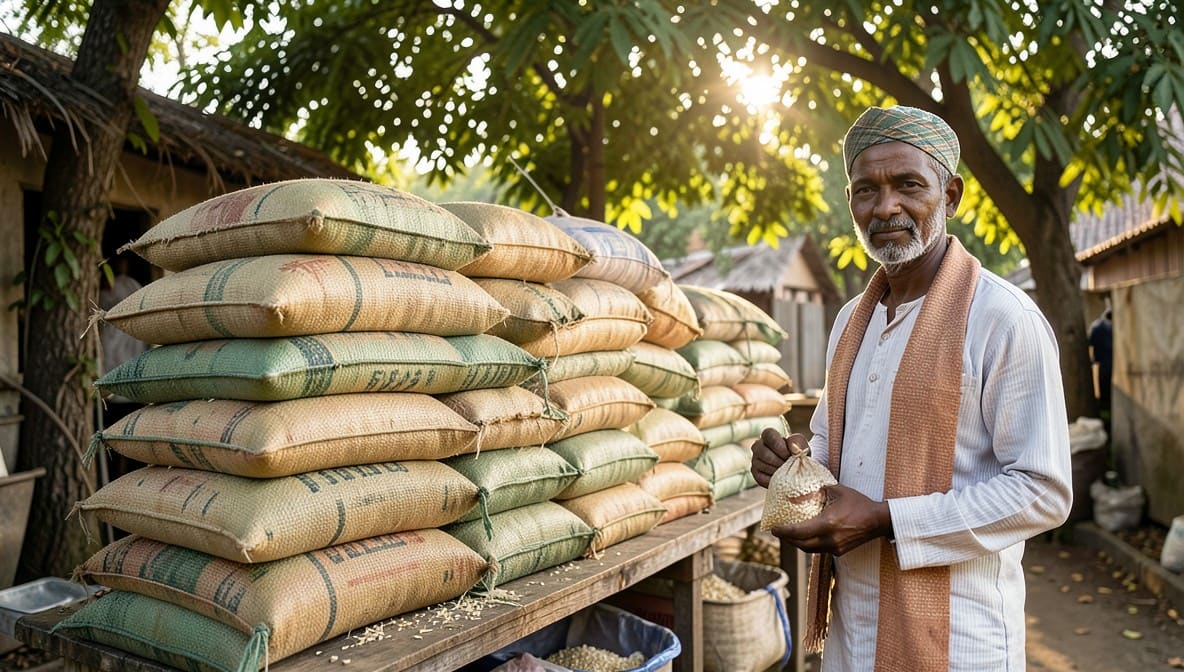
The petitioner, Bantu Shiva, a kirana store owner from Miryalaguda, Nalgonda District, was named as Accused No.2 in C.O.R. No. 123 of 2025, registered by the Prohibition & Excise Station, Miryalaguda. The proceedings were initiated on allegations that he was in possession of 60 white bags of black jaggery (each 50 kg) and 2 white bags of alum, allegedly intended for illicit liquor manufacture. The charges were framed under Section 7(a) read with Section 8(e) of the Telangana Prohibition Act, 1995, and Section 34(e) of the Telangana Excise Act, 1995.
Key Facts
- The seized items consisted exclusively of black jaggery and alum.
- Black jaggery is a traditional agricultural product derived from sugarcane juice, commonly used in food preparation and rural households.
- Alum, while regulated, was not the primary focus of the legal challenge; the central issue was the classification of black jaggery.
- No evidence was presented that the petitioner manufactured, transported, or sold illicit liquor.
- The prosecution did not allege that the jaggery was adulterated or mixed with any other substance.
Procedural History
- 15.01.2025: C.O.R. No. 123 of 2025 registered against Bantu Shiva and others.
- 20.03.2025: Petitioner filed application for quashing before the High Court under Section 528 of the Bharatiya Nagarik Suraksha Sanhita, 2023 (BNSS).
- 13.11.2025: The Telangana High Court, in Crl.P. No. 14768 of 2025, quashed similar proceedings against accused persons in Mahabubabad District for possession of black jaggery, holding it was not a 'material' under Section 2(22A) of the Excise Act.
- 01.04.2026: Present petition filed by Bantu Shiva, relying on the precedent set in Crl.P. No. 14768 of 2025.
The Parties' Positions
For the Petitioner:
- Counsel argued that the prosecution was directly covered by the precedent in Crl.P. No. 14768 of 2025, where the same court held that black jaggery is an agricultural produce and not a 'material' as defined under Section 2(22A) of the Telangana Excise Act.
- Submitted that continuing proceedings amounted to an abuse of process of law.
- Relied on Government of Andhra Pradesh Memo No. 47802/Ex.III.1/2006-13 dated 20.12.2010, which explicitly excluded jaggery from the definition of 'material' to protect farmers and traders.
For the Respondent-State:
- The Additional Public Prosecutor did not dispute the petitioner’s submission.
- Did not contest the applicability of the precedent or the interpretation of Section 2(22A).
- Did not present any new evidence or legal argument to distinguish the present case.
Relief Sought
The petitioner sought quashing of C.O.R. No. 123 of 2025 and stay of all further proceedings against him, on the ground that the charges were legally unsustainable and constituted an abuse of process.
The Legal Issue
The central question was whether possession of black jaggery, without any evidence of its use in illicit liquor manufacture, constitutes an offence under Section 34(e) of the Telangana Excise Act, 1995, given that black jaggery is not included in the statutory definition of 'material' under Section 2(22A).
Arguments Presented
For the Petitioner
The petitioner’s counsel relied on the binding precedent in Crl.P. No. 14768 of 2025, where the same High Court held that black jaggery is an agricultural produce and its bi-product, excluded from the definition of 'material' under Section 2(22A) of the Excise Act by a Government notification dated 20.12.2010. Counsel emphasized that Section 34(e) only penalizes possession of materials specified under Section 2(22A), and since jaggery is not among them, no offence is made out. The continuation of proceedings, counsel argued, was a clear abuse of process under Section 528 of BNSS.
For the Respondent
The Additional Public Prosecutor did not oppose the petition. He acknowledged that the legal position had been settled by the earlier judgment in Crl.P. No. 14768 of 2025 and did not contest the petitioner’s reliance on the Government memo or statutory interpretation. No counter-arguments were advanced.
The Court's Analysis
The Court undertook a three-step analysis: statutory definition, administrative interpretation, and precedent.
First, the Court examined Section 2(22A) of the Telangana Excise Act, which defines 'material' as including 'molasses, wash and such other substances as the State Government may, by notification, specify'. The Court noted that black jaggery was never notified as a 'material' under this provision.
Second, the Court referenced the Government of Andhra Pradesh’s Memo dated 20.12.2010, which explicitly rejected proposals to include jaggery in the definition of 'material', stating that such inclusion would adversely affect genuine farmers and traders. The Court held that this administrative interpretation, though issued by the erstwhile unified state, remains persuasive and binding in Telangana due to continuity of law and policy.
Third, the Court relied on its own judgment in Crl.P. No. 14768 of 2025, which had already held that prosecuting individuals for possession of black jaggery under Section 34(e) is legally untenable. The Court observed:
"The continued prosecution of individuals for possessing an agricultural product, which the State Government itself has excluded from the ambit of prohibited materials, amounts to an abuse of the process of law."
The Court emphasized that Section 34(e) requires the material in question to be one specifically notified under Section 2(22A). Since black jaggery is not so notified, and is in fact protected by government policy, no offence under Section 34(e) can be established. The Court further noted that the absence of any allegation of adulteration or intent to manufacture illicit liquor rendered the prosecution baseless.
The Verdict
The Criminal Petition is allowed. The proceedings in C.O.R. No. 123 of 2025 against the petitioner/accused No.2 are hereby quashed. All pending miscellaneous applications in the matter are closed. The State is directed to cease all further action against the petitioner in relation to this case.
What This Means For Similar Cases
Agricultural Produce Cannot Be Prosecuted Under Excise Provisions
- Practitioners must challenge any prosecution based solely on possession of unadulterated jaggery, sugar cane residue, or similar agricultural by-products.
- The burden shifts to the prosecution to prove the substance was notified as a 'material' under Section 2(22A) - mere suspicion of use in liquor manufacture is insufficient.
Abuse of Process Doctrine Applies Broadly
- Courts will quash proceedings under Section 528 of BNSS where the charge is legally unsustainable on its face.
- This judgment reinforces that procedural fairness requires dismissal of charges that violate statutory definitions and administrative policy.
Precedent Binding Across Districts
-
Orders from one bench of the Telangana High Court bind other benches and lower courts in similar factual contexts.
-
Lawyers should cite Crl.P. No. 14768 of 2025 and the 2010 Government Memo as binding authority in all excise-related cases involving jaggery.
-
Always verify whether the seized item is listed in the State Government’s notification under Section 2(22A).
-
If the item is an agricultural product (e.g., jaggery, molasses, sugarcane waste), argue that it is excluded by policy and cannot trigger Section 34(e).
-
File quashing petitions under Section 528 of BNSS at the earliest stage to prevent harassment and unnecessary litigation.