The Himachal Pradesh High Court recently delivered a significant ruling on the scope of Section 336 of the Indian Penal Code (IPC), clarifying that employees of statutory bodies like the National Highways Authority of India (NHAI) cannot be held vicariously liable for criminal offences without specific allegations of rash or negligent conduct. The judgment underscores the necessity of direct evidence linking an accused to the alleged offence, particularly in cases involving road accidents and public infrastructure maintenance.
Background & Facts
The Dispute
The case arose from FIR No. 142 of 2020, registered at Police Station Bhawarna, District Kangra, Himachal Pradesh, on 10.09.2020. The complainant, Munish Kumar, alleged that on the morning of the incident, his motorcycle was hit by a jeep bearing registration No. HP-37-G-2266, driven by Dilip Kumar. The collision resulted in the death of the rider of another motorcycle (HP-29-B-7448). The complainant initially attributed the accident to the rash and negligent driving of the jeep driver.
Key Facts
- Date of Incident: 10.09.2020, around 9:15 AM near Paror bridge, District Kangra.
- Vehicles Involved: Motorcycle (HP-29-B-7448) and jeep (HP-37-G-2266).
- Victim: Rider of motorcycle HP-29-B-7448, who succumbed to injuries.
- Initial Allegation: Rash and negligent driving by Dilip Kumar, driver of the jeep.
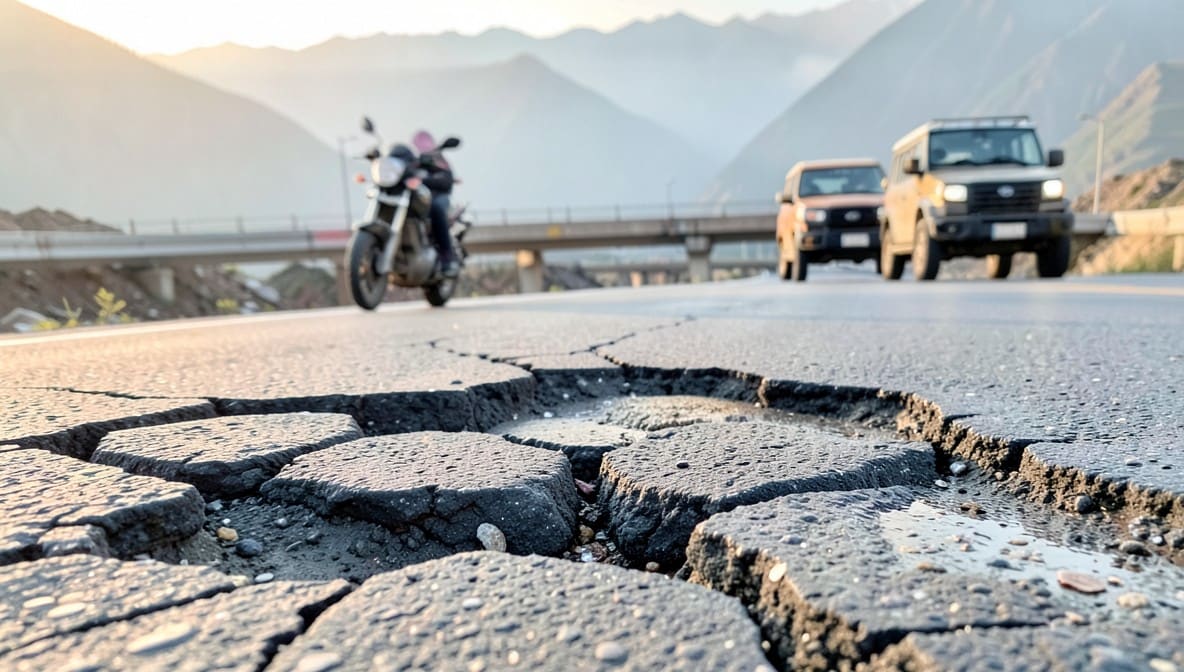
- Subsequent Investigation Finding: The accident occurred due to a damaged patch on the road, maintained by the NHAI.
- Petitioner’s Role: Sourabh Kumar, Deputy Manager (Technical) at NHAI’s Palampur office, was subsequently arraigned as an accused.
Procedural History
- 10.09.2020: FIR registered under Sections 279, 337, 304-A IPC and Section 187 of the Motor Vehicles Act.
- 24.06.2021: Police filed a challan before the Judicial Magistrate, First Class, Court No. 2, Palampur, naming both Dilip Kumar and the petitioner as accused.
- Post-Investigation: The police concluded that the accident was caused by potholes on the National Highway, implicating the petitioner as an NHAI official.
- 28.03.2025: The petitioner filed Cr.MMO No. 814 of 2025 under Section 528 of the Bharatiya Nagarik Suraksha Sanhita (BNSS) for quashing the FIR and consequent proceedings.
Relief Sought
The petitioner sought quashing of FIR No. 142 of 2020 and all proceedings arising therefrom, contending that no offence under Section 336 IPC was made out against him.
The Legal Issue
The central question before the Court was whether an NHAI employee, in the absence of specific allegations of rash or negligent conduct, could be held criminally liable under Section 336 IPC for a road accident caused by poor maintenance of a National Highway.
Arguments Presented
For the Petitioner
- No Direct Allegation: The complainant’s statement attributed the accident solely to the rash and negligent driving of Dilip Kumar, with no mention of the petitioner’s conduct.
- No Proof of Negligence: There was no evidence that the petitioner had prior knowledge of potholes on the road or failed to act upon any report regarding the same.
- Vicarious Liability Inapplicable: Section 336 IPC requires proof of a direct rash or negligent act by the accused. The petitioner, as a junior official, could not be held vicariously liable for NHAI’s failure to maintain the road.
- No Role in Maintenance: The petitioner was not responsible for road maintenance; such duties were assigned to concessioners under NHAI agreements.
For the Respondent-State
- Duty of Care: The petitioner, as Deputy Manager of NHAI, was responsible for ensuring the safety of the road, and his failure to maintain it endangered lives.
- Constructive Liability: The accident occurred due to poor road conditions, which fell under the petitioner’s purview, justifying his inclusion as an accused.
- Public Safety Concern: The rash and negligent act under Section 336 IPC could be inferred from the petitioner’s failure to act despite being aware of the road’s condition.
The Court's Analysis
The Court undertook a detailed examination of the scope of Section 528 BNSS (analogous to Section 482 CrPC) and the principles governing quashing of criminal proceedings, relying on precedents such as B.N. John v. State of U.P. and Ajay Malik v. State of Uttarakhand. The Court reiterated the seven categories under which an FIR can be quashed, emphasizing that no prima facie case should exist against the accused.
"The law relating to quashing of criminal cases was explained by the Hon’ble Supreme Court in B.N. John v. State of U.P. as under:... Of the aforesaid criteria, clause no. (1), (4) and (6) would be of relevance to us in this case. In clause (1) it has been mentioned that where the allegations made in the first information report or the complaint, even if they are taken at their face value and accepted in their entirety do not prima facie constitute any offence or make out a case against the accused, then the FIR or the complaint can be quashed."
The Court then analyzed Section 336 IPC, which penalizes acts done rashly or negligently that endanger human life or personal safety. It held that three essential elements must be proven:
- The accused committed an act.
- The act was done rashly or negligently.
- The act endangered human life or personal safety.
Applying this test, the Court found:
- No Direct Allegation: The complainant’s statement exclusively blamed Dilip Kumar for the accident, with no mention of the petitioner’s conduct.
- No Evidence of Negligence: There was no proof that the petitioner had knowledge of potholes or failed to act upon any report.
- No Vicarious Liability: The Court relied on HDFC Securities Limited v. State of Maharashtra and Sharad Kumar Sanghi v. Sangat Rane, holding that vicarious liability under IPC requires specific allegations against the accused. The petitioner, as a junior official, could not be held liable for NHAI’s failure to maintain the road.
"Hon'ble Apex Court in case titled HDFC Securities Limited vs. State of Maharashtra has categorically held that Indian Penal Code does not provide for vicarious liability for any offence alleged to have been committed by a Company. If such liability was sought to be impugned by the legislature creating a legal fiction, the same would have been specifically provided in the statute as is the case in the Negotiable Instruments Act."
The Court further observed that no evidence was adduced to show that the petitioner was solely responsible for road maintenance or that he had failed to act despite knowledge of the potholes.
The Verdict
The Court allowed the petition, quashing FIR No. 142 of 2020 and all consequent proceedings against the petitioner. The petitioner was acquitted of all charges under Sections 279, 337, 304-A IPC and Section 187 of the Motor Vehicles Act. The judgment emphasized that continuation of the trial would amount to abuse of process, given the absence of prima facie evidence linking the petitioner to the offence.
What This Means For Similar Cases
No Vicarious Liability Under IPC Without Specific Allegations
- Direct Evidence Required: Courts will not infer criminal liability against employees of statutory bodies (e.g., NHAI, municipal corporations) without specific allegations of rash or negligent conduct.
- Corporate vs. Individual Liability: Unlike statutes such as the Negotiable Instruments Act, the IPC does not recognize vicarious liability for offences committed by an organization. Specific allegations must be made against the accused.
Road Maintenance Liability: A High Threshold for Criminal Liability
- Knowledge and Failure to Act: To invoke Section 336 IPC, the prosecution must prove that the accused had prior knowledge of the hazard (e.g., potholes) and failed to act despite such knowledge.
- Role-Specific Liability: Junior officials cannot be held liable for systemic failures unless their specific acts or omissions are proven to be rash or negligent.
Quashing Proceedings: When to Invoke Section 528 BNSS
- No Prima Facie Case: If the FIR does not disclose an offence against the accused, courts may quash proceedings to prevent abuse of process.
- Civil vs. Criminal Disputes: Disputes arising from contractual or statutory duties (e.g., road maintenance) may not automatically attract criminal liability unless gross negligence is proven.
- Settlement and Compounding: Even in cases involving public infrastructure, if the dispute is civil in nature, parties may explore compounding to avoid criminal proceedings.