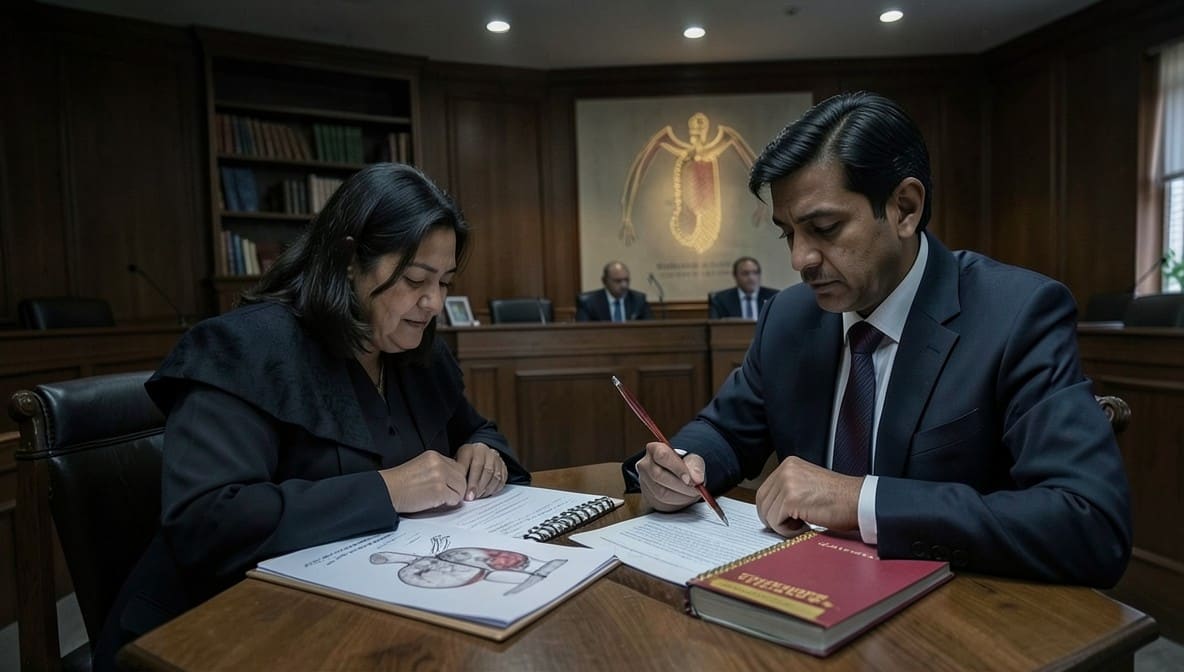
The Gauhati High Court has reaffirmed that procedural safeguards under Section 313 of the Code of Criminal Procedure are not mere formalities but essential to ensuring a fair trial. When incriminating evidence is not put to the accused for explanation, the conviction cannot stand if prejudice is established, even in cases involving serious offences like murder.
Background & Facts
The Dispute
The appellant, Bablu Bhuyan, was convicted under Section 302/201 IPC for the murder and disposal of his wife’s body, based primarily on the testimony of PW-4, who claimed to have seen the appellant and his co-accused, Dilip Bhuyan, carrying the corpse. The prosecution alleged that the appellant, having killed his wife during a marital dispute, conspired with Dilip Bhuyan to conceal the crime by disposing of the body.
Procedural History
- 2017: Sessions Case No. 269 (S-N)/2017 initiated against Bablu Bhuyan and Dilip Bhuyan
- 2021: Additional Sessions Judge, Sivasagar, convicted Bablu Bhuyan under Section 302/201 IPC and sentenced him to life imprisonment with fine
- 2021: Dilip Bhuyan was convicted only under Section 201 IPC and sentenced to a lesser term
- 2021: Bablu Bhuyan filed criminal appeal before the Gauhati High Court challenging his conviction and sentence
Relief Sought
The appellant sought setting aside of his conviction under Section 302 IPC, arguing that: (1) the incriminating evidence of PW-4 was not put to him during his examination under Section 313 Cr.P.C., and (2) the principle of parity demanded identical treatment for him and his co-accused, Dilip Bhuyan.
The Legal Issue
The central question was whether the failure to put a critical piece of incriminating evidence to the accused during his examination under Section 313 Cr.P.C. renders the conviction unsustainable, and whether such omission, if prejudicial, necessitates a retrial from the stage of Section 313 examination.
Arguments Presented
For the Appellant
The learned Amicus Curiae argued that PW-4’s testimony - that the appellant and Dilip Bhuyan threatened him after being seen carrying the body - was a pivotal incriminating circumstance. This was never put to the appellant during his Section 313 Cr.P.C. examination, violating his statutory right to explain. Reliance was placed on Vaibhav v. State of Maharashtra and Kuldip Singh v. State of Delhi, which hold that evidence not put to the accused cannot form the basis of conviction. The appellant also contended that the conviction under Section 302 IPC was inconsistent with the co-accused’s conviction under Section 201 IPC alone, violating the principle of parity as laid down in Yogarani v. State.
For the Respondent
The State contended that the appellant had admitted the core facts during his Section 313 examination, including that he was present with the body. It argued that the omission was technical and did not prejudice the accused, as the appellant had not denied being present. The State further contended that the difference in conviction between the two accused was justified by the appellant’s role as the husband and primary suspect, and that the principle of parity did not apply where roles differed.
The Court's Analysis
The Court meticulously examined the Section 313 Cr.P.C. record and found that the crucial testimony of PW-4 - regarding the threat made to him by the appellant and Dilip Bhuyan - was entirely absent from the questions posed to the appellant. The Court noted that while Section 313 Cr.P.C. is not a trial, it is a statutory safeguard designed to ensure the accused has a fair opportunity to explain incriminating material.
"The accused should be drawn to every inculpatory material during his examination under Section 313 Cr.P.C., to enable him to explain the same."
The Court cited Kuldip Singh v. State of Delhi and Nar Singh v. State of Haryana, emphasizing that non-compliance with Section 313 Cr.P.C. does not automatically vitiate proceedings, but where the omission relates to a vital circumstance and causes prejudice, the appellate court must intervene. The Court found that the threat alleged by PW-4 was not merely corroborative but central to establishing the appellant’s consciousness of guilt and intent to conceal the crime. Since the appellant was never given a chance to respond to this, the Court concluded that the omission had occasioned prejudice.
The Court also rejected the State’s argument that the appellant’s general admission of presence negated the prejudice. It held that the failure to confront the accused with specific allegations of threat and intimidation deprived him of the opportunity to offer a plausible explanation - such as fear, coercion, or mistaken identity - which could have materially affected the outcome.
The Verdict
The appellant succeeded. The Gauhati High Court set aside the conviction and sentence under Section 302/201 IPC as it pertained to Bablu Bhuyan and remanded the matter to the trial court for retrial from the stage of recording his statement under Section 313 Cr.P.C. The conviction of the co-accused, Dilip Bhuyan, under Section 201 IPC was left undisturbed.
What This Means For Similar Cases
Procedural Compliance Is Non-Negotiable
- Practitioners must scrutinize Section 313 Cr.P.C. records in every appeal to ensure all incriminating evidence is put to the accused
- Failure to do so, even in grave offences, mandates retrial if prejudice is established
- Appellate courts cannot assume that general admissions cure specific omissions
Evidence Not Put to Accused Cannot Be Relied Upon
- Any piece of evidence - oral or circumstantial - that was not put to the accused during Section 313 examination must be excluded from consideration
- Courts must not rely on such evidence to infer guilt, even if it appears compelling
- This applies equally to statements of witnesses, recovery memos, or forensic reports
Parity Does Not Automatically Apply, But Procedural Fairness Does
- While differences in conviction between co-accused are permissible where roles differ, procedural fairness is absolute
- A conviction cannot be sustained on evidence the accused was never given a chance to explain
- This ruling reinforces that fair trial rights under Article 21 override technical distinctions in charges