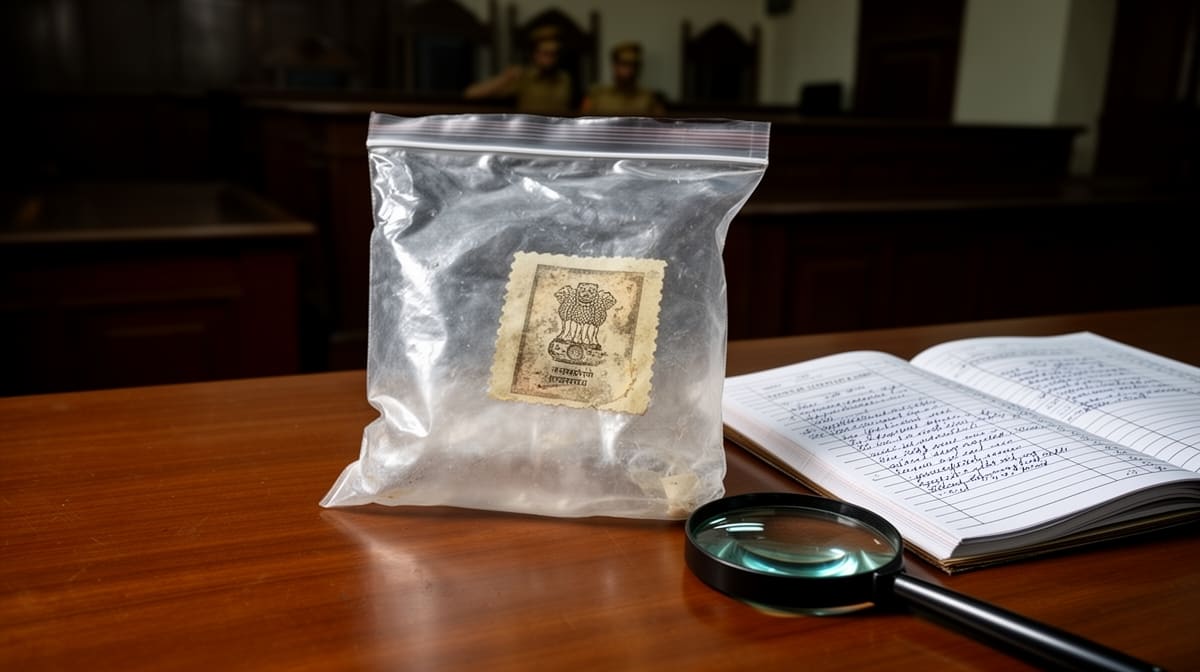
The High Court of Punjab and Haryana at Chandigarh examined two criminal appeals arising from a gruesome gang-rape and murder case. It held that the trial court’s failure to put all material incriminating circumstances before the accused under Section 313 of the Code of Criminal Procedure constituted a curable irregularity, and therefore remanded the matter for fresh examination and sentencing.
Background & Facts
The Dispute
The State of Haryana prosecuted Pardeep, aged 35, and Sagar alias Kallu, aged 25, for the abduction, gang-rape and murder of a minor girl (referred to as “Laadli”) on 13 January 2018 in Matlauda, Panipat. Both were convicted by the Sessions Court of multiple offences including murder (IPC 302 r/w 34), gang-rape (IPC 376A), kidnapping (IPC 363 r/w 34), and offences under the POCSO Act. The trial court imposed death sentences on each appellant for the murder and rape charges, along with additional imprisonment and fines for the other offences.
Key Facts
- 14 January 2018: Laadli’s maternal uncle filed a written complaint with the police post at Urlana Kalan, Panipat reporting her disappearance.
- 14 January 2018: Police recovered Laadli’s dead body behind the village chaupal.
- 14 January 2018: Home guard Surender recorded an extra-judicial confession from the accused, later entered as PW-1.
- 14 January 2018: Investigating officers recovered a large iron pan (tasla) and the victim’s slippers, identified by the complainant.
- 14 January 2018: Forensic Science Laboratory (FSL) detected human semen and blood on vaginal swabs, slides and the recovered items.
- 14 January 2018: Post-mortem report concluded death by asphyxia due to strangulation; the report noted that a final opinion on sexual assault would await the chemical examiner’s report.
- 18 February 2022: The trial court pronounced the death sentences and other terms of imprisonment.
- 4 August 2026: The High Court delivered its judgment, setting aside the conviction and ordering remand.
Procedural History
- 9 January 2018: FIR No. 009 registered at Matlauda Police Station under IPC 302, 201, 366-A, 376-A, 363, 366, 376-D and POCSO Act.
- 20 March 2018: Charges framed for the offences listed above.
- Date not specified: Trial Court convicted the accused and imposed death sentences.
- 10 February 2022: Appeal CRA-D-173-2022 filed by Pardeep.
- Date not specified: Appeal CRA-D-469-2022 filed by Sagar alias Kallu.
- 4 August 2026: High Court judgment delivered, disposing of both appeals.
Parties' Positions
- Appellants (Pardeep and Sagar): Contended that the trial court failed to put material incriminating evidence before them under Section 313 (now Section 351 BNSS, 2023), violating the principle of audi alteram partem and causing prejudice. They sought setting aside of the conviction and a fresh trial.
- Respondent (State of Haryana): Argued that the omission was not fatal, that the conviction was based on ample evidence, and that the appellate court should not interfere with the trial court’s sentencing.
Relief Sought
The appellants sought quashing of the conviction and death sentences and a direction to the trial court to re-examine them under Section 313 (Section 351 BNSS) and to record fresh statements before passing a new judgment.
The Legal Issue
Whether the trial court’s failure to put all material incriminating circumstances before the accused under Section 313 of the Code of Criminal Procedure (now Section 351 BNSS, 2023) constitutes a fatal defect that warrants setting aside the conviction, or a curable irregularity that can be remedied by remanding the case for fresh examination.
Arguments Presented
For the Appellant
- The appellants relied on Rambhau & Anr. v. State of Maharashtra and Zahira Habibulla H. Sheikh v. State of Gujarat to argue that Section 313 mandates the court to put each material circumstance to the accused, and non-compliance is a serious irregularity.
- Cited Natasha Singh v. CBI and Rajaram Prasad Yadav v. State of Bihar to emphasize that the power to summon additional evidence under Section 311 CrPC and Section 391 CrPC can be exercised to cure such irregularities.
- Submitted that the omission deprived them of the opportunity to explain crucial evidence such as the recovered tasla, slippers and forensic findings, thereby violating natural justice.
For the Respondent
- Relied on State of Maharashtra v. Laxman Jairam and Ajay Kumar Ghoshal v. State of Bihar to contend that the omission did not cause material prejudice and that the conviction rested on independent evidence.
- Asserted that the appellate court should not disturb the trial court’s sentencing absent a clear miscarriage of justice.
- Emphasised that the procedural lapse was merely a defect, not a fatal flaw, and could be ignored.
The Court's Analysis
The Court began by interpreting the statutory framework. Section 313 CrPC (now Section 351 BNSS, 2023) obliges the court to put each material circumstance appearing in the prosecution evidence before the accused so that he may explain it. The provision is rooted in the principle of audi alteram partem and is not a mere formality.
"The object of examination under s.313 is to give the accused an opportunity to explain any circumstance appearing in the evidence against him."
The Court noted that the trial court had recorded the accused’s statements in a mechanical manner, asking only generic questions and failing to put specific incriminating facts - such as the identification of the tasla and slippers, and the forensic findings of semen and blood - to the accused. This omission, the Court held, amounted to a serious procedural irregularity.
The Court then examined the jurisprudence on the consequences of such irregularities. In Rambhau the Supreme Court described Section 391 CrPC as an exception allowing the appellate court to obtain additional evidence to prevent miscarriage of justice. Zahira Sheikh and Natasha Singh reiterated that the court must actively ensure that the accused is aware of the material against him. The Court distinguished Ajay Kumar Ghoshal, where the omission was held not to cause prejudice, by observing that in the present case the omitted material was central to the prosecution’s case.
The Court further considered whether the defect was curable. It relied on Rajaram Prasad Yadav and Nar Singh which state that a failure to put material circumstances to the accused does not automatically vitiate the trial; the defect can be cured if the court is satisfied that no substantial prejudice resulted. However, the Court emphasized that when the omitted evidence is material and its exclusion could affect the verdict, the defect must be remedied by a fresh examination.
Applying these principles, the Court concluded that:
- The trial court’s omission was a curable irregularity but a serious one, requiring correction.
- The appellate court has the power under Section 311 CrPC and Section 391 CrPC to direct the trial court to take fresh evidence, including the testimony of the forensic doctors.
- The appropriate remedy is to set aside the conviction and sentence and remand the matter to the Sessions Court to re-examine the accused under Section 351 BNSS, record fresh statements, allow defence evidence, and then pass a fresh judgment.
The Verdict
The Court set aside the death sentences and all other sentences imposed on Pardeep and Sagar alias Kallu. It remanded the case to the Sessions Court to resume the trial from the stage of summoning the concerned doctors, to record fresh statements of the accused under Section 351 BNSS (313 CrPC), to allow the accused to lead defence evidence, and to pass a fresh judgment in accordance with law. No monetary relief was awarded.
What This Means For Similar Cases
Omission Under Section 313 Is a Curable Irregularity
- Courts will not automatically overturn convictions for procedural lapses; however, if material incriminating facts are not put to the accused, the defect must be cured by fresh examination.
- Practitioners must ensure that the trial court’s Section 313 questionnaire addresses each specific piece of incriminating evidence.
Appellate Courts Can Direct Fresh Examination
- Under Sections 311 and 391 CrPC, appellate courts may summon witnesses, obtain additional forensic reports, and order re-examination of the accused to rectify procedural defects.
- A remand order should specify the exact stage (e.g., recording of statements under Section 313) to avoid unnecessary delay.
Assessing Prejudice and Timeliness
- The burden of showing prejudice rests on the accused; courts will examine whether the omitted material could have altered the outcome.
- Even after several years, a curable defect can be remedied if the court is convinced that the accused’s right to a fair trial has been compromised.
Actionable Takeaways for Practitioners
- Draft precise Section 313 questions that reflect each incriminating fact.
- Preserve all forensic and material evidence for possible re-examination.
- When raising a Section 313 violation on appeal, cite the full line of Supreme Court precedents to demonstrate the seriousness of the omission.
- Be prepared to argue both the existence of prejudice and the feasibility of a curable remedy.