In a significant ruling on the right to a fair trial, the Karnataka High Court has set aside an order rejecting an application under Section 311 of the Code of Criminal Procedure (CrPC) to recall two material witnesses for further cross-examination. The Court emphasized that incomplete or ineffective cross-examination due to technical issues, such as network problems during video conferencing, cannot be ignored, and directed the trial court to reconsider the application while imposing costs on the petitioners.
Background & Facts
The Dispute
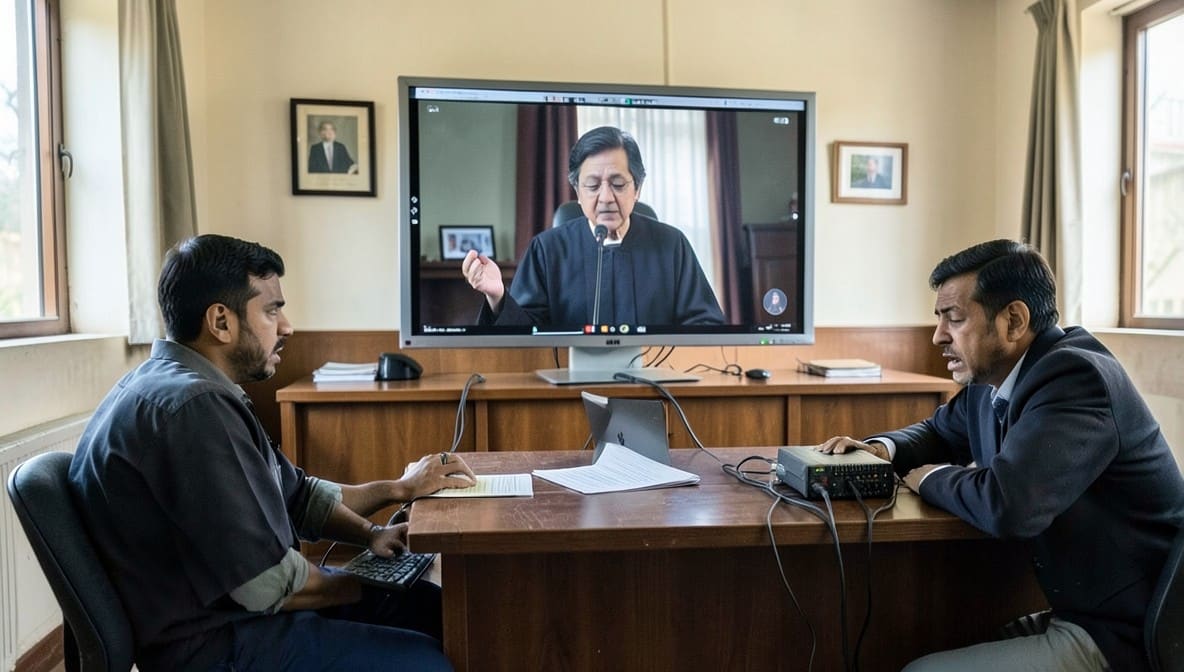
The case arises from a criminal trial pending before the Additional District and Sessions Judge, Koppal, in SC No. 79/2021, involving offences under Sections 302, 201, and 149 of the Indian Penal Code (IPC). The petitioners, accused in the trial, sought to recall PW-19 and PW-20 for further cross-examination on the ground that their earlier cross-examination via video conference was incomplete and ineffective due to network issues.
Key Facts
- The trial pertains to Crime No. 232/2021 registered at Gangavathi Rural Police Station
- The petitioners are accused of offences under Sections 302 (murder), 201 (causing disappearance of evidence), and 149 (unlawful assembly) of the IPC
- PW-19 and PW-20 were examined and cross-examined via video conference
- The petitioners alleged that the cross-examination was incomplete due to network connectivity issues
- The petitioners filed an application under Section 311 CrPC to recall the witnesses for further cross-examination
Procedural History
- 2021: Trial commenced before the Additional District and Sessions Judge, Koppal (SC No. 79/2021)
- Date not specified: Examination and cross-examination of PW-19 and PW-20 conducted via video conference
- Date not specified: Petitioners filed an application under Section 311 CrPC to recall PW-19 and PW-20 for further cross-examination
- 15.04.2026: Trial court rejected the application with a non-speaking order stating, "The application filed under Section 311 of Cr.P.C. by the counsel for the accused No.1 to 5 is hereby rejected"
- 2026: Petitioners filed the present Criminal Petition No. 101597 of 2026 under Section 482 CrPC (corresponding to Section 528 of the Bharatiya Nagarik Suraksha Sanhita (BNSS), 2023) challenging the trial court's order
Relief Sought
The petitioners sought:
- Quashing of the trial court's order dated 15.04.2026 rejecting their application under Section 311 CrPC
- Recall of PW-19 and PW-20 for further cross-examination
- A direction to the trial court to allow the petitioners to complete their cross-examination of the said witnesses
The Legal Issue
The central question before the High Court was whether the trial court erred in rejecting the petitioners' application under Section 311 CrPC to recall material witnesses for further cross-examination, particularly when the earlier cross-examination was alleged to be incomplete due to technical issues, and whether the order was sustainable in law given its non-speaking nature.
Arguments Presented
For the Petitioners
- The petitioners contended that the cross-examination of PW-19 and PW-20 via video conference was incomplete and ineffective due to network connectivity issues
- They argued that Section 311 CrPC empowers the court to recall witnesses at any stage of the proceedings if it appears necessary for the just decision of the case
- The impugned order was non-speaking and did not disclose any reasons for rejecting the application, rendering it unsustainable in law
- The petitioners relied on the principle that the right to cross-examine witnesses is a fundamental aspect of a fair trial and cannot be curtailed arbitrarily
For the Respondent/State
- The learned High Court Government Pleader (HCGP) opposed the petition, arguing that the trial court was justified in rejecting the application
- It was contended that the petitioners had already been given sufficient opportunity to cross-examine the witnesses and that the application was an attempt to delay the proceedings
The Court's Analysis
The High Court critically examined the impugned order and observed that it was non-speaking, failing to provide any reasons for rejecting the petitioners' application under Section 311 CrPC. The Court emphasized the importance of a reasoned order, particularly in criminal proceedings where the liberty of the accused is at stake.
The Court noted that Section 311 CrPC confers wide discretion on the trial court to recall witnesses at any stage of the proceedings if it appears necessary for the just decision of the case. This discretion, however, must be exercised judiciously and not arbitrarily. The Court observed that the trial court had not considered the petitioners' contention that the cross-examination was incomplete due to technical issues, which could potentially prejudice their defence.
"The impugned order reads as under: 'The application filed under Section 311 of Cr.P.C. by the counsel for the accused No.1 to 5 is hereby rejected.' The order does not disclose the reasons. The Court is of the view that the impugned order has to be set aside for not disclosing the reasons and for that purpose; it has to be remanded for fresh consideration."
The Court further held that the right to cross-examine witnesses is a cornerstone of a fair trial, and any impediment to this right, such as technical issues during video conferencing, must be addressed to ensure justice. The Court acknowledged that PW-19 and PW-20 were material witnesses, and their effective cross-examination was crucial for the adjudication of the case.
However, the Court also took note of the fact that the trial had been pending since 2021 and that the witnesses had already been examined. To balance the interests of justice with the need for expeditious disposal, the Court imposed a cost of ₹5,000 on the petitioners, payable to the District Legal Services Authority, Koppal, as a condition for recalling the witnesses.
The Verdict
The Karnataka High Court allowed the criminal petition in part. The Court:
- Set aside the trial court's order dated 15.04.2026 rejecting the petitioners' application under Section 311 CrPC
- Remanded the matter to the trial court for fresh consideration of the application
- Directed the recall of PW-19 and PW-20 for further cross-examination by the petitioners
- Imposed a cost of ₹5,000 on the petitioners, payable to the District Legal Services Authority, Koppal, as a condition for recalling the witnesses
- Clarified that the petitioners would not be permitted to cross-examine the witnesses on matters already covered in the earlier cross-examination
What This Means For Similar Cases
Non-Speaking Orders Are Unacceptable in Criminal Proceedings
- Courts must provide reasoned orders, particularly in criminal cases where the liberty of the accused is at stake
- A non-speaking order rejecting an application under Section 311 CrPC is liable to be set aside, as it fails to meet the standards of judicial propriety and fairness
- Practitioners should challenge non-speaking orders on the ground that they violate the principles of natural justice and the right to a fair trial
Right to Cross-Examination Must Be Effectively Ensured
- The right to cross-examine witnesses is a fundamental aspect of a fair trial and cannot be curtailed arbitrarily
- Technical issues during video conferencing, such as network problems, which impede effective cross-examination, must be addressed by the court
- If cross-examination is incomplete due to such issues, the court should exercise its discretion under Section 311 CrPC to recall the witnesses for further cross-examination
- However, this discretion must be balanced with the need for expeditious disposal of cases, and courts may impose costs or other conditions to prevent abuse of the process
Video Conferencing in Criminal Trials: Procedural Safeguards Are Essential
- While video conferencing is a valuable tool for ensuring the expeditious disposal of cases, particularly in remote or resource-constrained settings, it must not compromise the rights of the accused
- Courts should ensure that technical infrastructure is robust and that witnesses are examined in a manner that allows for effective cross-examination
- If technical issues arise during video conferencing, the court should take proactive steps to address them, such as adjourning the proceedings or recalling the witnesses for further examination
- Practitioners should be vigilant about technical issues during video conferencing and raise objections promptly to preserve the right to a fair trial