The Delhi High Court has unequivocally rejected the notion that violent acts disguised as protest can be shielded from serious criminal liability. In a landmark ruling, the Court held that deliberately hurling a burning effigy onto the rooftop and gate of a security room housing personnel constitutes an attempt to murder under Section 307 IPC, regardless of whether injury occurred. The judgment underscores that intent and imminently dangerous conduct, not mere outcome, define criminal liability under the IPC.
Background & Facts
The Dispute
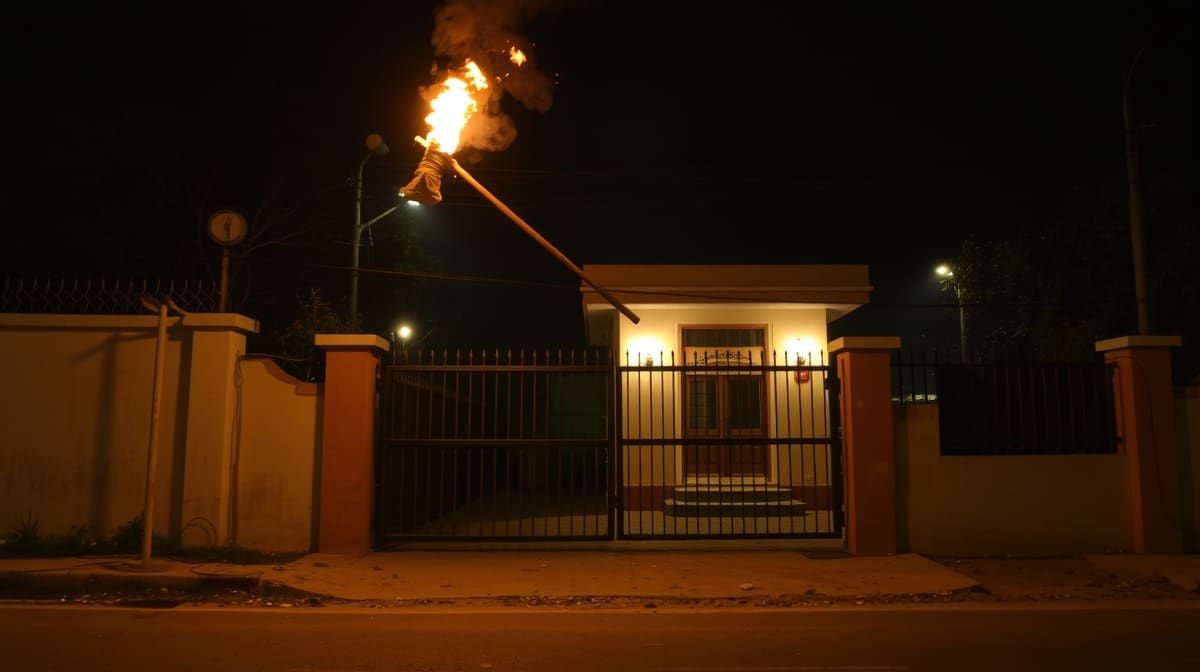
The petitioners, identified as JAGDEEP SINGH @ JAGGA and others, were charged under Sections 307, 436, 285, 147, 149, and 188 IPC following an incident on 21.06.2022 at Moti Lal Nehru Marg, New Delhi. The target of the act was the official bungalow of a prominent political personality. The petitioners, along with a group, gathered outside the bungalow gate, burned an effigy of the individual on the main road, then carried the burning effigy across a wide footpath and service road to hurl its flaming remains onto the gate and rooftop of the security room where guards were stationed.
Key Facts
- The incident occurred on 21.06.2022 at approximately 04:30 pm
- The effigy was burned using combustible material and carried on a wooden pole (danda)
- The petitioners crossed the main road, a wide footpath, and a service road to reach a position directly opposite the security room
- The burning effigy was thrown with force over the gate and onto the rooftop of the security room
- CCTV footage captured the entire sequence, including the petitioners’ approach, the act of throwing, and their immediate flight from the scene
- Security personnel were present inside the guardroom at the time of the act
- No one was physically injured, but the security men attempted to intervene and were forced to retreat
- The petitioners fled the scene immediately after the act, without surrendering or accepting arrest
- The chargesheet included the CCTV footage as key evidence
Procedural History
- 21.06.2022: Incident occurred at Moti Lal Nehru Marg, New Delhi
- 22.06.2022: FIR registered at Police Station, South Delhi
- 15.08.2022: Chargesheet filed by SI Ashish Yadav and SI Nikhil Raman
- 10.11.2022: Petitioners filed application for discharge under Section 227 CrPC
- 12.01.2023: Trial Court dismissed discharge application, holding prima facie case made out under Sections 307, 436, and 188 IPC
- 15.03.2023: Petitioners filed CRL.REV.P. 531/2025 before the Delhi High Court challenging the dismissal of discharge
- 25.04.2026: Hearing conducted before Justice Girish Kathpalia, during which CCTV footage was played in open court
- 16.05.2026: Judgment delivered dismissing the petition
The Parties' Positions
For the Petitioners
- Argued that no injury occurred and no deadly weapon was used, negating intent to kill
- Contended that the act was a form of protest and thus should attract only minor offences like Section 285 IPC (negligent conduct with fire)
- Asserted that Section 436 IPC (mischief by fire) does not apply because no explosive substance was used
- Admitted that charges under Sections 147, 149, and 188 IPC were valid, but sought discharge on the more serious charges
For the Respondent (State)
- Maintained that the act was intentional, not negligent, and demonstrated clear mens rea
- Highlighted that the petitioners deliberately crossed multiple obstacles to reach a position from which the burning effigy could be thrown directly at the security room
- Cited eyewitness statements confirming the petitioners’ intent to harm the guards
- Emphasized that the CCTV footage corroborated the prosecution’s version and refuted the protest narrative
- Argued that discharge is not warranted where a prima facie case exists under any charge, especially when the accused admit to other serious offences
Relief Sought
The petitioners sought quashing of the trial court’s order dated 12.01.2023, discharge from charges under Sections 307 and 436 IPC, and a direction to frame charges only under Sections 147, 149, 188, and 285 IPC.
The Legal Issue
The central question was whether the act of deliberately throwing a burning effigy onto the rooftop and gate of a security room occupied by personnel constitutes an attempt to murder under Section 307 IPC, even in the absence of physical injury or use of a firearm or explosive.
Arguments Presented
For the Petitioner
The petitioners relied on the absence of injury and the lack of a conventional weapon to argue that Section 307 IPC could not apply. They contended that the act was a symbolic protest, akin to burning an effigy in public, and that the trajectory of the burning material was accidental or misdirected. They cited State of Maharashtra v. Balwantrai to argue that mere endangerment without specific intent to kill cannot attract Section 307. They further argued that Section 285 IPC was the appropriate charge, as the act, if criminal at all, was negligent rather than intentional.
For the Respondent
The State countered that Section 307 IPC does not require actual injury or use of a firearm. It requires only the intention to cause death or knowledge that the act is so imminently dangerous that it must, in all probability, cause death. The State relied on State of Punjab v. Baldev Singh and K.M. Chandrasekhar v. State of Kerala to argue that the petitioners’ deliberate act of crossing roads and service lanes to position themselves for maximum impact demonstrated mens rea. The CCTV footage, they argued, showed a calculated act of violence, not protest.
The Court's Analysis
The Court began by rejecting the characterization of the act as protest. It observed that legitimate protest does not involve crossing multiple barriers to target a confined space occupied by individuals. The Court noted:
"If it was a simple protest outside house of that prominent person, it remains unexplained as to why the petitioners would, after burning the effigy, go across to the other end, after crossing the wide footpath followed by the wide service road and then throw the burning effigy across the gate and rooftop of the security room of the bungalow."
The Court emphasized that Section 307 IPC is not contingent on the success of the act. Drawing from Section 300 IPC, it held that culpable homicide amounts to murder if the act is done with knowledge that it is so imminently dangerous that it must, in all probability, cause death. The Court found that the petitioners must have known that hurling a burning object onto a confined space where security personnel were stationed was inherently lethal. The fact that no one was injured was, in the Court’s view, a matter of fortune, not intent.
Regarding Section 436 IPC, the Court clarified that the provision covers mischief by fire, not merely explosives. The Court stated:
"Merely because no explosive was used, it cannot be said that the offence is not made out. For, the offence under Section 436 IPC covers mischief by not just explosive substance but even by fire..."
On Section 285 IPC, the Court dismissed the petitioners’ argument outright, noting that negligence implies carelessness, not deliberate action. The petitioners’ conduct was intentional, premeditated, and executed with precision - the antithesis of negligence.
The Court also underscored the societal danger of normalizing such conduct:
"Protests do form a significant part of a democracy. But violence in the name of protest cannot be acceptable to any tenet of demosprudence. Such acts of shoot and scoot do not constitute protest."
Importantly, the Court clarified that its observations were not binding on the trial court’s eventual assessment of evidence, but were necessary to determine whether a prima facie case existed for framing charges.
The Verdict
The petition was dismissed. The Delhi High Court upheld the trial court’s order refusing discharge under Section 307 IPC and Section 436 IPC. The petitioners were directed to deposit a cost of Rs. 25,000/- online via www.bharatkeveer.gov.in within one week of the judgment. The accompanying application was also dismissed. A copy of the order was directed to be sent to the trial court to ensure compliance with the cost imposition.
What This Means For Similar Cases
Protest Cannot Shield Intentional Violence
- Practitioners must now argue that any act involving deliberate targeting of occupied structures with fire or hazardous materials cannot be dismissed as protest
- The burden shifts to the accused to prove absence of mens rea - mere assertion of protest intent is insufficient
- Courts will examine the trajectory, positioning, and timing of the act to determine intentionality
Section 307 IPC Applies Without Injury or Weapon
- Section 307 IPC is triggered by knowledge of imminently dangerous conduct, not by outcome
- Burning objects, molten materials, or projectiles thrown at confined spaces with occupants can constitute attempt to murder
- The absence of injury or weapon is irrelevant if the act is inherently lethal in context
Section 436 IPC Covers Fire-Based Mischief
- Prosecutors may now confidently invoke Section 436 IPC in cases involving arson or fire-based damage to property, even without explosives
- The distinction between fire and explosive is legally immaterial under this provision
- CCTV footage and circumstantial evidence are sufficient to establish the actus reus
Negligence vs. Intentional Conduct Must Be Clearly Distinguished
- Section 285 IPC is not a default charge for fire-related incidents - it applies only to accidental or careless conduct
- Where the act is deliberate, targeted, and executed with precision, Section 285 is inapplicable
- Courts will scrutinize the sequence of actions to determine whether negligence or intent governs the conduct
Cost Imposition for Frivolous Litigation
- Courts may now impose costs on petitioners who challenge discharge orders in cases involving clear acts of violence disguised as protest
- The use of a government portal (bharatkeveer.gov.in) for cost payment signals a new norm for enforcing accountability
- Frivolous petitions seeking discharge in cases with strong CCTV and eyewitness evidence will face financial penalties