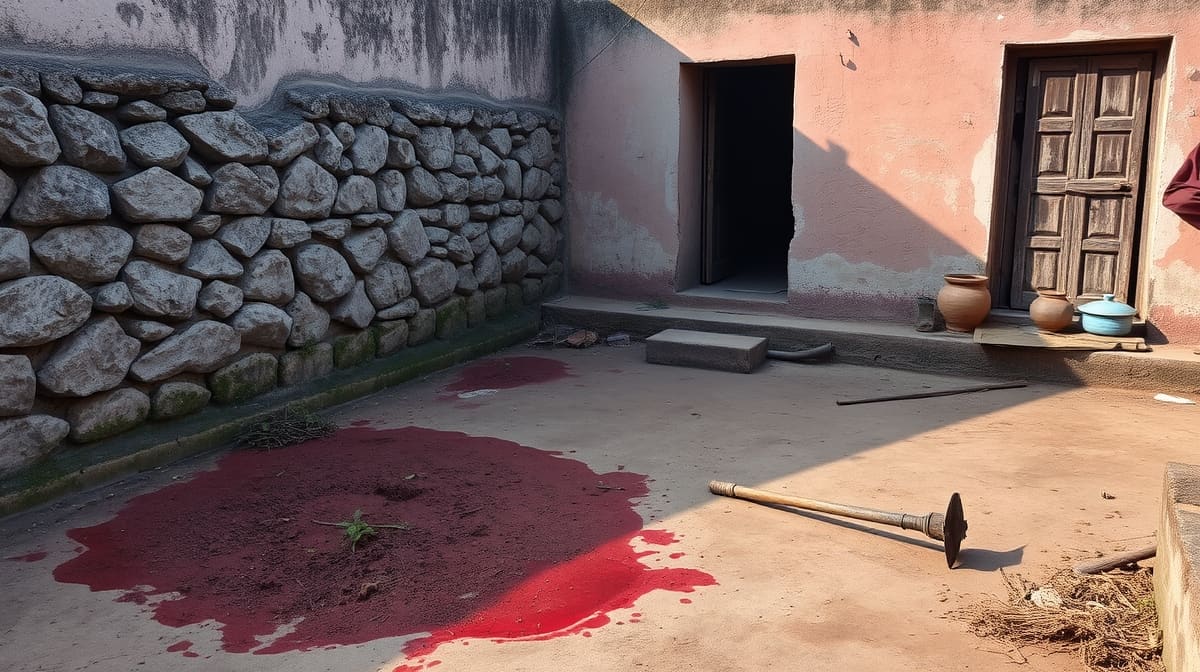
The Patna High Court has clarified that an assault arising from a sudden altercation, even if it results in a grievous head injury, does not automatically constitute an attempt to murder under Section 307 IPC unless the prosecution establishes a definite intention or knowledge to cause death. The judgment underscores the necessity of proving specific intent beyond mere use of a blunt weapon and prior enmity.
Background & Facts
The Dispute
The appellants - Sukhari Ram, Rajendra Ram, Dularchand Ram, and Mahipat Ram - were convicted under Section 307/34 and Section 323 of the Indian Penal Code for an alleged attempt to murder and voluntarily causing hurt. The incident occurred on 12.02.2003 at approximately 21:30 hours near a well in village Khamindoura, P.S. Durgawati, District Kaimur. The complainant, Chhabilal Ram, was returning home from Durgawati Bazaar when he was allegedly surrounded and assaulted by the accused persons due to prior enmity.
Key Facts
- The informant, Chhabilal Ram, was struck on the head with a lathi by Mahipat Ram, causing him to fall and raise an alarm.
- The incident occurred at night in darkness, with no street lighting.
- The informant’s nephew, Om Prakash Ram (P.W.2), arrived at the scene after the assault and took him for medical treatment.
- The injury report (Exhibit-2 and Exhibit-2/1) revealed a lacerated wound on the fronto-parietal region, a depressed fracture of the right basi-frontal bone, and a small extra-dural haematoma.
- The doctor (P.W.4) classified the injury as grievous and dangerous to life but admitted the injury could also result from a fall on a hard stone.
- The informant admitted to prior litigation with the accused.
- No blood-stained articles, weapons, or motorcycle tracks were recovered from the scene.
- The Investigating Officer (P.W.8) admitted he did not record statements from independent witnesses or collect physical evidence.
- P.W.1 (Ghuna Ram) was declared hostile.
- P.W.5 (Chhabilal Ram) admitted in deposition that only Mahipat Ram assaulted him.
- P.W.3 (Bikrama Ram), P.W.6 (Surendra Ram), and P.W.7 (Nibulal Prasad) were relatives of the informant and admitted to prior enmity.
Procedural History
- 12.02.2003: Alleged occurrence at approximately 21:30 hours.
- 13.02.2003: FIR (Case No. 15/2003) registered at Durgawati Police Station.
- 17.01.2012: Judgment of conviction delivered by the 1st Additional Sessions Judge, Kaimur.
- 21.01.2012: Order of sentence passed, sentencing appellants to 10 years RI under Section 307/34 and 1 year RI under Section 323 (to run concurrently).
- 05.02.2012: Filing of Criminal Appeal (SJ) No. 57 of 2012 and Criminal Appeal (SJ) No. 95 of 2012 before the Patna High Court.
- 30.04.2026: Judgment delivered by Justice Purnendu Singh.
The Parties' Positions
Appellants: Argued that the prosecution failed to prove common intention, that the sole eyewitness (P.W.2) was interested, that the informant admitted only one accused was involved, and that the medical evidence did not conclusively establish assault. They contended the injuries could have resulted from a fall and that the trial court ignored the applicability of Section 360 Cr.P.C.
State: Maintained that the trial court correctly appreciated the evidence and that the conviction under Section 307/34 was justified based on the grievous nature of the injury and the use of a lathi.
Relief Sought
The appellants sought quashing of the conviction under Section 307/34 IPC and reduction of the sentence under Section 323 IPC, arguing that the punishment of 10 years RI was grossly disproportionate and legally unsustainable.
The Legal Issue
The central question was whether the use of a lathi in a sudden altercation arising from prior enmity, resulting in a grievous head injury, is sufficient to establish the specific intention or knowledge required to convict under Section 307 IPC, or whether the evidence only supports a conviction for voluntarily causing hurt under Section 323 IPC.
Arguments Presented
For the Appellant
Learned counsel argued that the prosecution failed to prove the requisite intention to cause death under Section 307 IPC. The sole eyewitness, P.W.2, was the nephew of the victim and thus interested. The informant himself admitted only Mahipat Ram assaulted him, negating common intention under Section 34. The medical evidence did not rule out accidental injury from a fall. The Investigating Officer failed to collect material evidence or record statements from independent witnesses. The trial court ignored the absence of premeditation and the applicability of Section 360 Cr.P.C. for first-time offenders on bail.
For the Respondent
The Additional Public Prosecutor contended that the grievous nature of the injury - a depressed fracture and extra-dural haematoma - coupled with the use of a lathi on the head, was sufficient to infer intention to kill. The trial court had correctly weighed the evidence and the conviction was sustainable under Section 307 IPC.
The Court's Analysis
The Court undertook a meticulous review of the evidence, emphasizing that Section 307 IPC requires proof of a definite intention or knowledge to cause death, accompanied by an overt act that clearly moves towards its execution. Mere use of a weapon or the gravity of injury alone is insufficient.
"The law recognizes that the existence of a guilty intention alone is not sufficient to constitute an attempt. There must be something more than planning or arranging the means to commit the crime."
The Court relied on Pulicherla Nagaraju v. State of A.P. (2007) and Joseph v. State of Kerala (1995) to apply the multi-factor test for determining intent: nature of weapon, part of body targeted, force employed, presence of premeditation, and prior enmity. The Court noted that the lathi was not a deadly weapon, the assault occurred suddenly at night, and there was no evidence of prior meeting of minds among the accused.
"The doctor admitted that such injuries could be caused by a fall on a hard surface, thereby not fully ruling out an alternative mode of injury and weakening the certainty of the prosecution version."
The Court further highlighted the absence of independent corroboration, the hostile testimony of P.W.1, and the failure of the Investigating Officer to preserve the scene or collect evidence. The testimonies of P.W.3, P.W.6, and P.W.7 were tainted by familial bias. The Court concluded that while the injury was grievous, the evidence did not establish the requisite mens rea for attempt to murder.
The Court distinguished Sivamani v. State (2023), noting that while grievous injury is not mandatory for Section 307, the surrounding circumstances must clearly indicate intent. Here, the circumstances pointed to a sudden fight, not a planned attack.
The Verdict
The appellants succeeded in part. The Patna High Court set aside the conviction under Section 307/34 IPC and modified it to conviction under Section 323 IPC only. The sentence of 10 years rigorous imprisonment under Section 307 was set aside. The sentence under Section 323 IPC of 1 year rigorous imprisonment was reduced to the period already undergone. The appellants are directed to be set at liberty forthwith, unless detained in any other case. Their bail bonds are discharged. The lower court records are to be returned with a copy of this judgment.
What This Means For Similar Cases
Intention Must Be Proven, Not Inferred from Injury Alone
- Practitioners must now argue that grievous injury, even from a blow to the head, does not automatically equate to intent to kill under Section 307 IPC.
- The burden remains on the prosecution to prove specific intent through conduct, weapon use, and context - not merely the outcome.
- Medical reports admitting alternative causes must be leveraged to challenge Section 307 charges.
Sudden Altercations Require Careful Distinction from Premeditated Attacks
- In cases arising from prior enmity but occurring suddenly at night or in the heat of argument, courts will scrutinize the presence of premeditation.
- Absence of prior planning, lack of independent witnesses, and failure to recover weapons or blood evidence will weigh heavily against Section 307 convictions.
- Section 360 Cr.P.C. must be invoked for first-time offenders where the act lacks premeditation.
Prosecution Must Avoid Overreliance on Interested Witnesses
- Testimonies of close relatives or interested parties (e.g., nephew of victim) require independent corroboration.
- Hostile witnesses and non-collection of physical evidence will fatally undermine prosecution cases under serious offences.
- Courts will not sustain convictions under Section 307 where the evidence is inconsistent, contradictory, or lacks forensic support.