The Rajasthan High Court has reaffirmed that participation in an unlawful assembly with a common object to cause grievous harm, resulting in death, attracts liability under Section 302 read with Section 149 IPC, even when no single accused is proven to have delivered the fatal blow. The judgment underscores that collective culpability under Section 149 does not require proof of individual intent to kill, but rather the shared purpose of the group.
Background & Facts
The Dispute
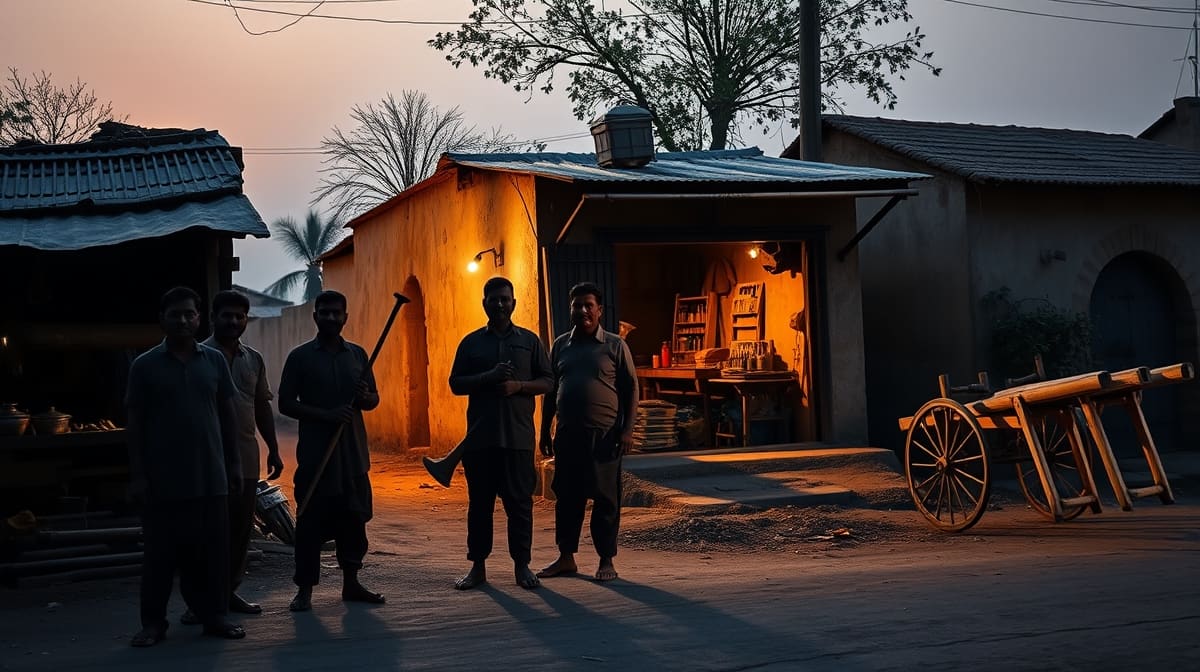
The dispute originated from a long-standing land passage conflict between the families of the deceased Mukhram and the accused-appellants, who were members of two rival clans in Village Dhandhra, District Sriganganagar. On 02.10.1999, Mukhram went to a mechanic shop to repair his bullock-cart, where a violent confrontation erupted between the two groups.
Key Facts
- The deceased, Mukhram, was the younger brother of the complainant, Rajaram @ Rajjiram.
- The accused-appellants were seven individuals: Lakshman Ram, Prabhu Ram, Lekh Ram, Raja Ram, Hanuman, Krishan Lal, and Devi Lal, all sons of Govind Ram or Rupa Ram.
- The incident occurred at approximately 6:00 P.M. on 02.10.1999 in broad daylight, near a mechanic shop in a densely populated village.
- The prosecution alleged that the accused-appellants, armed with sharp-edged weapons (gandasi, kasiya) and lathis, surrounded and assaulted Mukhram and Rajaram.
- According to the prosecution, Raja Ram struck Mukhram’s head with a gandasi, while Lakshman Ram inflicted injuries on his leg with a sickle.
- Rajaram, the injured complainant, was also assaulted with axes and lathis by Krishan Lal and others.
- Mukhram succumbed to his injuries at 9:45 P.M. on the same day.
- The complainant filed a written report (Parchabayan) at 10:00 P.M. on 02.10.1999, naming all seven accused.
- FIR No. 175/1999 was registered on the same day.
- The initial charge sheet named five accused; Krishan Lal and Devi Lal were added as accused on 29.10.2001.
- The prosecution examined 14 witnesses and exhibited 52 documents and 12 articles.
- The defence examined three witnesses and exhibited seven documents.
Procedural History
- 02.10.1999: Incident occurred at approximately 6:00 P.M.
- 10:00 P.M., 02.10.1999: Written report (Parchabayan) Ex.P-11 recorded by police.
- 02.10.1999: FIR No. 175/1999 registered.
- 03.10.1999: Post-mortem conducted by Dr. Devi Lal Bhakar.
- 29.10.2001: Krishan Lal and Devi Lal added as accused by court order.
- 04.12.2002: Trial Court convicted all seven accused under Sections 147, 148, 149, 302, 326, 324, 323 IPC.
- 11.05.2026: Final arguments concluded before the High Court.
- 16.05.2026: Judgment pronounced.
The Parties' Positions
For the Appellants
The appellants contended that:
- The prosecution case rested solely on interested witnesses (close relatives of the deceased).
- No independent witnesses were examined despite the occurrence being in a populated area.
- The names of Krishan Lal and Devi Lal were absent from early police statements (Ex.D-3, Ex.D-6), indicating fabrication.
- The delay in recording P.W.-2’s statement (claimed to be after one month) raised suspicion.
- The recovered weapons showed no blood stains, breaking the chain of evidence.
- The medical evidence showed no injury to vital organs sufficient for murder, suggesting only grievous hurt.
- The defence version of a sudden fight and private defence was ignored.
- The trial court inconsistently rejected defence testimony as biased while accepting prosecution testimony without corroboration.
For the Respondent
The State contended that:
- The Parchabayan (Ex.P-11) named all seven accused immediately after the incident.
- The ocular testimony of multiple witnesses, including the injured complainant, was consistent and reliable.
- Minor discrepancies in weapon descriptions were natural and did not undermine the core narrative.
- The omission of names in police statements was due to investigative lapses, not fabrication.
- The medical evidence clearly established that injuries to the chest punctured the lungs and were sufficient to cause death.
- The forensic report confirmed blood on the clothes of the deceased and injured, corroborating the ocular account.
- The absence of injuries on the accused weakened the plea of private defence.
- The common object of the unlawful assembly was to inflict serious harm, making all participants liable for murder.
Relief Sought
The appellants sought:
- Acquittal on charges under Section 302/149 IPC.
- Reduction of conviction to lesser offences under Sections 325/149 or 304 Part-II IPC.
- Setting aside of the trial court’s judgment and sentence.
- Release from custody.
The Legal Issue
The central question was whether Section 302 read with Section 149 IPC can be applied when the fatal injury is not proven to have been inflicted by a specific accused, but the group acted with a common object to cause grievous harm resulting in death.
Arguments Presented
For the Appellant
The appellants relied on State of U.P. v. Krishna Kumar and Rajendra Prasad v. State of Bihar to argue that conviction under Section 302/149 requires proof of individual participation in the fatal act. They contended that the absence of blood on recovered weapons, the delay in recording statements, and the omission of names in early police reports rendered the prosecution case unreliable. They further cited Kartar Singh v. State of Punjab to assert that the defence of private defence was wrongly rejected without adequate reasoning.
For the Respondent
The State relied on Kishan Singh v. State of Rajasthan and Bhagwan Das v. State of Haryana to argue that Section 149 imposes vicarious liability based on common object, not individual intent. They emphasized that the Parchabayan, medical evidence, and forensic reports collectively established the presence, weapons, and conduct of all accused. They cited State of Maharashtra v. Damodar to assert that minor inconsistencies in witness statements do not invalidate the prosecution case if the core narrative remains intact.
The Court's Analysis
The Court undertook a meticulous re-appreciation of the evidence, beginning with the medical testimony of P.W.-6 Dr. Devi Lal Bhakar. The doctor opined that injury Nos. 1 and 2 on the skull were caused by a sharp-edged weapon, while injuries Nos. 3 and 4 on the chest were blunt-force injuries that punctured the lungs and were sufficient in the ordinary course of nature to cause death. The Court held that this medical opinion was unshaken by cross-examination and was fully corroborated by the post-mortem report (Ex.P-22) and injury report (Ex.P-13).
"The medical opinion furnished by the said witness regarding the injuries noticed on the body of the deceased and the cause of death, as reflected in the post-mortem report, remains wholly unshaken."
The Court then examined the ocular testimony of six eyewitnesses, including the injured complainant. Despite the appellants’ contention that these were interested witnesses, the Court held that the presence of an injured witness elevates the credibility of testimony, and the consistency across multiple witnesses - regarding the weapons used, the number of assailants, and the sequence of events - created a compelling narrative. Minor variations in descriptions of weapons (e.g., whether Laxman Ram carried a sickle or a lathi with a blade) were deemed natural and immaterial.
The Court addressed the absence of Krishan Lal and Devi Lal in certain police statements. It held that the Parchabayan, filed immediately after the incident, named all seven accused. The omission in later Section 161 statements was attributed to investigative lapses, not fabrication, and could not override the consistent trial testimony. The Court cited State of U.P. v. M.K. Mishra to affirm that procedural irregularities do not invalidate a case if the core evidence is reliable.
Regarding the forensic report showing no blood on recovered weapons, the Court held that recovery evidence is corroborative, not determinative. The presence of blood on the clothes of the deceased and injured (Articles 6 - 12) confirmed the occurrence of violence, and the recovery of weapons matching the description of those used in the assault was sufficient to establish connection.
The Court rejected the defence of private defence on two grounds: first, no weapon was found in the hands of the deceased or complainant; second, none of the accused sustained any injury, which is inconsistent with a genuine fight. The Court held that the assault was deliberate, concerted, and prolonged, indicating a common object to inflict serious harm.
"The nature, seat and manner of injuries inflicted upon the deceased Mukhram and complainant Rajaram @ Rajjiram by sharp-edged weapons like gandasi as well as lathis clearly reflect that the assault was deliberate, concerted and not a spontaneous act arising out of a sudden fight, thereby ruling out the defence plea of private defence."
The Court concluded that the common object of the unlawful assembly was to assault and intimidate the complainant’s family, and the resulting death was a natural consequence of that object. Therefore, all seven accused were liable under Section 302/149 IPC, regardless of whether each delivered the fatal blow.
The Verdict
The appeal was dismissed. The judgment and sentence of the trial court dated 04.12.2002 were affirmed. All seven appellants were directed to be taken into custody immediately. The conviction under Sections 302/149 IPC, 326/149 IPC, 324/149 IPC, 323/149 IPC, 148 IPC, and 147 IPC stood confirmed. The sentences, ordered to run concurrently, remain in force. The record was directed to be sent back to the trial court for compliance.
What This Means For Similar Cases
Common Object Can Substitute Individual Intent in Murder Cases
- Practitioners must now argue that in cases of unlawful assembly, the prosecution need not prove which member delivered the fatal blow.
- The focus must shift to whether the group shared a common object to cause grievous harm, and whether death was a probable consequence.
- This judgment reinforces that Section 149 IPC is a tool for collective accountability, not individual culpability.
Ocular Evidence Trumps Forensic Gaps
- Absence of blood on recovered weapons will not defeat a prosecution case if ocular and medical evidence are consistent and credible.
- Forensic reports are corroborative; they cannot override direct testimony unless they directly contradict it.
- Courts will prioritize the narrative of multiple eyewitnesses over technical gaps in recovery evidence.
Defence of Private Defence Requires Physical Evidence
- To successfully claim private defence, the accused must show:
- Presence of imminent threat from the victim
- Use of proportionate force
- Injuries sustained by the accused
- Absence of injuries on the accused is now a decisive factor against the plea.
- Courts will view unexplained absence of injuries as evidence of aggression, not defence.