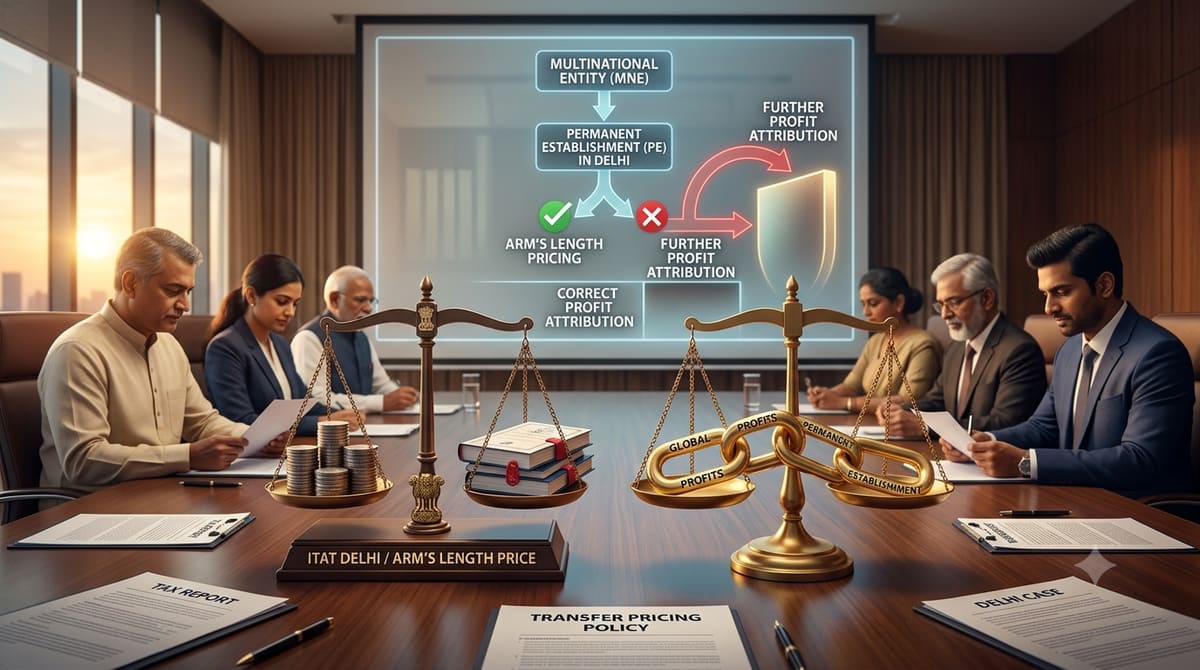
The Income Tax Appellate Tribunal, Mumbai, has clarified that penalty under Section 271G of the Income Tax Act cannot be imposed merely on technical grounds when the Transfer Pricing Officer accepts the Arm's Length Price without adjustment and the assessee has substantially complied with documentation obligations. This ruling reinforces the principle that penal consequences must be proportionate to actual prejudice to revenue.
Background & Facts
The Dispute
The appeals before the Tribunal arise from penalty orders issued under Section 271G of the Income Tax Act, 1961, for Assessment Years 2013-14 and 2015-16. The penalty was levied by the Transfer Pricing Officer (TPO) for alleged failure to furnish complete documentation as required under Section 92D read with Rule 10D of the Income Tax Rules. The assessee, Gems Private Limited, is engaged in the import, cutting, polishing, and export of diamonds, with substantial international transactions with Associated Enterprises (AEs). The TPO contended that the assessee failed to provide transaction-specific profitability data for AE transactions, instead submitting only entity-level margins that combined AE and non-AE transactions.
Key Facts
- The assessee adopted the Transactional Net Margin Method (TNMM) as the most appropriate method for benchmarking international transactions.
- The TPO, in orders dated 31.10.2016 (A.Y. 2013-14) and 31.10.2018 (A.Y. 2015-16), observed that the assessee did not furnish segmental profitability data as required under clauses (g), (h), and (i) of Rule 10D(1).
- Penalty orders were passed on 26.04.2017 (A.Y. 2013-14) and 25.04.2019 (A.Y. 2015-16), levying penalties of Rs. 2,08,07,996 and Rs. 1,77,77,097 respectively, at 2% of the value of international transactions.
- The TPO acknowledged that the assessee maintained detailed books of account, including purchase and sales registers, and had access to data capable of segmental allocation.
- However, the TPO also recorded in paragraph 9 of the transfer pricing order: "...the assessee's overall margin is in the range of the comparables, therefore, the value of international transactions with AE are not being disturbed & no adjustment is made in the assessee's case..."
- The assessee submitted that the nature of diamond trading makes precise cost allocation per transaction impracticable due to the bulk, variability, and commingling of rough diamonds.
- The assessee had previously obtained deletion of identical penalties for A.Y. 2011-12 and 2012-13 from the same Tribunal Bench.
Procedural History
- 31.10.2016: Transfer Pricing Order under Section 92CA(3) for A.Y. 2013-14
- 26.04.2017: Penalty order under Section 271G issued for A.Y. 2013-14
- 31.10.2018: Transfer Pricing Order under Section 92CA(3) for A.Y. 2015-16
- 25.04.2019: Penalty order under Section 271G issued for A.Y. 2015-16
- 29.05.2025: CIT(A) deleted both penalty orders, holding substantial compliance and reasonable cause under Section 273B
- 08.04.2026: Hearing before ITAT Mumbai
- 13.05.2026: Judgment pronounced
The Parties' Positions
For the Revenue (Appellant)
- Argued that failure to furnish transaction-specific profitability data under Rule 10D(1)(g), (h), and (i) constituted a clear breach of Section 92D.
- Contended that the TPO’s observation that the assessee could have computed segmental data but chose not to negated any claim of reasonable cause.
- Relied on Shatrunjay Diamonds (261 ITR 258) to assert that the burden of proving arm’s length pricing lies on the assessee.
- Maintained that penalty under Section 271G is independent of whether ALP is adjusted; non-furnishing of documents itself triggers liability.
For the Assessee (Respondent)
- Submitted that it had furnished all available documentation, including transfer pricing study reports and entity-level margins.
- Argued that the nature of diamond trade makes precise cost allocation per transaction commercially impracticable.
- Relied on prior ITAT decisions in its own cases for A.Y. 2011-12 and 2012-13, where identical penalties were deleted.
- Invoked Section 273B, asserting that the alleged non-compliance was due to reasonable cause.
- Emphasized that the TPO himself accepted the benchmarking and made no adjustment to ALP, negating any prejudice to revenue.
Relief Sought
The Revenue sought to set aside the CIT(A)’s orders deleting the penalties and restore the penalty orders dated 26.04.2017 and 25.04.2019 for A.Y. 2013-14 and 2015-16 respectively.
The Legal Issue
The central question was whether Section 271G permits imposition of penalty for non-furnishing of transfer pricing documentation when the Transfer Pricing Officer has accepted the Arm's Length Price without adjustment and the assessee has demonstrated substantial compliance, particularly in light of the practical constraints of the diamond trade and the protection under Section 273B.
Arguments Presented
For the Appellant
The Revenue contended that Section 271G is a strict liability provision, and failure to furnish documents prescribed under Rule 10D, even if no ALP adjustment is made, constitutes an independent default. It argued that the TPO’s findings in paragraphs 7.13 - 7.15 established that the assessee had the means to compute segmental profitability but deliberately chose not to, thereby frustrating the determination of ALP. The Revenue relied on Shatrunjay Diamonds to assert that the burden of proving arm’s length pricing lies with the assessee, and failure to meet this burden justifies penalty. It further argued that the CIT(A) failed to specify the nature of the reasonable cause and ignored the binding precedent of the Bombay High Court.
For the Respondent
The assessee countered that Section 271G is not a mechanical penalty provision and must be read with the saving clause under Section 273B. It submitted that the documentation furnished was sufficient for TNMM, and the inability to segregate costs per transaction was due to the inherent nature of diamond trading, where rough stones are commingled and processed in batches. It relied on two prior ITAT decisions in its own favor for A.Y. 2011-12 and 2012-13, where the same Bench had held that such practical difficulties constitute reasonable cause. The assessee emphasized that the TPO’s own admission that no adjustment was made to ALP negated any claim of prejudice to revenue.
The Court's Analysis
The Tribunal began by noting the undisputed fact that the TPO, despite identifying alleged documentation deficiencies, made no adjustment to the Arm’s Length Price of the international transactions. The TPO explicitly recorded that the assessee’s overall margins fell within the range of comparables, thereby validating the pricing.
"...the assessee's overall margin is in the range of the comparables, therefore, the value of international transactions with AE are not being disturbed & no adjustment is made in the assessee's case..."
The Tribunal held that this acceptance of the benchmarking results fundamentally undermines the Revenue’s contention that the assessee’s non-compliance frustrated the determination of ALP. If the ALP was correctly determined and accepted, then the alleged deficiency in documentation could not have caused any material prejudice.
The Tribunal further examined the nature of the assessee’s business. It acknowledged that diamond trading involves bulk procurement, commingling of rough stones, and batch processing, making it commercially impracticable to trace the cost of each individual diamond to specific AE transactions. This practical constraint had been previously recognized by the same Tribunal in its earlier orders for A.Y. 2011-12 and 2012-13.
"...we are of the considered view that the assessee had substantially complied with the directions of the TPO and placed on his record the requisite information, to the extent the same was practically possible in light of the very nature of its trade..."
The Tribunal held that the CIT(A) correctly applied Section 273B, recognizing that the alleged non-compliance was due to reasonable cause. The Revenue failed to distinguish the facts of the current years from those in the earlier decided cases.
The Tribunal also rejected the Revenue’s reliance on Shatrunjay Diamonds (261 ITR 258), noting that the case pertained to Section 40A(2)(b) concerning disallowance of excessive expenditure, not penalty proceedings under Section 271G. The statutory frameworks are distinct: Section 40A(2)(b) involves substantive disallowance based on reasonableness, while Section 271G concerns procedural non-compliance with a built-in safeguard under Section 273B.
The Tribunal further cited Kapu Gems LLP and Interjewel Pvt. Ltd. to reinforce that penalty under Section 271G cannot be imposed where the assessee has substantially complied and the ALP is accepted.
The Verdict
The appeals filed by the Revenue were dismissed. The Tribunal upheld the orders of the CIT(A) dated 29.05.2025, which deleted the penalties of Rs. 2,08,07,996 for A.Y. 2013-14 and Rs. 1,77,77,097 for A.Y. 2015-16. The Tribunal held that the levy of penalty under Section 271G was not justified in the absence of any adjustment to the Arm’s Length Price and in light of substantial compliance and reasonable cause under Section 273B.
What This Means For Similar Cases
Substantial Compliance Overrides Technical Non-Compliance
- Practitioners must argue that penalty under Section 271G is not automatic; it requires proof of prejudice to revenue determination.
- Where the TPO accepts the ALP without adjustment, the burden shifts to the Revenue to demonstrate actual harm from documentation gaps.
- Merely citing Rule 10D clauses without showing impact on ALP determination is insufficient to sustain penalty.
Reasonable Cause in Specialized Industries Is Recognized
- Businesses in sectors like diamond trading, pharmaceuticals, or software development, where cost allocation is inherently complex, can rely on Kapu Gems and Interjewel to invoke Section 273B.
- Documentation should be tailored to practical feasibility; courts will consider industry norms and operational constraints.
- Maintain contemporaneous records explaining why certain data could not be produced (e.g., batch processing logs, industry white papers).
Precedent from Coordinate Bench Is Binding
- When a coordinate bench of the ITAT has decided identical facts in favor of the assessee, the Revenue must distinguish the facts materially - mere procedural similarity is not enough.
- Tax officers must review prior tribunal decisions in the assessee’s own case before initiating penalty proceedings.
- Assessee’s counsel should always cite prior favorable ITAT orders as binding precedent under the doctrine of consistency.