The Jharkhand High Court set aside a trial court's compensation enhancement in land acquisition proceedings, holding that the proper application of Section 26(b) of the Right to Fair Compensation and Transparency in Land Acquisition, Rehabilitation and Resettlement Act, 2013 requires consideration of sale deeds from the nearest adjoining village when no sale transactions exist in the acquired area, and enhanced compensation to Rs. 99,300 per decimal based on a verified sale deed from Kankebar village.
Background & Facts
The Dispute
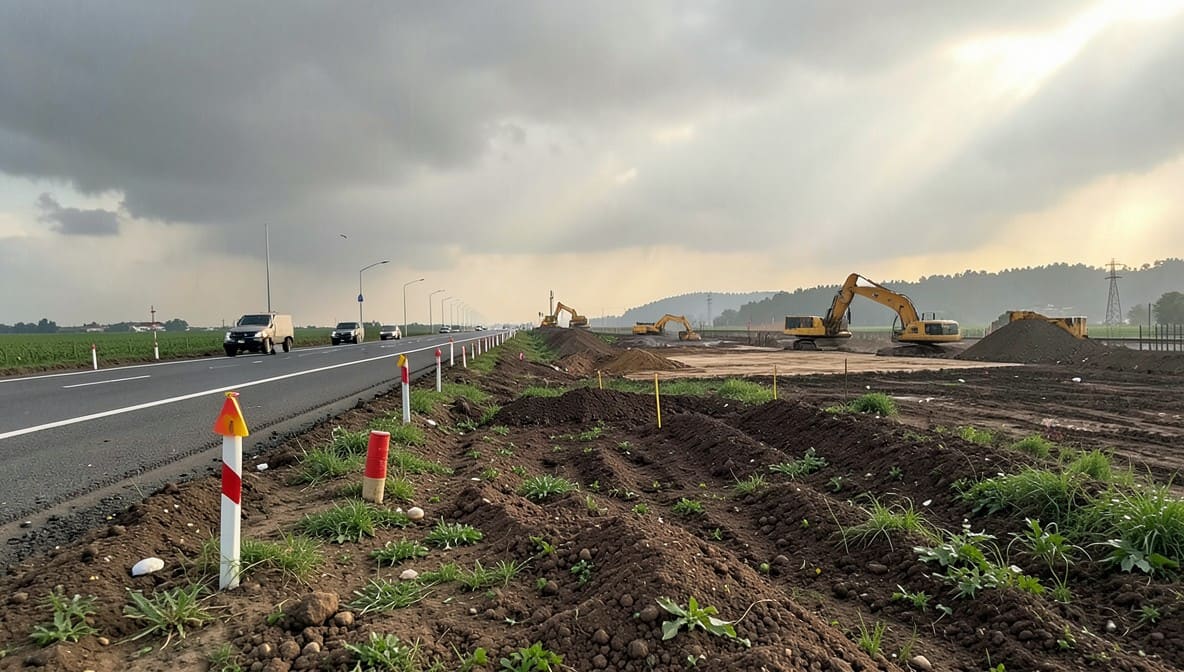
The appellants, landowners of Village Gandke in Ramgarh district, Jharkhand, challenged the compensation awarded for their land acquired for the widening and strengthening of Lalki Ghati to Marang Marcha (N.H. 23) Road. The acquisition was undertaken under Notification No. 407/L.A. dated 01.07.2019 issued under Section 11 of the Act of 2013, with Declaration No. 109/L.A. dated 18.02.2020. The learned Principal District Judge-cum-L.A.R.R.A., Hazaribag initially awarded compensation at Rs. 3,740 per decimal (the circle rate for agricultural land) but enhanced it to Rs. 11,000 per decimal on reference under Section 64 of the Act. The appellants sought further enhancement to Rs. 1,50,000 per decimal, claiming this reflected the true market value based on sale deeds from adjacent villages Kankebar and Murramkala.
Key Facts
- The acquisition involved 58 Land Acquisition Case Nos. 614/2022 to 671/2022, covering a total area of 2.75 acres (130 decimals) of Village Gandke, Thana No. 99, Revenue Thana Ramgarh, Anchal Ramgarh.
- Notification No. 407/L.A. dated 01.07.2019 (Exhibit A) initiated acquisition for road widening under Section 11 of the Act of 2013.
- Declaration No. 109/L.A. dated 18.02.2020 (Exhibit B) was issued under Section 19(1) of the Act of 2013.
- The District Land Acquisition Officer, Ramgarh fixed compensation at Rs. 3,740 per decimal based on the prevailing circle rate for agricultural land.
- The learned court enhanced compensation to Rs. 11,000 per decimal on reference.
- Appellants claimed compensation at Rs. 1,50,000 per decimal, supported by seven sale deeds:
- Ext.1: Sale Deed No. 831/804 dated 30.04.2016 (Kankebar, 4.5 decimals, Rs. 10,00,000)
- Ext.1/1: Sale Deed No. 938/918 dated 14.07.2017 (Kankebar, 6.25 decimals, Rs. 6,20,625)
- Ext.1/2: Sale Deed No. 1979/1931 dated 26.11.2018 (Murramkala, 13.75 decimals, Rs. 31,63,000)
- Ext.1/3: Sale Deed No. 1378 dated 17.11.2017 (Murramkala, 24 decimals, Rs. 51,00,000)
- Ext.1/4: Sale Deed No. 2084 dated 31.12.2018 (Murramkala, 13 decimals, Rs. 30,00,000)
- Ext.1/5: Sale Deed No. 1599/1562 dated 23.10.2019 (Kankebar, 14 decimals, Rs. 38,00,000)
- Ext.1/6: Sale Deed No. 122 dated 28.01.2019 (Murramkala, 7.5 decimals, Rs. 29,70,000)
- Village maps were exhibited: Mark-X (Kankebar) and Mark-X/1 (Gandke).
- Witnesses PW-1 (Harakhnath Mahto) and PW-2 (Yogendra Prasad Ganjhu) testified that Gandke and Kankebar are adjacent villages with similar land characteristics.
- PW-1 stated his land (Plot No. 1182, Khata No. 45, 12 decimals) was acquired and compensated at Rs. 3,740 per decimal despite market value being Rs. 1,50,000 per decimal.
- PW-2 stated his land (Plot No. 383, Khata No. 39, 0.08 acres) was acquired under the same process.
- Both witnesses affirmed that Gandke village has significant development (Radha Govind University, DPS School, etc.) and lies within 2-3 km of Ramgarh Town headquarters.
- The respondents' sole witness DW-1 (Deepak Kumar, Junior Engineer) admitted Gandke and Kankebar are adjacent villages and acknowledged land rates around Ramgarh range from Rs. 1,00,000 to Rs. 2,00,000 per decimal.
Procedural History
- 01.07.2019: Notification No. 407/L.A. issued under Section 11 of the Act of 2013 for land acquisition.
- 18.02.2020: Declaration No. 109/L.A. issued under Section 19(1) of the Act of 2020.
- 11.04.2022: District Land Acquisition Officer, Ramgarh issued reference order(s) under Section 64 of the Act of 2013 after claimants objected to compensation.
- 24.02.2025: Learned Principal District Judge-cum-L.A.R.R.A., Hazaribag passed common judgment enhancing compensation to Rs. 11,000 per decimal.
- 07.09.2026: Arguments heard before the High Court.
- 15.09.2026: Judgment pronounced (Date of Judgment: 15.09.2026).
The Parties' Positions
Appellants' Contention: The trial court erred by not considering sale deeds from Kankebar (the nearest adjoining village) under Section 26(b) Explanation 2, instead relying on government assessment despite evidence showing higher market value. They argued that land acquired for road widening possesses commercial potential, and compensation must reflect the highest value of comparable land in the vicinity, citing the principle that market value considers land's potential use.
Respondents' Contention: The appellants failed to produce valid exemplar sale deeds from Village Gandke itself; the exhibited deeds were from Murramkala and Kankebar and pertained to residential land, not comparable to the Tanr category land of Gandke. The onus to prove higher compensation lay with the claimants, which they discharged not. The trial court's enhancement to Rs. 11,000 per decimal was legally sustainable and required no interference.
Relief Sought
The appellants sought enhancement of compensation from Rs. 11,000 per decimal to Rs. 1,50,000 per decimal (or alternatively Rs. 1,51,731 per decimal based on their calculation), together with all statutory benefits including solatium, additional compensation, and interest as provided under the Act of 2013.
The Legal Issue
The central question was whether the determination of compensation by the learned Principal District Judge-cum-L.A.R.R.A., Hazaribag, enhancing the rate from Rs. 3,740 per decimal to Rs. 11,000 per decimal, was in conformity with the provisions of Section 26 of the Right to Fair Compensation and Transparency in Land Acquisition, Rehabilitation and Resettlement Act, 2013, particularly regarding the consideration of sale deeds from adjoining villages for market value determination under Section 26(b) Explanation 2.
Arguments Presented
For the Appellants
The appellants relied on Section 26(b) Explanation 2 of the Act of 2013, arguing that when no sale deed exists in the acquired village, the market value must be determined from the average sale price of similar land in the nearest village. They exhibited seven sale deeds from Kankebar and Murramkala, asserting Kankebar was proven adjacent to Gandke through witness testimony and village maps (Exhibit X and X/1). They contended that only sale deeds within three years prior to the notification (01.07.2016 to 30.06.2019) were eligible, making Ext.1/1 (Sale Deed No. 938/918 dated 14.07.2017) the sole qualifying deed. They calculated the average rate from three highest-valued agricultural sale deeds (Ext.1/2, Ext.1/3, Ext.1/6) as Rs. 1,51,731 per decimal, claiming entitlement to this rate or their claimed Rs. 1,50,000 per decimal. They cited the settled principle that compensation must be based on the highest value of comparable land, criticizing the trial court's arbitrary fixation of Rs. 11,000 per decimal without nexus to evidence or statutory methodology. They further argued that land acquired for road widening possesses commercial potential, and treating it purely as agricultural land ignores its true market value, referencing the Act's objective to cure the anti-farmer nature of the 1894 Act.
For the Respondents
The respondents contended that the appellants failed to produce any valid exemplar sale deeds from Village Gandke, rendering their claim for higher compensation unsubstantiated. They argued that the exhibited sale deeds from Murramkala and Kankebar pertained to residential land, while the acquired land in Gandke was classified as Tanr category, making them incomparable. They asserted that the onus to prove higher compensation lay with the claimants, which they failed to discharge, as evidenced by PW-1's admission that he produced no document regarding land at Rs. 1.5 lakh per decimal. They maintained that the trial court properly enhanced compensation to Rs. 11,000 per decimal based on government assessment and interest of justice, and that the State's submission regarding claimants accepting compensation without protest was wrongly rejected. They emphasized that separate land acquisition cases were registered but claimants did not come forward to give evidence, allowing adverse inference under Section 114(g) of the Indian Evidence Act.
The Court's Analysis
The Court began by noting that land acquisition proceedings are governed by Sections 11, 26, and 27 of the Act of 2013, with compensation to be determined under Section 26. It outlined the three modes for compensation determination under Section 26(1): (a) market value specified in the Indian Stamp Act, 1899; (b) average sale price for similar land in the nearest village or vicinity; or (c) consented amount under private projects, with the highest value to be taken.
The Court found that the District Land Acquisition Officer had not endeavored to find market rates from the nearest adjoining village despite recording no sale deeds in Gandke from 2016-2019, violating the legal obligation under Section 26(1)(b) to compare circle rate with nearest village market value. It held that the trial court erroneously declined to consider the appellants' sale deeds on two grounds: first, that the deeds were not from Mouza Gandke but from Murramkala and Kankebar (which did not show nearest Mouza), and second, that the claimed rate of Rs. 1,57,183 per decimal was too high compared to government assessment.
The Court rejected both grounds. It accepted the appellants' proof that Kankebar is the adjoining village to Gandke through witness statements (PW-1 and PW-2) and the map evidence (Exhibit X and X/1), noting that the trial court had overlooked this evidence. It found that Exhibit 1/1 (Sale Deed No. 938/918 dated 14.07.2017 from Kankebar, 6.25 decimals for Rs. 6,20,625) was the only sale deed falling within the three-year period prior to notification (01.07.2016 to 30.06.2019) and from the proved adjoining village Kankebar. The Court calculated the average sale price per decimal from this deed as Rs. 99,300.
The Court further held that the nature and location of the acquired land must be considered: while Exhibit 1/1 showed vacant residential land with no road boundary, the acquired land in Gandke had road access on multiple sides and national highway frontage, providing locational advantage not present in the exemplar deed. It emphasized that the learned court had enhanced compensation to Rs. 11,000 per decimal citing 'interest of justice' despite the record revealing cogent materials seeking enhancement to a much higher rate. The Court concluded that the trial court's judgment omitted proper consideration of materials on record while enhancing compensation, and was not in conformity with Section 26 of the Act of 2013.
"It is important to note that the learned court has enhanced the compensation at flat rate of Rs. 11,000/ - per decimal and found the compensation fixed by the District Land Acquisition Officer at circle rate of agricultural land not acceptable, but no deliberations have been made with respect to the exhibited sale deeds."
"Considering the totality of circumstances as discussed above and upon due consideration of the materials on record, this court, while answering the core point of determination, holds that the judgment and award passed by the learned court of the Principal District Judge -cum- L.A.R.R.A., Hazaribag is not in conformity with the provisions of section 26 of the Right to Fair Compensation and Transparency in Land Acquisition, Rehabilitation and Resettlement Act, 2013 and the learned Court has omitted to properly consider the materials on record while enhancing the compensation to flat rate of Rs. 11,000/ - only per decimal from Rs. 3740/ - per decimal by citing interest of justice although the records reveal that cogent materials were produced seeking enhancement of compensation to much more."
"In view of the aforesaid discussions, the compensation is enhanced to flat rate of Rs. 99,300/ - per decimal."
The Verdict
The appellants succeeded in their appeals. The Court set aside the impugned judgment dated 24.02.2025 which had enhanced compensation to Rs. 11,000 per decimal, and instead enhanced the rate of compensation to Rs. 99,300 per decimal for the acquired land in Village Gandke. The claimants are entitled to all statutory benefits under the Act of 2013 including solatium, additional compensation, and interest. The Office of the Principal District Judge-cum-L.A.R.R.A., Hazaribag is directed to prepare the revised award accordingly, with payment of compensation along with all benefits to be made within three months from the date of the award.
What This Means For Similar Cases
Nearest Village Determination Is Fact-Sensitive
Courts must rigorously examine evidence of adjacency when determining the 'nearest village' under Section 26(b) Explanation 2. Mere assertion that sale deeds are from a different village is insufficient; objective proof through witness testimony, maps, and land characteristics is required. In this case, the High Court accepted adjacency based on consistent witness statements (PW-1 and PW-2) and village maps showing common boundary, rejecting the trial court's oversight of this evidence. Practitioners should proactively gather such evidence - including revenue records, physical verification, and expert testimony - to establish village proximity for market value computation.
Strict Adherence to Three-Year Window for Sale Deeds
Only sale deeds registered within the three years immediately preceding the notification under Section 11 are eligible for consideration under Section 26(b) Explanation 2. The Court excluded six of the seven exhibited deeds because they fell outside the 01.07.2016 to 30.06.2019 window (Ext.1 too early, Ext.1/2, Ext.1/3, Ext.1/4, Ext.1/5, Ext.1/6 too late or from Murramkala). This creates a strict evidentiary burden: claimants must identify and produce sale deeds from the adjoining village within this precise timeframe. Failure to do so risks reliance on circle rate alone, as seen in the initial award of Rs. 3,740 per decimal.
Locational Advantage Must Be Factored Into Market Value
The acquired land's specific characteristics - such as road frontage, proximity to highways, and developmental potential - must be compared to the exemplar sale deed used for computation. Here, the Court noted that while Exhibit 1/1 showed vacant residential land with no road boundary, the acquired land had national highway frontage and multi-sided road access, justifying an upward adjustment beyond the bare average rate. Lawyers should document and argue for such locational premiums through evidence of infrastructure, zoning, and comparable transactions involving similarly situated land, ensuring compensation reflects not just raw agricultural value but the land's actual market context for the acquisition purpose.