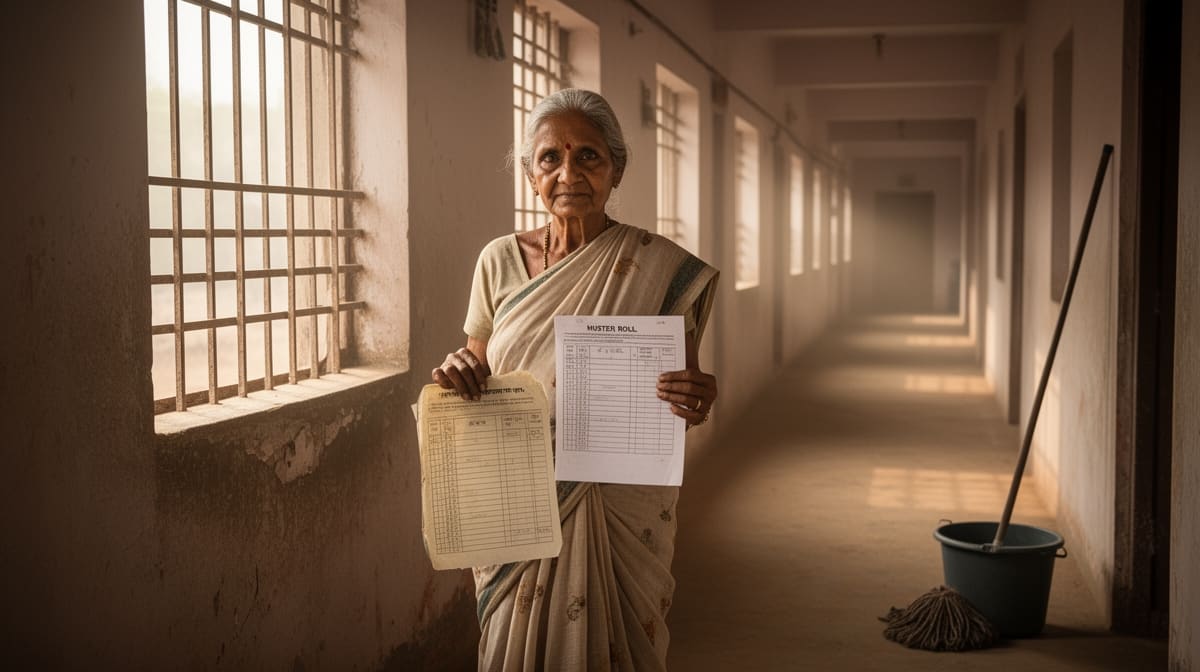
The Bombay High Court has clarified that when an employer denies employment but withholds critical records like attendance registers and salary vouchers, courts may draw an adverse inference against them. This judgment reinforces that statutory protections under the Industrial Disputes Act apply even to informal workers, and that reinstatement is not the only remedy when superannuation renders it impractical.
Background & Facts
The Dispute
The petitioner, Shobha Laxman Kamthe, worked as a sweeper in the Bharati Vidyapeeth Ladies Hostel for approximately eleven years, performing cleaning duties in hostels under the supervision of the Chief Rector. She alleged that her wages were below the statutory minimum and that she was denied statutory benefits. After joining the Pune Majdoor Sabha and raising labour grievances, she was orally terminated on 30 November 2003 without notice or retrenchment compensation.
Procedural History
- 2002: Petitioner filed ULP Complaint No.12 of 2002 before the Industrial Court, which was dismissed for lack of jurisdiction.
- 2003: Reference No.620 of 2004 was made by the Deputy Commissioner of Labour under Section 10(1)(c) read with Section 12(5) of the Industrial Disputes Act, 1947, seeking reinstatement and back wages.
- 2011: First Labour Court, Pune rejected the claim, holding no employer-employee relationship existed.
- 2013-2015: Multiple writ petitions were filed under Article 227 of the Constitution challenging the 2011 award.
Relief Sought
The petitioner sought reinstatement with continuity of service and full back wages. In light of her superannuation during pendency of litigation, she alternatively sought monetary compensation in lieu of reinstatement.
The Legal Issue
The central question was whether Section 25F of the Industrial Disputes Act applies when an employer denies employment but fails to produce attendance and wage records that are exclusively in its control, and whether monetary compensation can be awarded instead of reinstatement upon superannuation.
Arguments Presented
For the Petitioner
The petitioner relied on R.M. Yellatti v. Assistant Executive Engineer (2006) to argue that when relevant documents like muster rolls and salary vouchers are in the exclusive possession of the employer and are withheld, an adverse inference must be drawn against the employer. She produced photocopies of muster rolls (1994-1995) and a salary voucher (1996), supported by oral testimony, to establish continuous service under Section 25B. She further contended that Section 25F was violated by termination without notice or compensation, and that superannuation rendered reinstatement impractical, entitling her to monetary relief.
For the Respondent
The respondent contended that no employer-employee relationship existed, as cleaning staff were engaged informally by students. It argued that the petitioner failed to prove 240 days of service in the preceding year under Section 25B, and that the secondary evidence produced was unreliable due to unexplained origin. It also relied on the earlier dismissal of ULP complaints for want of jurisdiction, asserting res judicata.
The Court's Analysis
The Court examined the legal framework under Section 25B and Section 25F of the Industrial Disputes Act, relying on Anil Mithra v. Sree Sankaracharya University of Sanskrit (2022) to affirm that continuous service is established if a worker completes 240 days in the preceding 12 months, regardless of intermittent breaks not attributable to the worker.
"When relevant records are expected to be in the possession of the employer and yet are not produced, the court is entitled to presume that the records, if produced, would not support the employer's case."
The Court held that the Labour Court correctly permitted secondary evidence under Section 65 of the Indian Evidence Act, as the originals were not in the petitioner’s custody and the respondent had denied their existence. The muster rolls and salary voucher, though photocopies, were corroborated by consistent oral testimony and were not contradicted by any records from the respondent. The absence of attendance registers or wage records from the employer was fatal to its defence.
The Court distinguished the earlier dismissal of ULP complaints, noting that jurisdictional denial under the MRTU and PULP Act did not constitute adjudication on the merits of employment under the Industrial Disputes Act. Once continuous service was established, Section 25F became mandatory, and termination without notice or compensation was illegal.
Regarding relief, the Court acknowledged that reinstatement was no longer feasible due to the petitioner’s superannuation. Citing settled principles, it held that monetary compensation is an appropriate substitute when reinstatement is impracticable, and that the quantum must reflect length of service, wages, and delay in adjudication.
The Verdict
The petitioner won. The Court held that Section 25F was violated due to termination without notice or retrenchment compensation, and that the failure to produce records warranted an adverse inference. Reinstatement was denied due to superannuation, but the petitioner was awarded Rs.2,00,000 as monetary compensation in full and final settlement.
What This Means For Similar Cases
Adverse Inference Arises from Withholding Records
- Practitioners must argue that when employers deny employment but refuse to produce attendance or wage records, courts are bound to infer that such records would have supported the worker’s claim.
- This shifts the evidentiary burden: the employer must explain non-production, not the worker to prove absence.
Superannuation Does Not Bar Compensation
- Even if reinstatement is impossible due to age or retirement, workers are entitled to monetary compensation under Section 25F violations.
- Compensation must be calculated based on last drawn wages, length of service, and delay in litigation - not merely nominal amounts.
Continuous Service Can Be Proved Through Circumstantial Evidence
- Muster rolls, salary vouchers, and witness testimony, even if secondary, can establish 240-day service under Section 25B.
- Employers cannot evade liability by claiming informal arrangements; control and supervision are decisive factors.