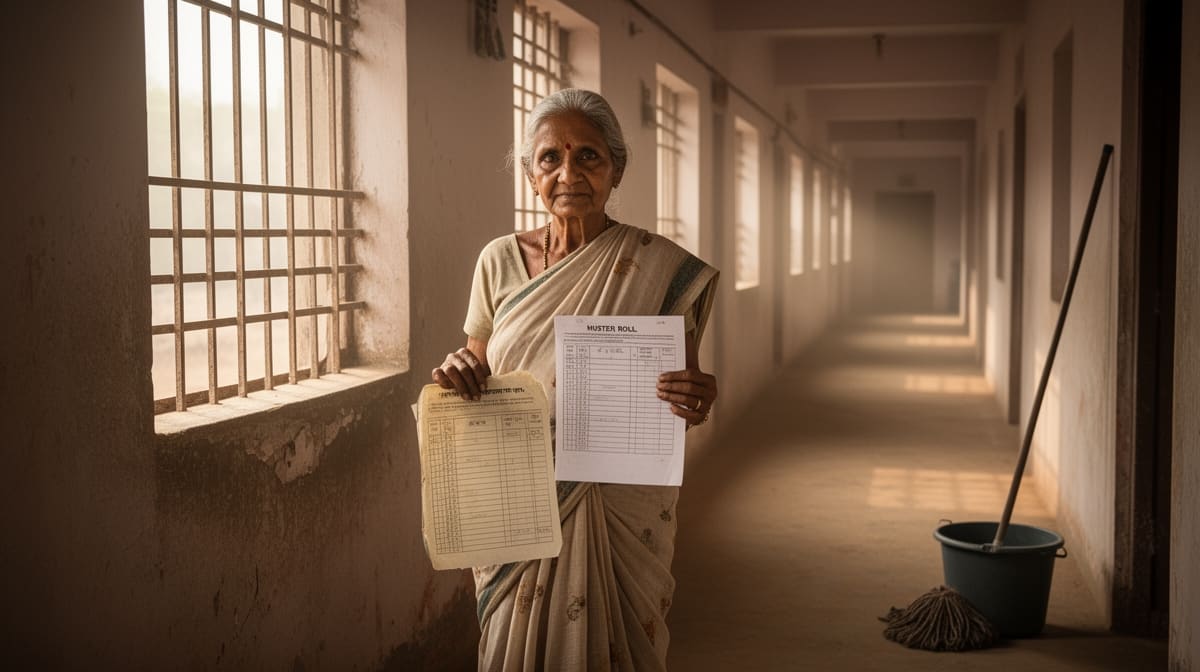
The Orissa High Court has affirmed that an employer’s failure to produce critical employment records, such as attendance registers, justifies an adverse inference in favour of a workman claiming continuous service. The judgment reinforces the principle that statutory adjudicators may draw reasonable inferences from withheld evidence, particularly when such records lie exclusively within the employer’s control.
Background & Facts
The Dispute
The dispute arose from the termination of service of Abhimanyu Behera, a workman employed by M/s Orient Paper Mills, Bhubaneswar. Behera claimed he had been engaged since 1984 as a daily wage worker and was subsequently appointed as a Watchman on a consolidated salary of Rs. 885 per month w.e.f. 01.08.1993. He alleged that his employment was abruptly terminated w.e.f. 14.02.1999 without notice, notice pay, or any opportunity of hearing, violating principles of natural justice.
Key Facts
- The workman was initially engaged on daily wages of Rs. 25/- per day w.e.f. 01.11.1984
- He was appointed as Watchman on consolidated salary w.e.f. 01.08.1993
- He filed a complaint before the District Labour Officer (DLO), Khordha, on 23.02.1999 alleging non-payment of minimum wages, bonus, and arrears
- On 19.04.1999, he filed a supplementary complaint alleging refusal of employment w.e.f. 14.02.1999
- The Management, in its response dated 03.04.1999 and 15.07.1999, admitted the workman was engaged occasionally on daily wage basis prior to 1995, but denied continuous employment
- Conciliation failed, leading to reference to the Labour Court on 17.07.2000
- The workman examined himself as the sole witness (AW/WW) and produced documents marked as Exhibits 1 to 6
- The Management examined its Factory Manager as the sole witness (MW), but produced no documents
- The Management claimed all documents submitted by the workman were forged, yet failed to produce attendance registers, wage registers, or lodge any FIR
- The workman was 72 years old at the time of judgment and bedridden
Procedural History
- 23.02.1999: Initial complaint filed before DLO, Khordha
- 19.04.1999: Supplementary complaint alleging refusal of employment
- 31.01.2000: Conciliation failed; Failure Report submitted
- 17.07.2000: Reference made to Labour Court, Bhubaneswar (I.D. Case No. 104 of 2000)
- 28.08.2001: Management filed written statement denying employer-employee relationship
- 02.02.2007: Ex-parte award passed in favour of workman
- 07.11.2007: Management’s application for restoration (R.M.C. No. 04 of 2007) dismissed
- 24.01.2017: Writ Petition No. 133 of 2008 dismissed; matter remanded for rehearing
- 31.03.2018: Labour Court passed award upholding workman’s claim and awarding Rs. 4,00,000/- as compensation
- 18.02.2026: Hearing before Orissa High Court
- 18.03.2026: Judgment delivered
The Parties' Positions
For the Petitioner (Management)
- Contended that no employer-employee relationship existed
- Alleged that documents submitted by the workman (Exhibits 1-6) were forged
- Argued that burden of proving workman status lay on the claimant
- Asserted that the reference dated 17.07.2000 was invalid as refusal of employment was never raised in the original complaint
- Claimed that adverse inference cannot be drawn without a specific application for production of records
For the Respondent (Workman)
- Maintained continuous service from 1984 to 1999
- Submitted documentary evidence including appointment letters and pay slips
- Argued that the Management’s failure to produce attendance and wage registers justified adverse inference
- Cited Sita Ram & Ors. v. Moti Lal and Director Fisheries v. Bhikubhai to support inference doctrine
- Highlighted that Management never challenged the reference before the Labour Court
Relief Sought
The workman sought:
- Recognition of continuous service from 01.11.1984 to 14.02.1999
- Compensation of Rs. 4,00,000/- as awarded by the Labour Court
- Interest at 6% per annum on the compensation amount until payment
- Enforcement of the award without further delay
The Legal Issue
The central question was whether the Labour Court was legally justified in drawing an adverse inference against the Management for its failure to produce attendance and wage registers, and whether the reference to the Labour Court was valid despite the initial complaint not explicitly mentioning refusal of employment.
Arguments Presented
For the Appellant/Petitioner
The Management relied on R.M. Yellatti v. Assistant Executive Engineer to argue that the burden of proving workman status and continuous service lies on the claimant. It contended that the Labour Court erred in shifting the burden to the employer and in drawing adverse inference without a formal application for production of records. It further argued that the reference dated 17.07.2000 was invalid because the dispute of refusal of employment was not part of the original complaint before the DLO, and that the Labour Court had no jurisdiction to adjudicate the validity of the reference.
For the Respondent/State
The workman’s counsel relied on Sita Ram & Ors. v. Moti Lal and Director Fisheries v. Bhikubhai to assert that when an employer withholds records under its exclusive control, an adverse inference may be drawn. He emphasized that the Management’s own witness admitted the existence of attendance registers and their non-production. He further argued that the supplementary complaint dated 19.04.1999 clearly raised the issue of refusal of employment, and that the Labour Court was not empowered to examine the validity of the reference, which was a matter for the appropriate Government.
The Court's Analysis
The Orissa High Court, while exercising its supervisory jurisdiction under Article 227, declined to interfere with the Labour Court’s findings. The Court observed that the Labour Court had meticulously examined both oral and documentary evidence, and had correctly applied the principle that an employer’s failure to produce records under its exclusive custody justifies an adverse inference.
"The management emphatically urged that all the documents exhibited by the 2nd party are forged and manufactured. MW.1 during his cross-examination at para-15 categorically admitted that separate records and registers were being maintained... and the same was not produced before this Court. So, there is every reason to presume that had the registers/records been produced, it could have gone against the management."
The Court noted that the Factory Manager, the sole witness for the Management, admitted the existence of attendance registers for the period 1993 onwards, yet refused to produce them. He also admitted that the Management had not verified the authenticity of the documents with the individuals who had signed them (P.B. Gupta and D.M. Bhandari), nor had it lodged any FIR for forgery.
The Court distinguished R.M. Yellatti on the ground that it dealt with the initial burden of proof, whereas the present case involved the employer’s failure to produce records after the claimant had made a prima facie case. The Court held that the Labour Court was entitled to draw an adverse inference under the settled jurisprudence of the Supreme Court, even though the Evidence Act does not strictly apply to proceedings under the Industrial Disputes Act.
Regarding the validity of the reference, the Court held that the supplementary complaint dated 19.04.1999, which was part of the conciliation record, clearly raised the issue of refusal of employment. The Labour Court was therefore competent to adjudicate the dispute. The Court further held that the validity of the reference is not within the jurisdiction of the Labour Court, and the Management’s failure to challenge it earlier precluded it from raising the issue for the first time in a writ petition.
The Court also rejected the contention that the award was perverse or based on evidence beyond pleadings, noting that no specific instance of such irregularity was pointed out.
The Verdict
The writ petition was dismissed. The Orissa High Court upheld the Labour Court’s award dated 31.03.2018, directing the Management to pay Rs. 4,00,000/- as compensation to the workman within one month. The Management is liable to pay accrued interest at 6% per annum on the awarded amount until full payment is made, as stipulated in the original award. No costs were awarded.
What This Means For Similar Cases
Adverse Inference Is Valid Without Formal Application
- Practitioners must now argue that an employer’s failure to produce attendance, wage, or service records, even without a formal application under Section 114 of the Evidence Act, justifies adverse inference under the Industrial Disputes Act
- The burden shifts to the employer to explain non-production when records are under its exclusive control
- Failure to produce such records, coupled with no FIR or verification efforts, strengthens the claimant’s case
Supplementary Complaints Can Validate References
- A supplementary complaint filed during conciliation proceedings, even if not part of the initial petition, can form the basis for a valid reference if it raises a new but related dispute
- Labour Courts may consider the full conciliation record, including subsequent filings, to determine the scope of the dispute
- Employers cannot later challenge the reference’s validity in writ proceedings if they did not raise it before the adjudicator
Delay and Laches Can Influence Enforcement
- Courts may impose strict timelines for compliance when litigation delays have caused undue hardship to the workman
- Prolonged litigation by employers, especially against elderly or vulnerable workers, may trigger equitable remedies beyond statutory mandates
- Enforcement directions may be issued even where the ID Act lacks explicit provisions, to prevent abuse of process