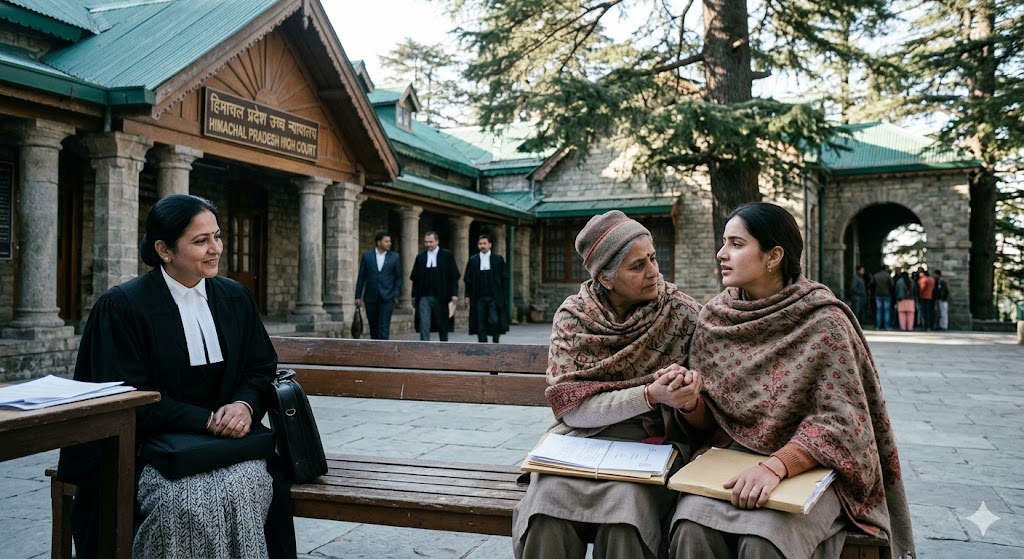
In a significant ruling on matrimonial dispute jurisdiction, the Himachal Pradesh High Court has underscored that the convenience of the wife - particularly when she is financially dependent and residing at a distant location - must take precedence in transfer petitions under Section 24 of the Code of Civil Procedure (CPC). The Court allowed the transfer of divorce proceedings from Sarkaghat to Hamirpur, emphasizing the wife's inability to bear litigation costs and the absence of financial support.
Background & Facts
The Dispute
The petitioner, Renu Bala, sought transfer of matrimonial proceedings initiated by her husband, Rameshwar, under Section 13(1)(i)(a) of the Hindu Marriage Act, 1955 (Case No. HMA/28/2025) from the Family Court, Sarkaghat, District Mandi, to the Family Court, Hamirpur. The petition was filed under Section 24(1)(a) CPC, which empowers courts to transfer cases for the ends of justice.
Key Facts
Marriage and Family: The parties were married on 07.05.2015 and have a minor daughter, Siya Goyal.
Matrimonial Discord: The petitioner alleged that the respondent-husband subjected her to physical abuse, dowry demands, and threats after the initial period of cordial relations. She claimed he beat her mercilessly, denied her basic necessities, and threatened her life when she refused to comply with dowry demands.
Litigation History: The respondent-husband filed a divorce petition (HMA/28/2025) under Section 13(1)(i)(a) of the Hindu Marriage Act before the Family Court, Sarkaghat. Meanwhile, the petitioner-wife had filed:
A petition under Section 125 CrPC for maintenance.
An execution petition for interim orders passed in the Section 125 CrPC proceedings.
Proceedings under the Protection of Women from Domestic Violence Act, 2005.All these cases were pending before the Family Court, Hamirpur.
Financial Dependence: The petitioner-wife resides in Village Bohni, District Hamirpur, with her aged parents, who are unable to support her financially. She has no independent source of income and claimed she cannot afford the 50-kilometer travel to Sarkaghat for litigation.
Non-Appearance of Respondent: Despite due service of notice, the respondent-husband failed to appear before the High Court to contest the transfer petition.
Procedural History
2025: Respondent-husband filed divorce petition (HMA/28/2025) before the Additional Principal Judge, Family Court, Sarkaghat.
2026: Petitioner-wife filed the present transfer petition (CMPMO No. 225 of 2026) before the Himachal Pradesh High Court under Section 24(1)(a) CPC.
15.06.2026: High Court allowed the transfer petition after noting the respondent’s non-appearance.
Relief Sought
The petitioner-wife sought transfer of Case No. HMA/28/2025 from the Family Court, Sarkaghat, to the Family Court, Hamirpur, citing:
Financial inability to travel to Sarkaghat.
Pending maintenance and domestic violence proceedings in Hamirpur.
Lack of support from the respondent-husband.
The Legal Issue
The central question before the Court was whether Section 24(1)(a) CPC permits the transfer of matrimonial proceedings on the ground of the wife’s convenience, financial dependence, and proximity to related litigation, particularly when the respondent fails to contest the transfer application.
Arguments Presented
For the Petitioner-Wife
The petitioner relied on the following contentions:
Convenience of the Wife: Under Section 24 CPC, the Court has wide discretion to transfer cases to ensure justice. The wife’s convenience, especially when she is financially dependent, should be prioritized.
Financial Hardship: The petitioner argued that she lacks the means to travel 50 kilometers to Sarkaghat for each hearing, given her reliance on aged parents for sustenance.
Consolidation of Proceedings: All her other cases (maintenance, domestic violence) were pending in Hamirpur, making it practical to consolidate them.
Non-Contestation by Respondent: The respondent’s failure to appear was deemed an admission of the allegations, strengthening the case for transfer.
For the Respondent-Husband
No arguments were presented as the respondent failed to appear despite due service of notice.
The Court's Analysis
The High Court, in its oral judgment, emphasized the following principles:
Paramount Consideration of Wife’s Convenience: The Court held that in matrimonial disputes, the convenience of the wife is a paramount factor, particularly when she is financially dependent and residing at a distant location. This aligns with the broader principle that Section 24 CPC is designed to prevent injustice and ensure fair access to justice.
Financial Dependence and Access to Justice: The Court noted that the petitioner-wife’s lack of income and reliance on aged parents rendered her incapable of bearing the costs of litigation in Sarkaghat. This financial vulnerability was a critical factor in allowing the transfer.
Non-Appearance of Respondent: The respondent’s failure to contest the transfer petition was interpreted as non-opposition to the wife’s plea, further tilting the balance in her favor.
Consolidation of Related Proceedings: The Court observed that transferring the case to Hamirpur would consolidate all related proceedings (maintenance, domestic violence, and divorce), thereby avoiding multiplicity of litigation and ensuring judicial efficiency.
The Court relied on the affidavit and uncontroverted allegations of the petitioner-wife, which included:
Physical and emotional abuse by the husband.
Dowry demands and threats to her life.
Financial dependence and inability to travel.
"A poor lady cannot be compelled to contest the litigation, which has been filed for dissolution of marriage, that too, at a far away place i.e., Sarkaghat, as, according to her, she is having no source of income and is fully dependent upon her aged parents."
The Court concluded that justice would be better served by transferring the case to Hamirpur, where the petitioner-wife could effectively participate in the proceedings.
The Verdict
The Himachal Pradesh High Court allowed the transfer petition and directed the following:
Transfer of Case No. HMA/28/2025 from the Additional Principal Judge, Family Court, Sarkaghat, to the Principal Judge, Family Court, Hamirpur.
The Family Court, Hamirpur was directed to proceed further after securing the presence of both parties.
All pending miscellaneous applications in the case were disposed of.
A copy of the order was directed to be sent to both courts for compliance.
What This Means For Similar Cases
Wife’s Convenience as a Decisive Factor
This judgment reaffirms that in transfer petitions under Section 24 CPC, the convenience of the wife - especially when she is financially dependent - can be a decisive factor. Practitioners should note:
Courts are likely to prioritize the wife’s access to justice when she demonstrates financial hardship or inability to travel.
Non-contestation by the husband can strengthen the wife’s plea, as uncontroverted allegations may be taken at face value.
Consolidation of Matrimonial Proceedings
Multiplicity of litigation can be avoided by seeking transfer to a court where related proceedings (e.g., maintenance, domestic violence) are already pending.
This reduces judicial burden and ensures coherent adjudication of interconnected disputes.
Financial Dependence and Litigation Costs
Financial dependence is a valid ground for transfer, particularly when the wife lacks independent income and relies on family support.
Courts may consider travel distance, costs, and logistical challenges as factors under Section 24 CPC.
Practitioners should highlight these aspects in transfer petitions to bolster their case.
Implications for Husbands in Transfer Petitions
Failure to contest a transfer petition may be interpreted as acquiescence, potentially leading to an unfavorable order.
Husbands opposing transfer petitions should present strong counter-arguments regarding their own convenience, financial means, or other equities.
This judgment serves as a precedent for prioritizing the wife’s convenience in matrimonial disputes, particularly when she is financially vulnerable and residing at a distant location.