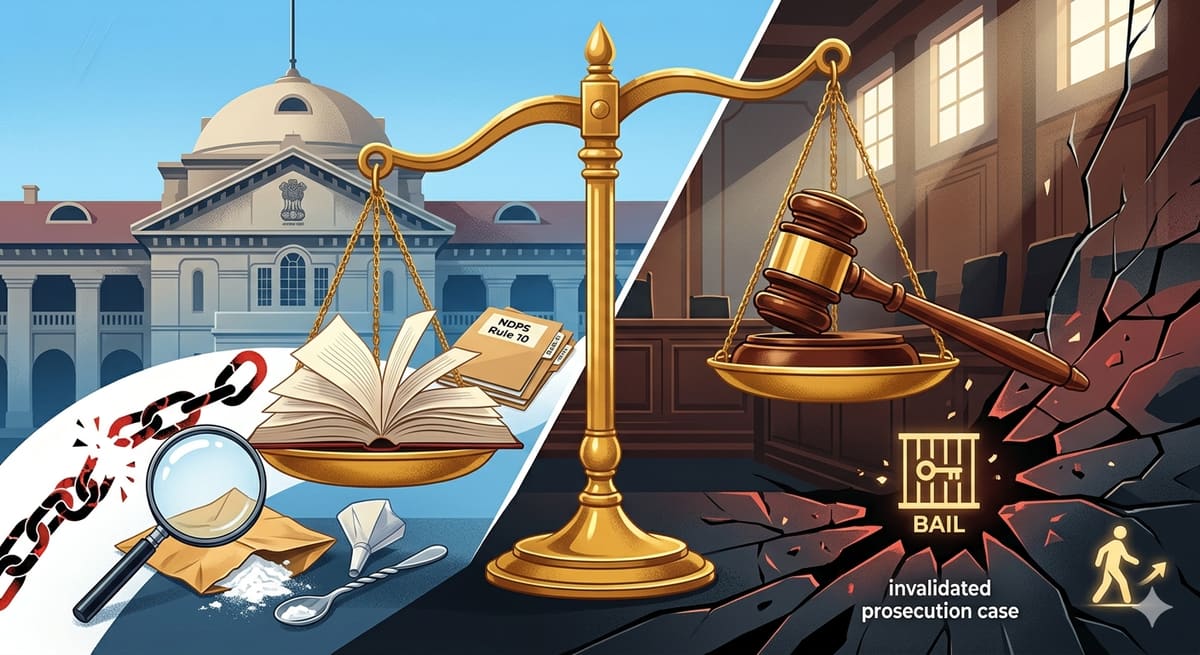
The High Court of Jammu & Kashmir and Ladakh has delivered a decisive ruling affirming that the statutory right of a drug manufacturer to receive a sealed portion of the sample before prosecution is not a mere formality but a fundamental safeguard against arbitrary enforcement. The quashing of the complaint underscores that procedural lapses in sample handling under the Drugs and Cosmetics Act, 1940, render prosecution legally unsustainable.
Background & Facts
The Dispute
The petitioner, August Remedies, a pharmaceutical manufacturer based in Himachal Pradesh, was named as an accused in a criminal complaint filed by the Drug Inspector of Jammu under Section 27(d) read with Section 18(a)(i) of the Drugs and Cosmetics Act, 1940. The complaint alleged that the petitioner’s drug, Tab CEFAM-250 (Batch No.349), failed quality tests for Cefuroxime assay. The sample was collected from M/s Shiv Shakti Medicos, a retailer in Jammu, not from the petitioner’s premises.
Procedural History
- 22.02.2010: Drug Inspector collected sample from retailer Shiv Shakti Medicos, dividing it into four portions as required.
- 19.07.2010: Government Analyst (CDFL, Jammu) submitted report declaring the sample non-standard.
- 28.08.2010: Inspector sent notice and report to petitioner via registered post, but address was incomplete and unverified.
- 10.07.2012: Petitioner first became aware of the complaint upon receiving summons from the trial court.
- 05.08.2013: Criminal revision before Additional Sessions Judge dismissed.
- 09.03.2026: High Court quashed the complaint.
Relief Sought
The petitioner sought quashing of the criminal proceedings on grounds of procedural violation under Sections 23 and 25 of the Act, particularly the failure to supply a sealed sample portion and the delayed, possibly unserved, government analyst report.
The Legal Issue
The central question was whether the failure to supply a sealed portion of the drug sample to the manufacturer under Section 23(4)(iii) of the Drugs and Cosmetics Act, 1940, vitiates the prosecution, even if the manufacturer received the government analyst’s report.
Arguments Presented
For the Petitioner
The petitioner argued that Section 23(4)(iii) mandates the immediate delivery of one sample portion to the manufacturer whose details are disclosed under Section 18A, irrespective of when the report is received. This right enables the manufacturer to independently test the sample and decide whether to contest the analyst’s findings within the 28-day window under Section 25(3). The failure to deliver the sample portion, coupled with the incomplete address used for service of the report, deprived the petitioner of its statutory right to challenge the report. Reliance was placed on Laboratory Pharmaceuticals India Ltd. v. State of Tamil Nadu (2018) 15 SCC 93.
For the Respondent
The State contended that the manufacturer received the government analyst’s report via registered post on 28.08.2010, and thus had sufficient notice to invoke Section 25(3). It argued that the failure to send the sample portion was a procedural irregularity, not a jurisdictional defect. The respondent further claimed that questions of fact - such as whether the report was actually received - must be determined at trial, and that the High Court should not interfere under its inherent jurisdiction under Section 561-A CrPC.
The Court's Analysis
The Court undertook a meticulous textual and purposive interpretation of Sections 23 and 25 of the Drugs and Cosmetics Act. It emphasized that the statutory scheme is designed to ensure fairness and scientific integrity in drug prosecutions. The Court held that Section 23(4)(iii) requires the sample portion to be sent to the manufacturer simultaneously with the sample sent to the Government Analyst - not after the report is received. This is not a technicality but a substantive right to enable the manufacturer to verify the findings independently.
"The supply of portion of the lifted sample before the report of analyst is received is compliance of Section 23(4)(iii) and a precursor for the manufacturer to get the lifted sample tested and analyzed by an independent Drug Laboratory."
The Court rejected the State’s argument that receipt of the report alone suffices. It noted that without the physical sample, the manufacturer cannot conduct its own analysis or request a re-test at the Central Drugs Laboratory under Section 25(4). The Court further found that the address used for service was incomplete and inconsistent with the petitioner’s official address, casting serious doubt on actual service. The delay in filing the complaint - over two years after the sample was collected and after the drug’s shelf life expired - further prejudiced the petitioner’s ability to seek re-analysis.
The Court relied on Laboratory Pharmaceuticals India Ltd., where the Supreme Court held that such procedural failures constitute a denial of natural justice and render the prosecution a "lame prosecution." The Court concluded that allowing the trial to proceed would amount to an abuse of process.
The Verdict
The petitioner succeeded. The Court held that the failure to supply a sealed sample portion to the manufacturer under Section 23(4)(iii), combined with the failure to establish actual service of the analyst’s report, vitiated the prosecution. The complaint was quashed, and all proceedings were set aside.
What This Means For Similar Cases
Sample Portion Must Be Delivered Concurrently
- Practitioners must ensure that in every drug prosecution, the sample portion under Section 23(4)(iii) is delivered to the manufacturer at the same time as the sample is sent to the Government Analyst.
- Merely sending the report later does not cure the violation.
- Failure to do so is grounds for quashing the complaint at any stage.
Service of Report Must Be Proven
- Postal service of the analyst’s report must be to the complete, verified, and official address of the manufacturer.
- A partial or incorrect address creates a rebuttable presumption of non-service.
- Prosecutors must maintain and produce proof of delivery (acknowledgment receipt) to satisfy due process.
Shelf Life and Delay Are Critical Factors
- Prosecutors must act with urgency; delays beyond the drug’s shelf life render re-analysis impossible and undermine the prosecution’s credibility.
- Courts will view prolonged inaction as evidence of negligence or mala fide intent.
- Delay beyond 28 days does not automatically bar defense if the initial procedural breach deprived the accused of opportunity.